


West Bank health facilities ‘trapped in a vicious cycle,' says Palestinian hospital director
Category: Health
Share
Archive
Like
LONDON: Attacks and other incidents affecting healthcare services and facilities in the occupied West Bank have surged this year, placing further strain on a system already hobbled by a worsening financial crisis and shortages of staff and medical supplies.
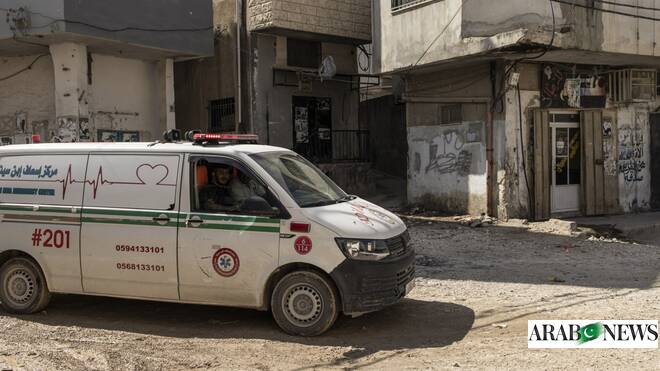
The World Health Organization recorded 98 incidents that affected healthcare in the territory between January and the end of July, most of which involved health transport services.
The number increased sharply in July; WHO data published on Aug. 11 revealed 37 attacks or other incidents targeting health facilities, workers or transport services that month, compared with a monthly average of about 10 earlier in the year.
There have been 25 cases this year of health workers or patients being arrested, the figures show. Other incidents have involved the use of force, or searches of medical staff, facilities and ambulances.
It comes as hospitals across the West Bank continue to struggle to maintain services after years of financial instability. Administrators say public and private hospitals have been unable to pay employees their full salaries for nearly three years as the Palestinian Authority faces reduced revenues and mounting debts.
'The situation is extremely difficult,' said Dr. Hazem Shalaldeh, director general of Al-Mizan Specialized Hospital in Hebron, in the southern West Bank.
'There were previously periods of improvement and decline, but this crisis has lasted around three years and was preceded by COVID-19. The Palestinian health sector has endured about five very difficult years.'
Al-Mizan hospital has been unable to pay its 400 employees in full for about three years.
'We have paid only a portion of their salaries,' Shalaldeh said. The same is true at other West Bank hospitals, he added, while at public hospitals employees are no longer paid regularly, which disrupts treatment and creates hardship for staff and patients alike.
The Israeli nonprofit organization Physicians for Human Rights Israel warned this month that the Palestinian public healthcare system in the West Bank was near collapse. It said that as Israel continues to withhold 'clearance revenues,' which are taxes and duties it collects on behalf of the Palestinian Authority, 447 of the Palestinian Health Ministry's 590 service branches have been forced to sharply reduce operations, with many now open only one or two days a week.
The cuts were directly related to the withholding of the tax revenues, it added, which are a major source of funding for public services in the territory.
'Clearance revenues have also become a source of pressure, with funds owed to the Palestinian people being withheld,' Shalaldeh confirmed.
Rights groups have long accused Israel of withholding this money to gain political leverage.
The Israeli finance minister, Bezalel Smotrich, stopped transferring monthly clearance revenues to the Palestinian Authority last year. By June this year, Israel had cumulatively withheld at least $2.5 billion from the authority since 2023, according to the International Crisis Group, a nonprofit organization that works to prevent, mitigate and resolve conflicts worldwide.
Shalaldeh, who also serves on the board of the Union of Private and Charitable Hospitals in Palestine, said the loss of employment opportunities for Palestinians inside Israel since the start of the war in Gaza in October 2023 has further deepened the crisis for doctors and their patients.
'Some of our patients used to get referred by the Ministry of Health, especially for high-cost cases, while others are private patients who pay for their own treatment,' he said. 'However, since the events in Gaza began, the number of self-paying patients has declined.'
More than half a million Palestinians lost their livelihoods in the West Bank and Gaza when Israel launched its military campaign in Gaza following the Hamas-led attacks on Oct. 7, 2023, the Palestinian General Federation of Trade Unions said in late 2025.
While some Palestinian health professionals who were employed abroad initially returned home to work at the start of the war, many subsequently departed again because of the opportunities on offer elsewhere, Shalaldeh said.
'This has also contributed to a decline in the quality of services provided to citizens,' he added.
There are three types of providers within the West Bank's health system: public hospitals; nonprofit hospitals affiliated with charitable institutions or associations; and private hospitals.
The Union of Private and Charitable Hospitals represents facilities that provide about 60 percent of all hospital beds in the territory, Shalaldeh said, and public hospitals account for the remaining 40 percent.
'Certain services, particularly specialized care, are concentrated in private and charitable hospitals,' Shalaldeh said. 'The public sector also provides primary healthcare services.'
The crisis began to emerge, on a more limited scale, during the COVID-19 pandemic in 2020 and 2021, when hospitals helped to contain the outbreak, he added. However, conditions took a turn for the worse after the war in Gaza began.
'Debt rose steadily and the Ministry of Health could no longer pay the amounts owed,' Shalaldeh said.
The financial shortfall has placed a heavy burden on hospitals, as well as suppliers of medical equipment, medicines and other essential materials, he added. Hospitals are not receiving money from the Ministry of Health and, as a result, they cannot cover their operating costs or meet obligations to suppliers.
'We have become trapped in a vicious cycle,' Shalaldeh said.
Since October 2023, the monthly deductions Israel makes from clearance revenues have risen from about $66 million to approximately $165 million, the World Bank has said. These deductions have cut the amount transferred to the Palestinian Authority by more than half.
Meanwhile, attacks by Israeli settlers and Israel's military have intensified across Palestinian territory. Medical Aid for Palestinians, a charity based in the UK, said settler attacks had reached their highest level since monitoring began in 2006, averaging six incidents a day.
There have also been at least 987 attacks on healthcare facilities and services in the West Bank since October 2023, the organization said in early July.
A note on cookies
Newshunt uses essential cookies to keep you signed in and to remember your language and country, so the site works the way you expect. With your permission, we'd also like to use analytics cookies to understand how people use Newshunt and improve it over time.
Accepting only affects analytics. To learn more, view our Privacy Policy or Terms & Conditions.
(0)Comments