


An Exercise in Being Humbled
Category: Entertainment
Share
Archive
Like
"Consider the bees: a most organised state, a republic most just."
I write this today with a burning hot welt next to my right bicep.
A bee sting I received, that was entirely my own fault.
This week: Getting stung, wild hives and my recipe for hot wild honey that is excellent, spooned over anything that might take your fancy.
Flagrant disobedience of the rules of the republic
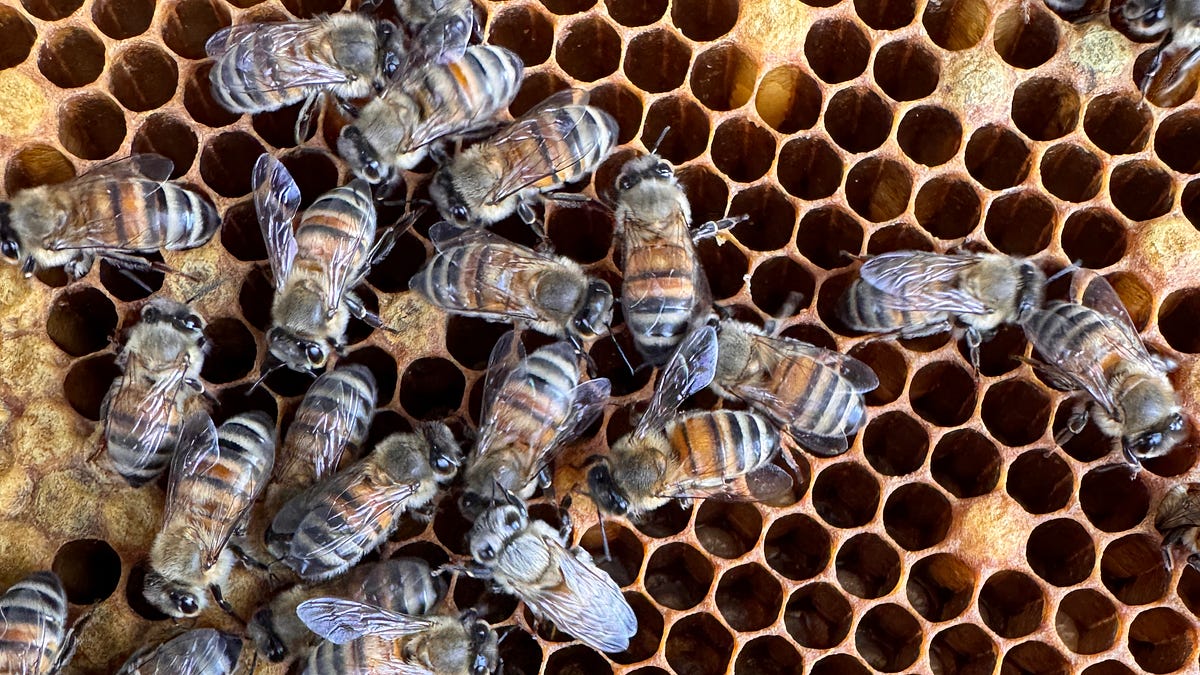
It is always an obvious risk I suppose, approaching a hive without donning a bee suit, especially one that has been working at full tilt for months over a long, hot summer; a reasonably tempered mass of fifty thousand odd bees packed into a collection of small wooden boxes in the corner of a fruit orchard, focused only on the task of filling their home with as much sweet nectar and brightly clustered hexagonal cells of pollen as they are able, and defending their home against any who might have any wild notions of robbing their honey before the forage comes to an end for this beekeeping season. And you'd certainly have to be foolish to then even think to take off the roof, whilst not properly attired, even if you've done it before, albeit just for a quick peek, to peer into the small empty space between the crown board and roof that you just removed, even if only to check if the feeder needs a top-up with syrup.
Because you will probably get stung.
On one notable occasion in my mind, I remember, high up in the wilds of a scorching hot pine forest, lost between sleepy villages in the remote hills of mountainous Greece, where, without a care in the world, I had stopped at the side of a parched, dusty track, miles from anywhere, and far away from anyone would interrupt their afternoon nap and actually give a shit, deep in a forest of tall, dark, resinous, needle point trees, sat high on a outcrop in the sempiternal blue where the sky and the ocean fade into one.
I had decided (in the spirit of any true Englishman on his holidays) to meddle with things that had no business being meddled with. On the track where I stood, I found my eyes drawn to a small collection of neatly stacked beehives, brightly painted in yellows and pinks and the ubiquitous soft blue that represents all that is Greek, spurred on by the thoughts of pine forest honey that I'd bought from the market, with its citrusy, resinous tang. Square wooden boxes full to the brim with bees, the wooden hives, gathered in a circle on the ground in a small rocky clearing of dusty shrubs and young saplings, the background, a harmonious refrain of a choir of cicadas, and far below, the spume topped waves clattered and rumbled, tumbled and turned over the timeless rearrangement of the stones of the deserted beaches way beneath.
Wild hives, as we say.
And never being the type to ignore any opportunity to examine such a collection of interesting things, especially such matters that I had no business examining, I took a walk straight to the front of the bright wooden boxes where the to and fro of the inhabitants became more menacing the closer I got.
This was my first mistake.
Actually, my second, as stopping the car and being nosy was my first.
A tiny headbutt to the side of my head was my warning.
It was apparent I was about to be chased away by the ferocity of the sudden emergence of a small cloud of ill tempered girls that quite literally shot out of the front of one of the apparently sleepy pink boxes, forcing me to run to the car and shut myself in whilst they gathered en masse on the window next to my head.
You would have thought I might at that point have learned the rules of the republic.
Guard duty
When it comes to primordial instinct, I think bees do it best. The ability of the first guard at the entrance to sense any threat, a signal from that one individual bee that then commands a chain reaction of organised chaos, a defensive cohort of tiny stinging insects whose purpose is to defend their hive, their stores and their queen at all costs.
Bees operate on a hierarchical system, 'Temporal Polyethism ', as those who like to assign glamorous terms to such things have done so here. Young bees, yet to develop their hardened exoskeleton and their capability to fly and, more importantly, to sting, work as hive cleaners, cell polishers and undertakers for the first part of their brief lives, keeping meticulous order of the boxes in which they've been born. For the first few days of their existence, these younger insects, also known to keepers as crawlers, are the reason a bee suit has straps at the ankle, and also why trainers and socks are not the most practical footwear for anyone inspecting a hive. As the days pass in their six weeks of life, they graduate to nursing the brood, then, when they're able to sting you proficiently, they become guards and foragers.
Guards
The word tells you everything you need to know here.
If you took a walk, let's say up to the gates of a mediaevel castle, you would very likely meet a handful of doughty, abrupt folk, an outfit likely armed with sharp objects who might wonder about your intentions, and you might correctly assume that if you decided to just nonchalantly, wander up to the front door, paying them no heed and then without knocking, gad about, prying into places that you had no business prying into, then it is very likely you might come to regret your actions.
This is the same with beehives.
You might have read that bees can learn faces, learn to know their keepers and are generally amiable little creatures; know that one false move will turn this around on a penny.
Take, for instance, last Friday.
I am a quite likely a fool.
I'm wearing a simple T-shirt, no bulky suit or veil, something I've done many times before when visiting the bees for a quick syrup check, and as I'm not taking off the square wooden cover that sits under the roof, I'm pretty convinced there'll be no trouble. Happily, the lazy legions of small fuzzy creatures are on their best behaviour so far this year; last summer, however, was an exercise in the futility of even attempting to get the bees to do what was best for them, despite their self-induced, perilous predicaments. They punished me often and without the slightest measure of mercy, as the welts on my neck were visible proof and the dozen or so stings I received in a week that year. In hindsight I know why they were fed up: a combination of my ineptness at reading them, my being shit scared of them, and another beekeeper who I invited over to assist me, who turned up wearing a dirty suit, likely covered in sting pheromone and who clattered around their hives with gay abandon, pissing them off to the point where they turned feral, a situation that took over a year to remedy.
Actually, not only me, but anyone and their dog who might have had the temerity to walk within ten metres of their home, and wholly in contrast to the previous years, whereby I was permitted to stop by the girls for an afternoon chat, without donning the equivalent of a sturdy hazmat suit.
It is something that I do every so often: just a quick look, I always tell myself, and mostly I'm right in my flagrant refusal to adhere to common sense, though on this deliciously warm afternoon in early September, I was about to be humbled by a creature no bigger than my thumbnail.
I sat and watched the entranced for five minutes or so, so enamoured by the pale yellow pollen baskets stuck to the legs of the returning foragers, full with the ivy pollen that clambers around the broken down wall, that runs along the side of the orchard. This flow, as it is known, is the last of the year before the bees will begin to reorganise themselves for the colder months that will soon be here. I have decided to let them have a couple more weeks before I take one box from each hive to collect for ourselves, leaving them with the lion's share for winter. As in the last month, the nights draw in and the temperature drops, after the equinox, these creatures know that a race is on to store as much as they can before time runs out, and what has been a gentle colony so far this year is just that little more tetchy at my presence.
I took the decision to feed the hives a light syrup for the last month, as the long spell of hot, dry weather here, recorded officially as a drought, ensured that, up until now, any source of nectar was short, and to keep the queen laying, tricking her into believing that all is well in the outside world, a flow of syrup keeps the hive working seemlessly. The majority of the honey is already capped, so whatever they store will be for their own consumption as winter moves in.
I stand up, walk behind the first hive and lift off the lid. Underneath is a square wooden board with a small plastic insert, a one way gate that allows any stragglers to go back down into the hive. Instead, I'm greeted by a small handful of bees who have worked out that they can go through in the other direction if they are persistent enough. I place a round feeder box and fill it with straw so that these curious girls who so love to rummage about and keep busy, can find their way to the syrup without risk of drowning. I pour in one litre and place it on the upturned roof of the hive by my feet. The bees that have gathered at the top are a problem, and not wearing a suit changed this visit from a simple quick feed, to interaction with a handful of girls who were minded enough to decide to sit in the void of the roof of their hive, and so warily I choose to take a small clutch of oak leaves, pulled from a tree and as I don't want to leave these bees stuck up here, unwilling to leave their meeting place. I gently brush them aside to make them fly up while the plan is to quickly place the roof back on and close them up.
I received no warning this time.
No quick buzz to my ear or a tap to the head as is usually the way, to let me know that I'd made a transgression.
It was quite simply a straightforward jab to the soft part of the inside of my elbow, a sharp needle-like sting that left the barb sticking out of the skin and the venom tube still firmly attached to ensure I was administered with teh full dose. I scraped the tiny stinger out from my arm, aware that the sting pheromone was now in the air and the signal had been given: not a problem under normal circumstances if indeed I was properly dressed, but standing here with bees flying about and the alarm signal given I made a quick move away from the hive, much to the amusement of my friend who was watching all this from a distance whilst taking a call.
Humbled by an insect, and what was I really expecting at this point in the year, I walked back up to the farm where I put on my suit and walked back down to the hive, placed the feeder correctly, apologised for my ill advised presumption, bade them farewell and told them I'd see them again in a week, correctly attired the next time.
Not so much a recipe but a preparation.
Using half a litre of last summer's honey, I decided to celebrate my swollen arm by making a few jars of hot honey. Something spicy to spoon over grilled meats or a scorched slice of sourdough, smeared with soft goat's cheese.
It certainly beats hands down anything you might buy in the shops.
I made three jars, one using Aleppo pepper, one using Jalapeno flakes and the other I crushed a handful of hot chillies we grew last year in the greenhouse that I'd dehydrated and couldn't find a use for.
How to:
Quite simply, take one cup measure of honey and scrape it into a small saucepan. Add one or two tablespoons of the chilli you think suits you best and very gently warm the mixture. Don't simmer or boil it as you'll ruin the goodness in the honey. It just needs warming through.
Stir the chilli through and then add a tablespoon of apple cider vinegar.
I'm fortunate enough to have a few hundred litres of apple cider vinegar, left over from the batch that I made from the orchard fruit two years ago in the autumn, (that as I remember, I still haven't told you how I did it), and for this honey, I thought it a good opportunity to use some of the rose petal-infused batch I made, to add a different perspective on the flavour.
Let the saucepan sit off the heat for a while to infuse.
Prepare a jar or some jars by heating them as you would for preserving a jam, pour in the spicy honey and place it somewhere you can't dig in for a week or two to let the heat develop and allow the colour of the chillis to darken the mixture. I don't strain mine as I like the texture, but you could certainly pour it through a fine sieve if you wish.
A glorious thick amber liquid, stained with the crushed flakes of the chillis, a perfect condiment for the autumn.
Welcome
I would like to extend a heartfelt welcome to all of you who are new to my work.
Two thousand of you in a matter of weeks.
There is a whole archive of over three years worth of writing and recipes to trawl through if you like, and I recently updated my recipe index to reflect any updates from the last year.
So again, welcome to you all.
Onwards
William
You'd be ever so welcome to upgrade or subscribe
A note on cookies
Newshunt uses essential cookies to keep you signed in and to remember your language and country, so the site works the way you expect. With your permission, we'd also like to use analytics cookies to understand how people use Newshunt and improve it over time.
Accepting only affects analytics. To learn more, view our Privacy Policy or Terms & Conditions.
(0)Comments