


I was there on 9/11
Category: Blend
Share
Archive
Like
Every year I've been on Facebook — for nearly 20 years — I've posted the same message on September 11:
Every year on this day, I wake up remembering the clear blue sky. It was a perfect September day in NYC without a cloud in the sky. I heard on the Today show that a small, single-engine plane had hit the World Trade Center. I headed out the door and stood at the Bergen Street stop thinking, 'That's a lot of smoke for a small plane.' I got on the train headed into the city, and before I arrived at my destination, the entire world changed forever. But on this morning every year, I'm also reminded of the friendships made in the days and weeks following, of the bravery of those who ran toward danger, and of the kindness of strangers.
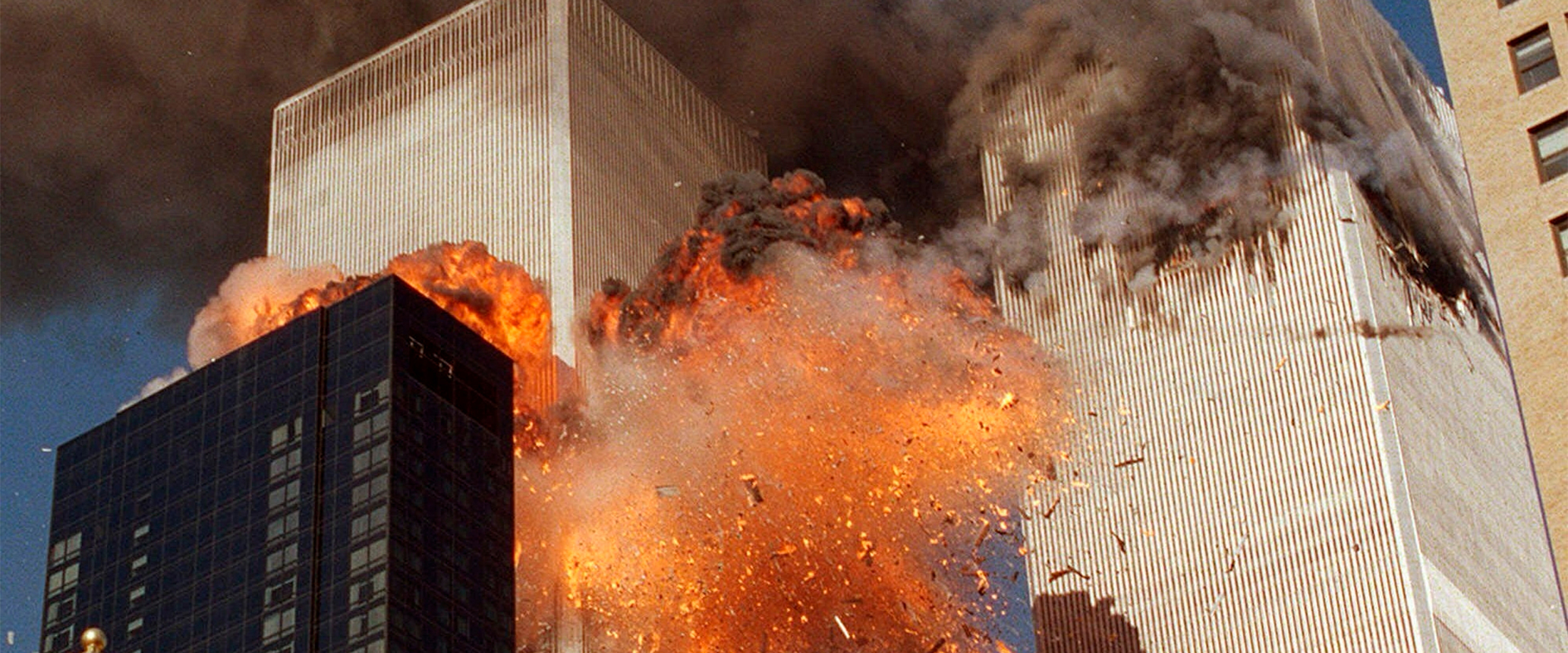
Rescue crews work next to the World Trade Center after its been hit by a terrorist attack. Sept 11, 2001 in Manhattan, New York City, NY. Two commercial planes were hijacked and crashed into the Twin Towers in New York City. (Photo by GARY FABIANO/SIPA USA)(Sipa via AP Images) My story is one story among many
In 2001, I had just relocated back to Brooklyn from a brief stint in Chicago. I began a master's degree in performance studies at NYU (my undergraduate alma mater) on Thursday, Sept. 6. I hadn't even been to all my classes when that fateful Tuesday rolled around.
I lived at the edge of the not-yet-gentrified neighborhood of Park Slope. That morning, as I was getting ready to leave my apartment for my part-time job I had, the Today Show was on in the background. Shortly after the North Tower was struck at 8:46 a.m., one of the anchors (maybe Katie Curic) announced that a 'small-engine plane' had struck the North Tower.
'Even on TV it looked like too much smoke to come from a small plane.'
I paused, looking at the screen. Even on TV it looked like too much smoke to come from a small plane. But that's what they said, so it must be true.
Moments later, I left my two cats in the care of the Today Show and walked out the door of my walkup and rounded the corner to the Bergen Street Station. Before I headed underground I stopped and stared at the smoke coming from the North Tower. Again, I thought, 'That seems like a lot of smoke.'
I descended into the subway station and boarded the Red Line. One stop later, I transferred to the Green Line Express which traveled directly underneath the Twin Towers on the southern tip of Manhattan. I was underground at approximately 9:03 a.m. when the second plane hit the South Tower.
When the train pulled into the 14th Street/Union Square station roughly 10 minutes later, a man in a business suit got on the train hysterical. The dissonance of seeing this well-dressed man in a state of emotional distress was jarring. He was yelling that we were under attack and that a second plane had hit the Twin Towers.
Rescue crews work next to the World Trade Center after its been hit by a terrorist attack. Sept 11, 2001 in Manhattan, New York City, NY.. (Photo by GARY FABIANO/SIPA USA)(Sipa via AP Images)
Many of my fellow travelers on the Green Line had begun their day somewhere farther out on Long Island. They had been underground the whole way and had no idea one plane had hit the towers — let alone two.
My instinct kicked in and I immediately jumped up and off the train.
Things are a little blurry at that point. I must have stepped onto an arriving local train, because I exited the subway at the 23rd Street stop — one stop north of Union Square.
'Immediately after coming aboveground I felt like I was in a dystopian movie. The scene still haunts me.'
Immediately after coming aboveground I felt like I was in a dystopian movie. The scene still haunts me.
The city was eerily silent. The usual construction noise that assaulted the senses was deafeningly silent — construction workers stood silently on platforms and beams looking down from above listening. Cars were stopped in the streets — no traffic moved. The drivers and occupants stood beside their open car doors, radios blaring for everyone to hear a play-by-play account of what was happening across the country.
I walked from 23rd Street toward my job on 60th Street listening. At 9:37 a.m., the silence was broken by the news that a plane had crashed into the Pentagon. People began weeping in the street.
When I arrived at my nonprofit job at the French Institute, I wanted someone to tell me what to do. No one did. A few people pretended to work while listening to the live news broadcast. I spent 15 minutes trying to get a line out to call my dad at his office in Irving, Texas. It was 2001 and I didn't have a cell phone.
Moments after I hung up the phone with my dad, the South Tower fell. We felt the rumble caused by the 110-floor, 500,000-ton building's collapse. At the same time, over the radio news anchors cried out in shock and horror.
Four minutes later, at 10:03 a.m., Flight 93 crashed in Pennsylvania. The news traveled quickly. Upon hearing this, I left my things and walked out of the office and over to Fifth Avenue — a roughly 4-minute walk. I stood looking southward at the remaining tower.
I wasn't the only one who came to that corner to look — to see with our own eyes what we could hardly believe to be true. There was a sports bar somewhere behind me with its windows open and a news broadcast blaring. I stood there taking it all in — trying to make sense of it.
And then, it happened as if in slow motion. The North Tower collapsed in on itself in front of my eyes at 10:28 a.m.
I remember the feeling of panic in my chest and the screams around me and from the bar behind me. Or was it my own screams? We were all in a moment of collective shock.
I stumbled back to my office. Still, no one with any authority was giving any direction to those of us who had made it into the office. Exasperated, I picked up my backpack and started walking.
I walked to the 59th Street Bridge and over to Queens. From there, I made my way southward back to my apartment in Brooklyn where I spent the next three days holding my cats while glued to the TV as images of unimaginable grief filled the television screen.
View of New York City, September 11, 2001. (Photo by: Universal History Archive/Universal Images Group via Getty Images) Then and now
In the days, weeks and months following that Tuesday, as the smell of smoldering steel wafted from Ground Zero, grieving New Yorkers were surrounded by love.
On subways and on the streets, people spoke with strangers and asked how they were doing. Individuals volunteered to go door-to-door in places like Chinatown to check on the elderly. At the French Institute where I worked, we received banners and cards from French schoolchildren who just wanted to make us feel better.
One thing that stood out to me then and now is how the Muslim community — Americans who saw their faith weaponized to kill thousands — reacted. Imams and other Muslim leaders spoke out again and again against the violence. They spoke of Islam as a religion of peace. They spoke of caring for their neighbors. They spoke of the grief and pain they felt as Americans devastated by such violence. The also spoke of the fear they felt in their own country in the midst of rising Islamophobia.
Pro-Trump protesters seen on and around Capitol building as smoke from grenade rises in Washington, DC on January 6, 2021. Rioters broke windows and breached the Capitol building in an attempt to overthrow the results of the 2020 election. Police used buttons and tear gas grenades to eventually disperse the crowd. Rioters used metal bars and tear gas as well against the police. (Photo by Lev Radin/Sipa USA)(Sipa via AP Images)
On January 6, 2021, images of Trump-supporting insurrectionists assaulting police officers, storming the Capitol building and waving Confederate flags filled our television screens. In the days, weeks and months following that day, I hoped evangelical Christians across the country who saw our shared Christan faith weaponized would speak out against the violence.
I waited for them to distance themselves from Donald Trump. I waited for them to speak of Christianity as a religion of peace that prioritizes caring for our neighbors. I waited for them to repent for their blasphemous sin of wrapping this man's lies and calls for violence in Christian symbols and rhetorics.
Instead, today as we approach the 25th anniversary of September 11, these same brothers and sisters in Christ have doubled down on their support for Trump. They also have embraced the new wave of Islamophobia sweeping across the country.
Those of us who belong to Christian Mainline churches and who value interfaith dialogue and our pluralistic democracy must call out their misuse of Christ's name.
Like our Muslim brothers and sisters who bravely spoke out against their fellow Muslims who committed violence on 9/11, we, too, must condemn the continued violence against Muslims and our democracy — both rhetorical and physical — committed by our fellow Christians.
This September 11, I'll be standing with faith leaders from across North Texas at mosques around DFW providing a protective ring around our Muslim siblings. We expect the 25th anniversary of that terrible Tuesday will bring out the worst of those who claim to be Christians. We plan to bring the best — the love embodied in the life, death and resurrection of Jesus Christ.
On September 11 I will also, once again, post online my annual reflection:
Every year on this day, I wake up remembering the clear blue sky. It was a perfect September day in NYC without a cloud in the sky. I heard on the Today show that a small, single-engine plane had hit the World Trade Center. I headed out the door and stood at the Bergen Street stop thinking, 'That's a lot of smoke for a small plane.' I got on the train headed into the city, and before I arrived at my destination, the entire world changed forever. But on this morning every year, I'm also reminded of the friendships made in the days and weeks following, of the bravery of those who ran toward danger, and of the kindness of strangers.
Mara Richards Bim
Mara Richards Bim serves as a Clemons Fellow with BNG and as the first Justice and Advocacy Fellow at Royal Lane Baptist Church in Dallas where she recently was ordained to the gospel ministry. She earned the master of divinity degree and a certificate in spiritual direction from Perkins School of Theology at SMU. She also is an award-winning theater artist and founder of the nationally acclaimed Cry Havoc Theater Company, which operated in Dallas from 2014 to 2023.
A note on cookies
Newshunt uses essential cookies to keep you signed in and to remember your language and country, so the site works the way you expect. With your permission, we'd also like to use analytics cookies to understand how people use Newshunt and improve it over time.
Accepting only affects analytics. To learn more, view our Privacy Policy or Terms & Conditions.
(0)Comments