


Hard lessons from classic "Stand By Me" flick
Category: Entertainment
Share
Archive
Like
I'm in an airplane again, as you read this post.
Thus, I am going to need your help on this one as we connect a few dots. I hope there are some Baby Boomers in the crowd who remember the Rob Reiner classic 'Stand By Me.' But hold that thought, because we have to talk about another topic first.
Rational Sheep is a reader-supported project. To support my work, please consider becoming a paid subscriber.
If you have followed recent debates about toddlers, children, teens and young people hooked on glowing screens, you know that a key player —Jonathan Haidt— has gone out of his way to discuss issues other than smartphones. Sometimes it helps to pause and look at the full title of his omnipresent bestseller: 'The Anxious Generation: How the Great Rewiring of Childhood Is Causing an Epidemic of Mental Illness.'
In addition to digital addictions, young'uns have also lost much of the freedom they used to have to run around and, you know, play. As many have noted, today's parents seem to have decided that kids playing in neighbors' yards is dangerous while it's perfectly safe to wander about online in cyberspace. Statistically speaking, that is ridiculous.
So, with that in mind, please flash back to this early Rational Sheep post:
The post focused on an experiment byDecca Aitkenhead, the feature fromThe Timeson the other side of the pond. There were some major changes made, of course, with technology, including changes with phones.Read about those details right here.
But here is the passage in the Aitkenhead piece that fueled hot debates online:
With clueless naivety, I therefore hatch a plan to offer the teens an unsupervised and smartphoneless camping trip in the countryside. The children, by now used to navigating the world without their devices, love this idea. I put the plan to The Sunday Times — and all hell breaks loose.
'It sounds like there is a lot that could go wrong,' a manager emails. A campfire is a 'no-no'. Another manager joins the thread. She wants the teens fitted with GPS trackers, and shadowed by a qualified first aider — or, safer still, for me to 'find someone whose children have already done this, and interview them' instead. The health and safety team join. 'There should be a level of chaperoning.'
What feels like a thousand emails later, they are persuaded that it is not outlandishly dangerous for teenagers to take public transport unaccompanied, walk across some fields and camp in someone's garden. Parental waivers are submitted, and an exhaustive five-page risk assessment compiled. Having never had to engage with any health and safety bureaucracy before, I'd had no idea this was normal.
Sound interesting?Read it all.
No one got killed or even hurt. And there were no guns involved. no showdowns with bullies or encounters with a dead body.
In other words, things were much more low-key than the events in Rob Reiner's classic coming-of-age flick 'Stand By Me.'
Recently, I sent my two kids (now adults) the URL to a fascinating think piece in The Free Press byKat Rosenfieldthat meditated, a bit, on what made that such an endearing movie for young people long ago.
I won't get into the details of the fantasy depicted in the movie, which seems like science fiction in today's world.
What I asked my children — who pushed for the creation of this Substack in the first place — was whether this 'Stand By Me' reflection was 'Rational Sheep material.' They both argued that it connected with several major themes here.
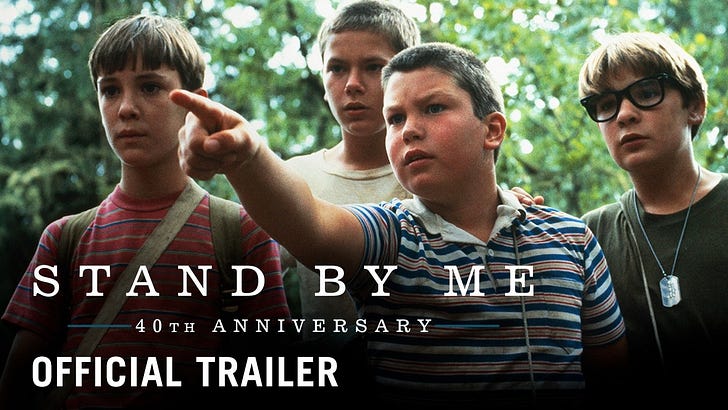
Thus, here is a key passage from the Rosenfield essay, starting with the image that defined the movie:
It's a striking image, four gangly boys lugging backpacks and bedrolls through the wilderness. The camera repeatedly draws back to emphasize the vastness of the landscape through which they wander, confidently and alone; the movie poster reproduces this same motif in silhouette. A portrait of a heroes' journey, yes, but also of a free-range adolescence that was bog-standard for generations—and yet, to anyone born after 1997, has become seemingly unfathomable.This was a world in which it was still possible for a group of kids on the cusp of 13 to simply disappear for a period of 36 hours, during which their parents were not just unaware of but also not even curious as to their whereabouts, and if they got into trouble somewhere along the way, they would simply have to get themselves out of it. More than that: The act of extricating yourself from a mess of your own making was understood to be valuable, even essential, fueled by an unspoken consensus that growing up is a thing kids could only truly do in moments when they were on their own, out of adult view. Your upbringing was your parents' responsibility, sure, but your coming-of-age? This was none of their business. You knew it, and so did they.
One more chunk of that:
… I wonder what a contemporary 12-year-old would make of this movie — and if his parents would even let him watch it. Some, I imagine, would be hesitant. Even more than the cigarette smoking, the ethnic jokes, the fact that the group casually totes a handgun into the woods—and worse, that this turns out to be an extremely good idea—this movie is a stunning, searing portrait of unstructured, unscheduled, utterly free-range childhood. What would today's adolescents, many of whom have spent their entire lives outfitted with tracking software that allows their parents to view their whereabouts at all times, who have never been free from observation even in moments when they are ostensibly alone, make of a story that depicts such an undertaking as attainable, let alone aspirational?
After all, notedRosenfield:
... This year, a poll from the Institute for Family Studies revealed that a majority of 14-year-olds aren't allowed to leave the street where they live without adult supervision.It's strange to think that today's kids, and probably a non-zero contingent of today's young adults, would see Stand by Me not as a coming-of-age adventure, or even a horror story, but a bizarre and unrelatable fantasy. …
OK, it's time to connect one final dot — back to Haidt, as he offered an introduction to anAfter Babelpiece byMariana Brussoniof the University of British Columbiathat ran with this headline: 'Why Children Need Risk, Fear, and Excitement in Play—And why adults' fears put them at risk.'
Haidt noted that this scholar has made the case that 'weharm children's social, physical, and even immune development when we remove all risk from their lives. … A concise summary of her work is this simple sentence, which she said to me during our meeting: 'Children should be kept as safe as necessary, not as safe as possible.'
Now, I do not expect many Rational Sheep readers to cheer when Brussoni makes a case for why 'risky play' is so important. After all, she defines the term as play in which 'kids can get hurt, and that their chances of getting hurt are higher than if they're more sedentary and playing quietly.'
Hey, I understand. I have two broken front teeth snapped off by a baseball that was tipped the wrong way during a rowdy multi-boy game of catch in the back yard. The emergency visit to a dentist is a rather painful memory.
Oh, and there is still a slight scar in my forehead from another incident back when I was seven or eight. This gets complicated. Suffice it to say, I was involved in a multi-player game of hide and seek that was spread out over several yards. I hid, quite effectively, in a thick bush next to our Wichita Falls, Texas, home.
Along came a kid in his own game of Tarzan, and he needed to strike an elephant with one of those homemade spears where you sharpen a piece of wood on the sidewalk until, well, you have a sharp point.
Alas, he decided that the bush in which I was hiding looked like an elephant.
The spear didn't penetrate my scull. It just went under the skin and slid to a stop about an inch sideways. There was a lot of blood, needless to say, and I did not pull the spear out. It must have been a wild sight for my mother when I ran screaming into the house holding a spear that was sticking out of my forehead.
I am sure some of you have childhood memories of your own. Any interesting scars?
Anyway, I will end with the overture for the 2024Brussoniessay, with this question: Is this piece, and the meditation on 'Stand By Me' relevant for pastors, parents, counselors and educators?
We parents are caught in a paradox. We desperately want to keep our children safe and ensure their success. We are also often terrified that they will get hurt and that they will fail—so we do everything we can to prevent that from happening. Yet many of those very efforts to manage our fears have paradoxically reduced our children's safety and their odds of success.
For over two decades, I haveresearchedchildren's development, injury prevention, and outdoor risky play. I have learned that when we prioritize children's play (especially the kind of play that involves some risk and lack of supervision) and the freedom to play how they choose, we help create environments where children and youth thrive.1When we don't, the consequences can be dire.
Think back to your favorite childhood play memory. Where were you? What were you doing? Was there an adult supervising you?
Adults in many Western nations, particularly those born before the 1990s,recall playing with friendsin their neighborhoods, local parks, and abandoned places, making up the rules as they went along, without adult supervision. They often recall a sense of joy, fun, and freedom as they would run, jump, and move their bodies in ways that weren't allowed indoors. They felt independent, taking risks and figuring things out for themselves. And this is the kind of childhood that hasbeen commonfor nearly all of human history. Children, like all young mammals, play.
Today, this kind of childhood is rare. Every successive generation of children since the 1970s has seen their outdoor play and freedom shrink. Time use data show that children's leisure time has gone down, particularly time spent in unstructured outdoor play, while time spent in academic and screen-based activities has increased.Between 1975 and 2015, outdoor play among UK children decreased by 29.4%, while screen-based activities increased by 22.4%.In the U.S., only 16% of children in 1997 played outdoors every day. By 2003 — just six years later — that dropped even further to 10%.
Sound familiar? Let me know what you think.
P.S. During my short trip, I have lost about 5% of my small-ish band of paid subscribers, the biggest drop ever. Folks who don't love Dolly Parton, maybe? Anyway, if you have the means, I would like to ask for your support. I have the subscription fee set as low as Substack will allow.
Share
A note on cookies
Newshunt uses essential cookies to keep you signed in and to remember your language and country, so the site works the way you expect. With your permission, we'd also like to use analytics cookies to understand how people use Newshunt and improve it over time.
Accepting only affects analytics. To learn more, view our Privacy Policy or Terms & Conditions.
(0)Comments