


TALL TOWN TALES
Category: Financial
Share
Archive
Like
I had never been there before, even though I knew it existed. My high school played there, but by the time I was attending we had switched to a more geographically aligned conference1So, I had name familiarity. I just hadn't viewed that particular lake. Still haven't seen the lake.
In the circle of fringe thinkers I frequent online, a commentator linked to this OPB (Oregon Public Broadcasting) story about Lakeview Oregon's fiscal problems. The Neo-Libertarians in the forum think it's about government overreach, but debt and imaginary money is what keeps the economy afloat.
LAKEVIEW DEBT CRISIS
Government, like most organizations, is prone to justifying their existence, and looking for ways to expand is their purpose2. And bureaucracies are just as prone to mission drift as any other entity. The Lakeview City Government planned for growth that didn't materialize. Leaving them laden with debt, and storage sheds filled with plumbing that will not be needed. The town is high centered on a mountain of debt. It is a textbook case of what happens when finance gets unmoored from actual, real things, gambling on a future outcome that didn't materialize.
The attempts to renegotiate the terms has come to nothing, so far. The travails of the denizens living their lives in a faraway small town don't matter to a spreadsheet buried deep in the bowels of finance, the very real people are not reflected in the numbers of the balance sheet.
The reality of this out of the way place is that government is a significant employer here, and being the Lake County seat, close proximity to Fremont-Winema National Forest, with a Forest Service Station, Bureau of Land Management headquarters, and the Lakeview Interagency Fire Agency, to the point that, according to the 2010 census, people employed by the government were only eclipsed by people working in healthcare, an increasingly common situation as the dreaded Boomer generation hits the exits.3
People graduating that year from the Lakeview High School have their portraits hung from the lamp posts, young people who will either leave the town, trying to find something to do in the outside world, or stay and try to find something to do inside the world they grew up in.
The bones of this town are good. Human scaled buildings, many of them a century or more old still stand, ready for retrofitting to a new reality, new purpose. The reality is that it requires a new vision, and everything is changing right now. The future is being reduced in scope, in size, and the elaborate conceits of the Age Of Progress will increasingly bump into the limits of a finite world. None of this will happen all at once, gradually people will adapt to a new reality. We are humans, that is what we do. Conditions in place dictate the dance.
I am not going to make any predictions about what will happen. We shall see. Events have a way of jumping off their appointed trajectories, and doing what it will. It's not always a disaster. People get forced to improvise, to look at things in a new way. I'm sure Lakeview will survive. It depends on what they find to do there. Towns need a reason to exist, and Lakeview has more than one, potentially. Farmland, agriculture, trading post, taking care of each other. Of course, there are a lot of variables here, and depending on tourism is not a guaranteed or reliable source of income.
There are a lot of ways this could go, and humans will have to figure out how to ride it out. We can do it. Will we? Probably not in a way we can imagine now, but that is the nature of us. We are the descendants of prey animals, who discovered that there was safety in numbers, and used that knowledge to burn down the world. But, we are a blip on Mother Gaia's time line, and who knows what her purpose was on letting us get so far off the leash. Maybe she is tired of having ice, maybe the so called Anthropocene is akin to termite infestation, or ant hills, or other world altering phenomenon. Humanity, as conqueror of nature, is really high on their own supply. We are one process among many, countless connections that make up existence. A process that outlives its usefulness will fade away.
People inhabited the valley for many thousands of years before the fur trappers showed up and did their thing. In the future, some of those indigenous practices will come back into use, but who knows. People are resilient, and everything waxes and wanes. If we are lucky.
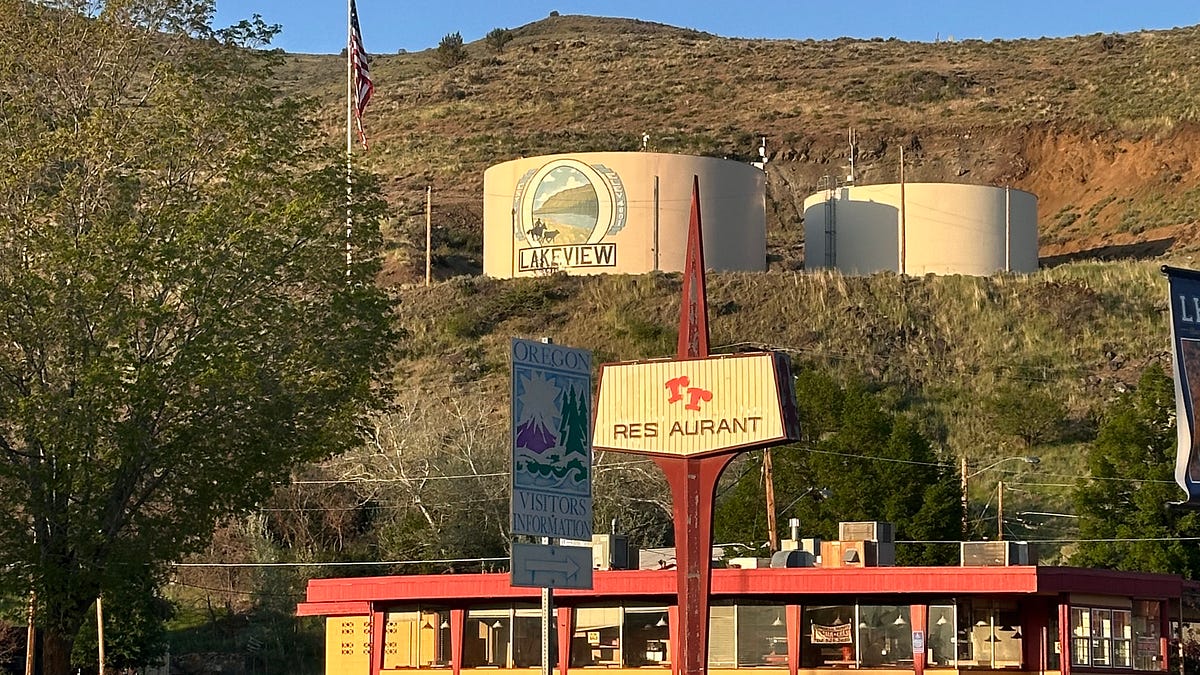
I spent less than 24 hours in Lakeview, and walked around a bit in the twilight. It was achingly familiar, even though I have never been there before. 2,000 population towns are my heritage, and I can't help but project that onto this town. I think reduced towns are a possible future. They can't play by the same old rules. They will have to invent a new game, which will truly be an old game, but that was then, this is now, it's different this time. They'll think of something. Which is true, but the reality is that it's up to us to adapt. The days of thinking we are in control are coming to a close.
History has a real sense of humor. If you don't like the punchline, just wait for the next joke. But the people in small towns aren't laughing. They are just living. And I respect that. I hope they find a reason to stay.
IT'S LABOR DAY4
Last year I wrote about what working meant in my family, and it struck a chord with those who read it. I will revisit the theme many more times before I exit, but I am pretty happy with this. And I will link it here.
If you can't kick down some bucks to me, at least go buy everything Mike Johnson has ever released. All available on Bandcamp.THE GREAT MIKE JOHNSON.
no pressure, but clicking the link will help.
BUY ME A COFFEE
As population waxes and wanes, schools change classification and leagues. Maybe not often, but often enough. According to OSAA's classification system for 2026–30, a 1A school has fewer than 65 students, 2A between 66 and 140 students, 3A between 141 and 280 students, 4A between 281 and 580 students, 5A between 581 and 1025 students, and the largest schools, 6A, have 1026 or more students.-Oregon School Activities Association (OSAA)
The Shirky Principle: Why Institutions Often Need the Problems They Claim to Solve
In 2010, writer and academic Clay Shirky articulated a deceptively simple but profound observation that has since become known as the Shirky Principle: 'Institutions will try to preserve the problem to which they are the solution.'
At its core, the idea is about incentives.
Once an organization—be it a government agency, corporation, nonprofit, or professional guild—exists to address a specific challenge, its survival, funding, and power become tied to the persistence of that challenge. Solving the problem completely can threaten the institution's relevance.
As a result, many organizations unconsciously (and sometimes consciously) work to maintain the status quo rather than eliminate the underlying issue.This isn't usually the result of cartoonish villainy. It's the natural outcome of misaligned incentives, bureaucratic inertia, and the human desire for stability. -Joshua Livingstone Medium May 7, 2026
https://medium.com/@joshualivingstone43/the-shirky-principle-why-institutions-often-need-the-problems-they-claim-to-solve-9b18034afcfc?sharedUserId=johnoneil
'Industry by Sex and Median Earnings", 2008-2012 American Community Survey 5-Year Estimates,American Fact Finder, United States Census Bureau, United States Department of Commerce, Washington, District of Columbia, 2012.
LABOR DAVE AT THE GORGE, FOR THOSE WHO CELEBRATE
A note on cookies
Newshunt uses essential cookies to keep you signed in and to remember your language and country, so the site works the way you expect. With your permission, we'd also like to use analytics cookies to understand how people use Newshunt and improve it over time.
Accepting only affects analytics. To learn more, view our Privacy Policy or Terms & Conditions.
(0)Comments