


The Long Shadow of Disaster: Rethinking Risk, Shocks, and Resilience — Part 2
Category: Financial
Share
Archive
Like
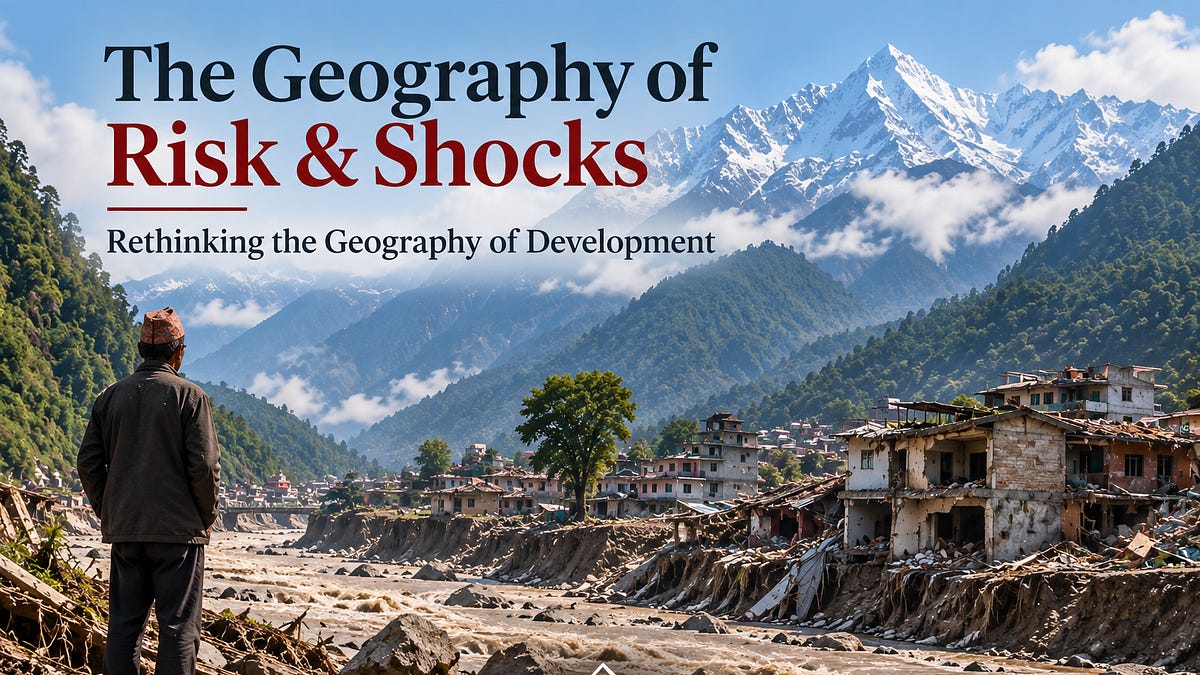
* Development can create its own geography of risk. Roads, markets, services, migration, and investment gradually pulled settlements and economic activity toward river corridors, creating interconnected engineering, investment, and settlement exposures even when individual household choices made economic sense.
* A disaster destroys much more than physical infrastructure. Its effects can erode financial, human, natural, and social capital—affecting health, schooling, livelihoods, household decisions, and future opportunities and capabilities long after the immediate shock has passed.
* Recovery must change the next decision. Engineering, investment, settlement, and climate-system risks need to inform reconstruction and future development. The real test is whether Nepal merely bounces back—or learns enough from each shock to bounce forward with lower exposure and stronger capabilities.
My earlier essay, 'After the Flood -Part 1,' argued that Nepal should use this tragedy to rethink the geography of development itself—seeing mountain-river corridors as interconnected ecological, economic, infrastructure, settlement, risk, and knowledge systems. It also called for river-basin development thinking within Nepal and stronger China–Nepal–India scientific cooperation across the shared Himalayan risk system.
This follow-up asks a different question: How did so many people and investments become exposed in the first place—and what determines whether communities recover from such a shock or carry its consequences for years to come?
As Nepal mourns the lives lost, remarkable stories of rescue, courage, and solidarity continue to emerge. Citizens, businesses, the diaspora, and international partners have mobilized assistance. IME Group contributed NPR 100 million, while Nvidia and its CEO contributed $10 million—reportedly an initiative strongly encouraged by more than 50 Nepali employees at the company.
Even more remarkable has been the persistence of the rescuers. Search-and-rescue operations have continued deep into the disaster, with Nepal's security forces working alongside specialized teams from India, China, and South Korea. More than 13,000 people had been rescued by September 4, according to the government, and workers were pulled alive from hydropower tunnels after nine and ten days.
These acts of generosity and human determination deserve our admiration.
Yet two debates are taking shape alongside the rescue and relief effort. One emphasizes climate justice: Nepal contributes very little to global warming yet bears a disproportionate share of the risks from a changing Himalayan environment. Another points closer to home: why were so many settlements, businesses, roads, hydropower facilities, and other investments concentrated along vulnerable river corridors?
Both questions matter.
Climate justice asks who should bear the cost of a risk Nepal did little to create.
Development policy must also ask why Nepal became so exposed to that risk in the first place—and how that exposure can be reduced before the next shock.
A recent firsthand account from the devastated Trishuli corridor by Manoj Kumar Kandel (Setopati) offers an illuminating glimpse of this changing geography. Traveling through affected communities, he describes bazaars that had grown on what were once the besi lands of hill villages—part of a much older relationship between settlements above and productive land along the river below.
In the aftermath of the disaster, it is tempting to look at these settlements and ask why people were living so close to the rivers in the first place. Certainly, unsafe construction, floodplain encroachment, weak zoning, and poorly planned infrastructure deserve scrutiny.
But criticism of the settlers tells only part of the story.
For generations, many hill communities organized their livelihoods vertically across the landscape through the familiar lek-besi relationship. Families could live in villages on higher ground while cultivating fertile land and pursuing seasonal economic activities closer to the rivers below. The river valley was part of the livelihood system without necessarily becoming the permanent center of settlement.
Over the past several decades, that geography changed.
The Maoist insurgency added insecurity to life in many rural villages. Roads expanded, often following river valleys. Markets followed roads. Buses, shops, schools, health services, government offices, hotels, and employment opportunities increasingly clustered around those emerging corridors. Foreign migration further weakened some traditional village economies. Meanwhile, national politics remained heavily preoccupied with struggles over power and distribution, leaving many rural communities largely to negotiate these transformations themselves.
People adapted. They often do.
Moving toward a roadside or riverside market could mean moving closer to transportation, customers, schools, health care, jobs, and economic opportunity. A location choice that looks dangerously irrational after a catastrophic flood may have been quite understandable when made by a household facing a very different set of immediate risks and opportunities. The remittance inflows helped too.
This does not make building on a dangerous floodplain safe. Nor does it absolve households, businesses, developers, or governments of responsibility.
But it changes the question — especially for the Kathmandu centric elites.
Instead of asking only why people built there, we should ask what combination of insecurity, roads, markets, migration, public policy, and changing livelihoods gradually pulled people and investment toward increasingly exposed river corridors.
The geography of risk was partly produced by the geography of development itself.
Road — Market — Services — Investment — Settlement — More Investment
Connectivity brought opportunity. Opportunity attracted people and capital. Over time, the economic corridor also became a corridor of concentrated exposure. In this case, frankly a corridor of deaths and destructions.
Disaster losses are usually counted first in what can be seen: homes, bridges, roads, hydropower plants, farms, hotels, and businesses.
But an economic shock destroys much more than physical capital.
Households can lose financial capital as savings disappear and debt rises. Human capital can suffer through injury, disrupted schooling, malnutrition, illness, and psychological trauma. Natural capital can be altered through erosion, sedimentation, damaged forests, and changed watersheds. Social capital—the networks of trust, reciprocity, and collective action that bind communities together—can be strained, but it can also become one of the most important resources for recovery.
The reconstruction bill therefore captures only part of the economic loss.
A family may rebuild its house and still not have recovered. It may have sold livestock or productive land, depleted savings, taken expensive loans, withdrawn a child from school, or sent a family member abroad because the local livelihood disappeared.
These coping decisions can carry the shock into the future. There are plenty of academic research works done on this topic.
Economists have increasingly documented this phenomenon.
Research on Nepal's 1988 earthquake, for example, found measurable educational effects among children exposed at very young ages. Infants born in severely affected districts subsequently completed less schooling and were substantially less likely to finish middle and high school. The effects were particularly pronounced among disadvantaged groups. [See reference]
The famous Dutch Hunger Winter provides another striking example from a very different kind of shock. Research following people exposed to severe prenatal nutritional deprivation has found effects persisting many decades later.
These events are obviously not equivalent to the present Himalayan disaster. But they demonstrate an important economic principle:
A severe shock today can become embodied in tomorrow's human capabilities.
The pathway may run through nutrition, health, schooling, debt, asset depletion, migration, or lost economic opportunity.
Simply: Disaster — Asset Loss — Household Stress — Coping Decisions — Capability Loss —Future Outcomes
That is the long shadow of disaster.
Fortunately, the same framework points toward another question. If shocks destroy different forms of capital, what forms of capital help people withstand them?
Our own research following Nepal's 2015 Gorkha earthquake offers some clues. [See references]
Field research in Sindhupalchowk examined communities where microfinance and women's savings activities had already been operating. Analysis of household data found a positive relationship between participation in microfinance and food security, including significant improvements when women participated.
Related research from our post-earthquake fieldwork examined something that rarely appears on a reconstruction balance sheet: social capital. We found that bonding social capital helped generate mutual trust, which in turn enabled collective action after the earthquake.
Other work from Sindhupalchowk showed how social entrepreneurs and citizen participation could facilitate the co-production of recovery rather than treating affected communities simply as passive recipients of reconstruction assistance.
None of this means that microfinance or social capital is a magic solution. Social networks can exclude as well as include, and credit can become burdensome rather than protective.
The more important lesson is simpler:
Resilience begins before the disaster.
Savings groups, credit relationships, trusted neighbors, reciprocal obligations, local organizations, community leadership, health systems, and family networks form a kind of invisible infrastructure. We may not call them disaster infrastructure before the shock. But when physical infrastructure disappears, they can become crucial to survival and recovery.
This suggests a research question worth pursuing much more systematically in Nepal:
What combinations of financial, human, institutional, and social capital allow households not merely to survive a disaster, but to recover without sacrificing their future productive capacity? [Our research was in collaboration between the Nepal Study Center— UNM scholars and the Kathmandu University]
Recovery is necessarily about replacing what has been lost. Resilience requires something more: changing the decisions that determine future exposure.
The recent disaster highlights at least four interconnected economic risks.
Engineering risk concerns whether past assumptions remain adequate for roads, bridges, tunnels, hydropower plants, and other infrastructure expected to survive for decades.
Investment risk asks whether geological, hydrological, and climatic risks are properly incorporated before large amounts of capital become locked into particular locations.
Household and settlement risk concerns where homes, farms, schools, hotels, and businesses should—or should not—be rebuilt.
Climate-system risk reflects the larger reality that Nepal faces consequences from changes in the global climate system that it did little to create and cannot manage by itself.
This is where the domestic development question meets the international climate-justice question. Loss and Damage finance and other forms of international risk sharing matter because some risks originate far beyond Nepal's borders. But international finance cannot substitute for reducing avoidable exposure at home.
Nor can insurance (e.g., flood) make an unsafe location safe.
Risk needs to enter the decision before the bridge, hydropower project, hotel, road, or house is built.
In Part I, I argued for looking at Nepal's major river basins as interconnected development and risk systems rather than seeing individual roads, hydropower projects, settlements, and investments in isolation. The argument here adds the human side of that geography.
We also need to understand why households came to occupy these emerging economic corridors, what capabilities they carried into the disaster, what the shock took away, and what enables them to recover afterward.
Nepal must rebuild. Families need homes. Roads and bridges must reconnect communities. Businesses and farms must reopen. Hydropower and other infrastructure will have to be restored.
But reconstruction cannot mean simply restoring what existed on August 25.
If we rebuild the same assets, using the same assumptions, in the same vulnerable locations, we may restore yesterday's economy while reproducing yesterday's risks.
The deeper measure of resilience is whether each shock leaves households, communities, engineers, investors, researchers, and public institutions better able to anticipate and withstand the next one.
That means recognizing social capital alongside physical capital. It means protecting human capabilities as carefully as infrastructure. It means understanding why people came to live in risky places rather than simply blaming them for being there. It means putting risk into investment decisions before disaster strikes. And it means ensuring that what Nepal learns from one catastrophe survives long enough to change its response to the next.
The real test of resilience is not simply whether Nepal bounces back.
It is whether Nepal can bounce forward—with more knowledge, stronger capabilities, and less vulnerability than before.
Dr. Alok K. Bohara, Emeritus Professor of Economics at the University of New Mexico, writes as an independent observer of Nepal's democratic evolution through the lens of complexity and emergence science. His systems-policy essays on Nepal's socio-economic and political landscape appear on Nepal Unplugged.
Setopati, राहत बोकेर त्रिशूली पारि पुग्दा देखिएको अर्को तस्बिर, Manoj Kumar Kandel, Bhadra, 20
https://www.setopati.com/author/1603
Paudel, J., & Ryu, H. (2018). 'Natural Disasters and Human Capital: The Case of Nepal's Earthquake.' World Development, 111, 1–12.
Rayamajhee, V., & Bohara, A. K. (2021). 'Social Capital, Trust, and Collective Action in Post-Earthquake Nepal.' Natural Hazards, 105, 1491–1519.
Rayamajhee, V., Storr, V. H., & Bohara, A. K. (2022). 'Social Entrepreneurship, Co-production, and Post-disaster Recovery.' Disasters, 46(1), 27–55.
Shahid, M. A., & Bohara, A. K. (2020). 'Does Microfinance Increase Food Security? Evidence from Nepal.' Journal of Food Security, 8(3), 89–97.
A note on cookies
Newshunt uses essential cookies to keep you signed in and to remember your language and country, so the site works the way you expect. With your permission, we'd also like to use analytics cookies to understand how people use Newshunt and improve it over time.
Accepting only affects analytics. To learn more, view our Privacy Policy or Terms & Conditions.
(0)Comments