


Good News on and for the Earth
Category: SciTech
Share
Archive
Like
I'll start with my own happy dance about getting a week of rain here in the Central Oregon high desert. We've been in serious drought but last week got enough rain to do some good for trees and other plants. In celebration I'm offering aWoohoo for Rain Special Offer 50% Discountfor new paid subscribers. That's just $37.50 for an entire year. Sure hope you'll become a rainmaker for TRANSCEND by upgrading to a paid subscription. Paid subscribers are who make this research and writing possible. Thank you!
Get 50% off for 1 year
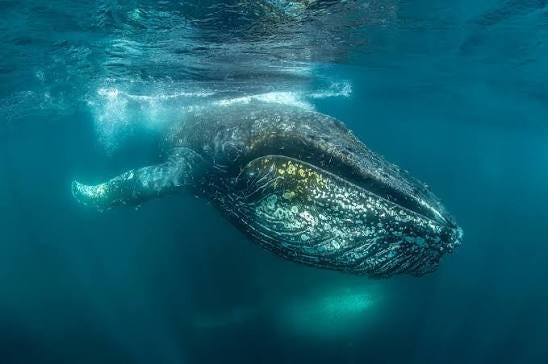
Humpback whales are staging one of the most remarkable comebacks in modern conservation history, with southern hemisphere populations growing from fewer than 10,000 at the peak of commercial whaling to more than 100,000 today.
Last December, a South African couple counted 299 humpbacks gathered in a single group — what experts describe as likely the largest such sighting on record. Here is agreat videoshowing that event.
It's a living signal of what decades of sustained international protection can achieve. Unfortunately, shipping traffic around southern Africa quadrupled after 2023 – a result of our consumption-driven economy – and this raises the risk of whales being struck by ships.
Nepal's tiger population has quadrupled since 2010, reaching 429. The success is attributed to anti-poaching efforts and community engagement. Worldwide, the wild tiger population has increased from about 3,200 in 2010 to 5,357 in 2025. Read more inHimalayan Times.
The Solomon Islands, Vanuatu, Papua New Guinea, and New Caledonia are establishing the world's first multinational Indigenous marine reserve spanning six million square kilometers, grounded in ancestral ocean stewardship and actively implementing conservation programs.
The multinational Indigenous marine reserve builds on a no-loss principle protecting key revenue sources while creating new pathways for investment. Implementation spans eco-tourism, small-scale Indigenous fisheries, sustainable aquaculture, and renewable ocean energy. Marine governance flows from ancestral wisdom through these practical programs, ensuring livelihoods and ecosystems grow together rather than compete.
Get details on this exciting new conservation and governance model atHappy Eco News.
Get 50% off for 1 year
NOTE: I'm really excited about this development because I'll get to check it out in person on a trip to Costa Rica next April. Excited to sloth out!
Costa Rica's economy depends on the wildlife its own roads have long put at risk — sloths and monkeys struck by cars, habitat split in two, coastal crabs unable to reach the sea to lay their eggs.
Lawmakers voted unanimously to make wildlife crossings a legal requirement, built into road planning from the earliest stage rather than added as an afterthought. In addition, citizens can now submit their own evidence to force retrofits on existing highways already causing harm.
Conservationists call it a meaningful shift away from decorative warning signs, which do little to slow drivers, toward structures proven to actually save lives.
Many countries are now deploying wildlife crossings over and under highways and they are proving highly effective in reducing wildlife deaths and human death and injury from crashes. While many might imagine themassive highway overpasseswhen they think of wildlife crossings, there are other innovative options uniquely made for specific animals, likesalamander tunnelsorcanopy ropes for monkeys.
Read full story atMongabay.
New Yorkers eat 3 million oysters a year. The shells are rebuilding New York Harbor, which once contained roughly half of the world's oysters. They filtered the water, absorbed wave energy, and provided habitat for fish, crabs, and birds across hundreds of acres of reef. Then over harvesting and pollution eliminated them almost entirely. The harbor that had once cleaned itself every three days was left to manage its own waste without its most powerful natural tool.
The Billion Oyster Project, based on Governor's Island, is changing that. Seventy-five New York City restaurants now divert their discarded oyster shells to the project rather than the landfill. The shells are cured in a pile until bacteria and invasive species are eliminated, then seeded with larvae in a hatchery that can raise ten million baby oysters at once. Trucked out to reef sites across the harbor, the oysters get to workfiltering water, building habitat, and absorbing the energyof incoming waves that might otherwise contribute to flooding.
So far, the project has raised 200 million live oysters across 19 acres of restored reef, filtering tens of trillions of gallons of harbor water in the process. Their goal is one billion oysters and 100 acres of reef by 2035. 'Oysters are what we call a keystone species,' said Bela Altman, the project's volunteer coordinator. 'If the oysters are thriving in an environment, all other biodiversity is thriving in that environment.'
At one billion oysters, those 100 new reefs wouldrefresh the entire water volume of New York Harbor every three days.Exactly as they once did.
There's nothing I love more than witnessing this magnificent planet heal.
Much love,
Cylvia
InTRANSCENDI offer information on critical environmental issues and actions we can take, options for economic system change, and practical tools for spiritual growth and wellbeing. The goal is to contribute to creating a world that works better for all beings. If this is of importance to you and you haven't done so already, please consider upgrading to a paid subscription. Here's a 50% Discount Woohoo for Rain Special Offer to make it even easier to join this community.
Get 50% off for 1 year
I appreciate all of you readers. You paid subscribers make it possible for me to do this research and writing and share it with everyone. Thank you so much.
If you prefer not to subscribe but still want to support, you can make a one-time contribution on myReThink Ministry website. Just scroll down to the donation window.
Before you go—hit the❤️like button and re-stack this edition right now. Every time you share, you're getting this information to someone who may be caught in a media silo propaganda bubble. That's part of creating a world that works better for all beings. Thank you!
Bring on the Good Rain!
A note on cookies
Newshunt uses essential cookies to keep you signed in and to remember your language and country, so the site works the way you expect. With your permission, we'd also like to use analytics cookies to understand how people use Newshunt and improve it over time.
Accepting only affects analytics. To learn more, view our Privacy Policy or Terms & Conditions.
(0)Comments