


Jerald Vedan
What my aunt's sari taught me about Indian identity and politics in KwaZulu-Natal

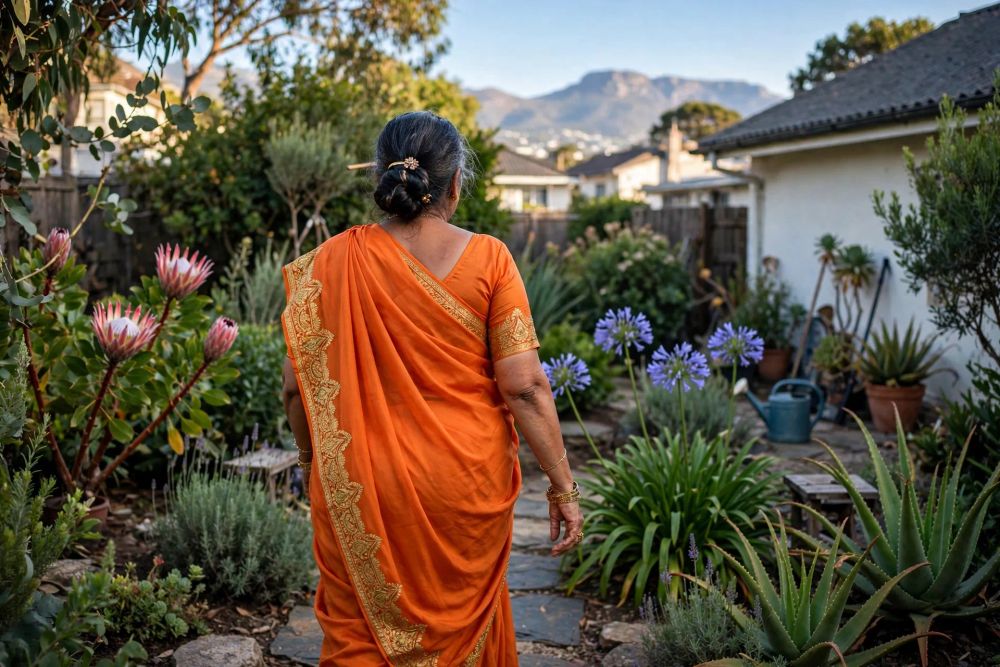
The writer says his 82-year-old aunt recently folded her favourite orange sari and handed it to her niece.
Image: Meta AI
MY 'Reservoir Hills' auntie has a cupboard full of saris. Silk ones for weddings, cotton ones for temple, and a particularly fierce orange one she wears when she wants to win an argument with my uncle.
She has been collecting them for decades. She knows the weight of each one, the drape and the exact angle of the pallu (loose, decorative end of a sari). She can tell you which sari works for a funeral and which one says: 'I'm not angry, just disappointed.'
She also knows something about politics that most commentators miss: sometimes, the best thing you can do is fold yourself up neatly, wait, and then unfold at the right moment.
I used to think she was passive. Now I think she might be the wisest person in Durban.
Here's the thing about being Indian in this province: everyone has a theory about us, but nobody quite knows what to do with us.
The ANC once courted us. Then, perhaps, they took us for granted. The IFP has never quite known what to make of us. The DA would love our support but sometimes struggles to speak to us without sounding like a corporate diversity workshop. And the MK Party is the new kid on the political block, and is turning heads. But around here, we have learnt to get cautious. We've seen this movie before. The plot is familiar. The directors? Let's just say their previous work was controversial, and the reviews weren't kind.
We have learned to listen to the speeches, watch the rallies and then ask the inconvenient question: What happens after the applause fades? Perhaps we should take a lesson from the sari.
It is six metres of fabric and six metres of possibility. Wrap it one way and it is traditional. Drape it another way and it is modern. Pull it over your head and it is respectful. Leave it loose and it is bold. It adapts. It survives. It never really goes out of style.
Unlike some political parties I could mention, it doesn't suddenly change its colours or claim to have all the answers. It simply waits to be unfolded. Perhaps our community should do the same. Not wait for a political party to rescue us. Wait, instead, for the right moment to remind ourselves of who we are and what we are capable of.
Our story did not begin with a ballot paper. We arrived in 1860, long before anyone thought of drawing the political boundaries that now define us. We endured indenture, discrimination, the Group Areas Act and the uncertainty of the transition to democracy. We built temples, mosques, churches, schools and businesses when there were few institutions to help us. We didn't merely survive; we built lives.
I grew up in Mayville during the apartheid years, in the neglected part of town. My father's house had no indoor toilet. We had an outhouse, a tin roof and a pride that no amount of poverty could dent. My mother used to say: 'God helps those who help themselves, but He also helps those who know how to fold a decent sari.'
I think she was joking. However, I'm not entirely sure. What I remember more clearly is the community around us. Indian, Zulu, coloured and white families lived alongside one another. We did not always agree, but there were moments when the labels mattered less than the people behind them. People looked out for each other. They shared and they survived. They didn't wait for a politician to arrive with a solution.
My aunt has also told me stories about the 1949 riots. She was a child then in Cato Manor, but those terrible days became part of her family memory, passed down not simply as political history, but as human history. She remembered stories of neighbours protecting neighbours. Zulu families sheltering Indian families. Indian families sharing food and comfort with Zulu families. And, in the middle of chaos, people remembered something politicians sometimes forget: we are human beings first.
My aunt said her mother never spoke much about politicians when recalling those days. She spoke about neighbours, and she spoke about aunties. She spoke about the woman next door who shared what little food she had. That lesson stayed with my aunt, and, somehow, it stayed with me.
Today our political landscape is changing again. Coalitions come and go. New parties emerge. Old loyalties weaken. Political slogans become louder and promises become grander. We are entitled to listen to all of them. But we are also entitled to ask questions. Who will fix the pothole? Who will keep the water running? Who will make our streets safer? Who will create opportunities for our children? And, perhaps most importantly: What are we prepared to do ourselves?
We need a quiet, stubborn, unglamorous revolution. We need community policing forums that do more than meet once a month and complain. We need bursary funds that don't wait for government approval. We need businesses that employ and train our young people. We need temples, mosques and churches that open their halls for skills training as readily as they open their doors for prayer. We need neighbours who know one another again.
Government has an enormous responsibility. Of course it does. But government cannot be our parent nor should we want it to be. The real strength of our community has always been our ability to organise, sacrifice, educate, build and help one another. That is what our grandparents understood. That is what our parents inherited. And that is what we must pass on.
My aunt is 82 now. She still wears her saris with pride, although she has apparently downgraded from six metres to a more manageable five. Her knees, she tells me, can no longer handle the extra weight.
Last week she folded her favourite one, the orange one, and handed it to my niece.
'This is yours now,' she said.
'Take care of it. And remember: you're not just wearing fabric. You're wearing history.'
I think she's right.
For 166 years, our community has been wearing history. The question now is what we will do with it. We can wrap ourselves in nostalgia and spend our days arguing about who betrayed whom. Or we can take the lessons of those who came before us and use them to build something better.
We can vote for whoever we believe deserves our vote. We can question them. Challenge them. Change our minds. But we should never surrender our future to them. Because our future does not belong to any political party. It belongs to us. And perhaps that is the wisdom hidden in my aunt's cupboard. A sari can be folded for a long time. It can lie quietly, apparently doing nothing. But when the moment comes, it unfolds. And when it does, it can fill an entire room with colour, history and possibility.
That, I think, is what we must do. Not disappear. Not retreat. Not wait for someone to save us. Unfold. And, when we do, let us remember those who taught us how. Just don't ask my aunt to fold it back perfectly afterwards. She'll tell you that's what daughters-in-law are for.
Jerald Vedan is an attorney, community leader, and social commentator based in KwaZulu-Natal.
** The views expressed do not necessarily reflect the views of IOL or post.co.za
Related Opinion
A note on cookies
Newshunt uses essential cookies to keep you signed in and to remember your language and country, so the site works the way you expect. With your permission, we'd also like to use analytics cookies to understand how people use Newshunt and improve it over time.
Accepting only affects analytics. To learn more, view our Privacy Policy or Terms & Conditions.
(0)Comments