


unknown
How ‘Rashtriya' became ‘Antar-rashtriya': Mohan Bhagwat's global outreach

New York and Toronto have told the world what the RSS says it is. London may tell us what it hopes to become
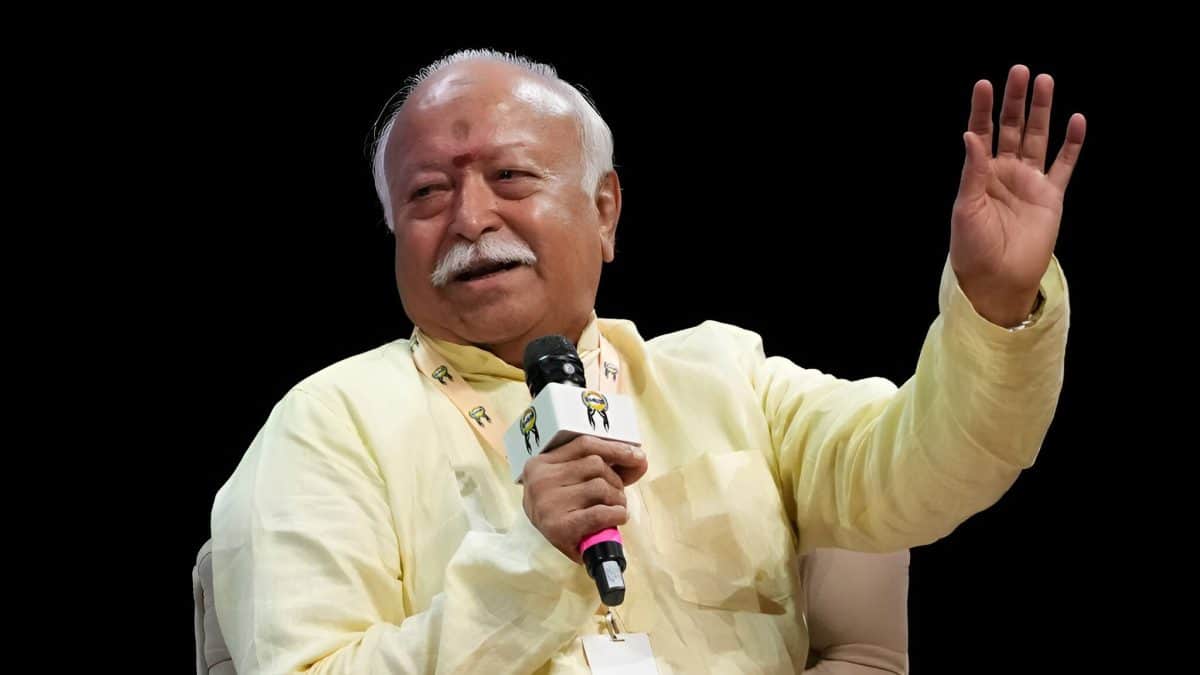
One of Mohan Bhagwat's extraordinary achievements during his seventeen years as Sarsanghchalak of the Rashtriya Swayamsevak Sangh is that he has not merely mainstreamed the RSS in India. In its centenary year, he has globalised its public voice.
And how. By celebrating Rakshabandhan, with RSS volunteers and friends tying the delicate bond of friendship, affection, and loyalty to thousands in the world's financial capital, the Big Apple. In doing so, he took an old RSS tradition, of celebrating six festivals, of which Raksha Bandhan is one, abroad.
The choice of three major English-speaking democracies, the United States, Canada and the United Kingdom, can hardly be accidental. By speaking largely in English, Bhagwat was not addressing only sympathetic sections of the Indian diaspora. He was speaking over their shoulders to the wider Anglophone world: the media, political establishments, universities, religious organisations and, increasingly, the digital public sphere.
Advertisement
The scale was considerable. On August 29, more than 6,000 delegates from 39 American states and hundreds of cities attended the Universal Oneness Celebration at Madison Square Garden in New York. Two days later, in Toronto, more than 2,000 delegates representing 175 organisations from all ten Canadian provinces attended the Hindu Vishwa Bandhu gathering. London, the final stop, culminates in a 'Celebration of Oneness' bringing together hundreds of organisations.
I followed these visits with considerable attention and curiosity. What surprised me was how little the real significance of Bhagwat's outreach was understood and how quickly the New York visit became enveloped in predictable polemics.
More from Opinion
More from Opinion
A coalition of organisations opposed the Madison Square Garden event. New York Mayor Zohran Mamdani declared himself in 'deep opposition' to the RSS, describing it as a movement 'predicated on an exclusionary vision' and contrasting it with the pluralistic, secular India in which everyone belongs. USCIRF went considerably further, urging the US government to consider sanctions against RSS members and even revoke Bhagwat's visa.
This was so ironic given that Bhagwat's event was 29 called 'Oneness' and repeatedly proclaimed the unity and oneness of all humanity. Now people would have to choose whom to believe — Mamdani or Bhagwat.
To demand that a man be prevented from speaking because one regards his ideology as insufficiently plural is a curious way of demonstrating one's own pluralism. Cancel culture has always contained this congenital contradiction: intolerance practised in the name of tolerance.
Advertisement
The old charges were rehearsed too — the RSS as 'paramilitary,' shadowy outfit behind Gandhi's assassination. And RSS as a Hindu majoritarian organisation which persecutes Muslims and Christians.
Nor was criticism confined to North America. Former Indian Congressman and Cabinet minister Kapil Sibal accused Bhagwat, in effect, of speaking wisely abroad while remaining silent at home: 'Words don't matter. Actions must speak.' And his was one of the mildest and most polite of rebuttals. The Left-oriented social media, especially on YouTube, went practically bonkers with all kinds of sensationalist speculations and accusations.
But Bhagwat was also attacked from the other direction. A harder Hindu Right, including commentators outside the formal RSS structure, has long found his language towards Muslims much too accommodating. His insistence that a Hindu who believes Muslims have no place in Bharat ceases, in that sense, to be Hindu; his affirmation that different paths can lead towards the same truth; his refusal to define Hindu strength as hostility to Abrahamic faiths.
So Bhagwat was struck from both flanks. To habitual detractors, he was disguising an exclusionary movement in the language of pluralism. To harder Hindu critics, he was diluting Hindu interests in the name of an impossible universalism.
Advertisement
What was remarkable was his refusal to be rattled by either.
I have heard Bhagwat speak on several occasions. I might be tempted to observe that his New York and Toronto talks were not necessarily his most brilliant or moving. Nor was the message startlingly new. But they were certainly among his bravest and most significant.
Let me explain why.
Hindus must not give up being Hindu merely because Hinduism is attacked. But neither must they become mirror images of those whom they accuse of intolerance, Bhagwat implied. In New York, he began with the American word 'pluralism' and connected it with India's 'unity in diversity'. Diversity, he said, is natural; unity is truth.
In Toronto the register shifted. India, Bhagwat argued, should aspire not to become a Mahashakti, a domineering superpower, but a Vishwaguru: a civilisation that leads through example, knowledge and service. 'We don't say all are one,' he said. 'We say all is one.'
But there was another message beneath these formulations that has received far less attention.
It was simply this: the RSS exists, grows, thrives, and exerts influence. It cannot be written off.
Moreover, RSS has survived a hundred years of hostility, misrepresentation, political reversals, bans, and internal crises.
The RSS's role and importance in national — and now international affairs — does not, moreover, depend upon the BJP remaining in office. The BJP may be the RSS's most successful political progeny, but the Sangh's own sense of purpose precedes governments and intends to outlast them.
Even more significantly, Bhagwat has now inserted the RSS's account of itself into the permanent global digital record. That too in English, before large audiences and in readily retrievable form.
That matters enormously in the age of search engines and artificial intelligence. Henceforth, anyone asserting what the RSS 'really believes' confronts an expanding first-party archive against which such claims can be tested.
There is a sting in the tail for Bhagwat's followers too. The standards he has publicly proclaimed are exceptionally high. If Hinduism means protecting diversity, accepting Muslims as integral to Bharat, refusing domination and serving humanity, then the challenge is no longer merely for the RSS's critics to understand Bhagwat.
It is for the RSS, and perhaps Hindus and Indians more generally, to live up to these high ideals.
In London, RSS spokesperson Sunil Ambekar has already supplied the transition. After a hundred years of experience in Bharat, he said, the time has come to 'share these experiences with the world'.
New York and Toronto have told the world what the RSS says it is. London may tell us what it hopes to become.
[To be concluded]
(Makarand R. Paranjape, author and public intellectual, is currently Sri Aurobindo Chair, Vedere University & Director of Education, AHCP LLC. Views expressed in the above piece are personal and solely those of the author. They do not necessarily reflect Firstpost's views.)
Related Opinion
A note on cookies
Newshunt uses essential cookies to keep you signed in and to remember your language and country, so the site works the way you expect. With your permission, we'd also like to use analytics cookies to understand how people use Newshunt and improve it over time.
Accepting only affects analytics. To learn more, view our Privacy Policy or Terms & Conditions.
(0)Comments