


unknown
Hanuman Ansh: The blockbuster nobody saw coming

The film's unexpected box-office success proves that spiritual storytelling can still find a mass audience
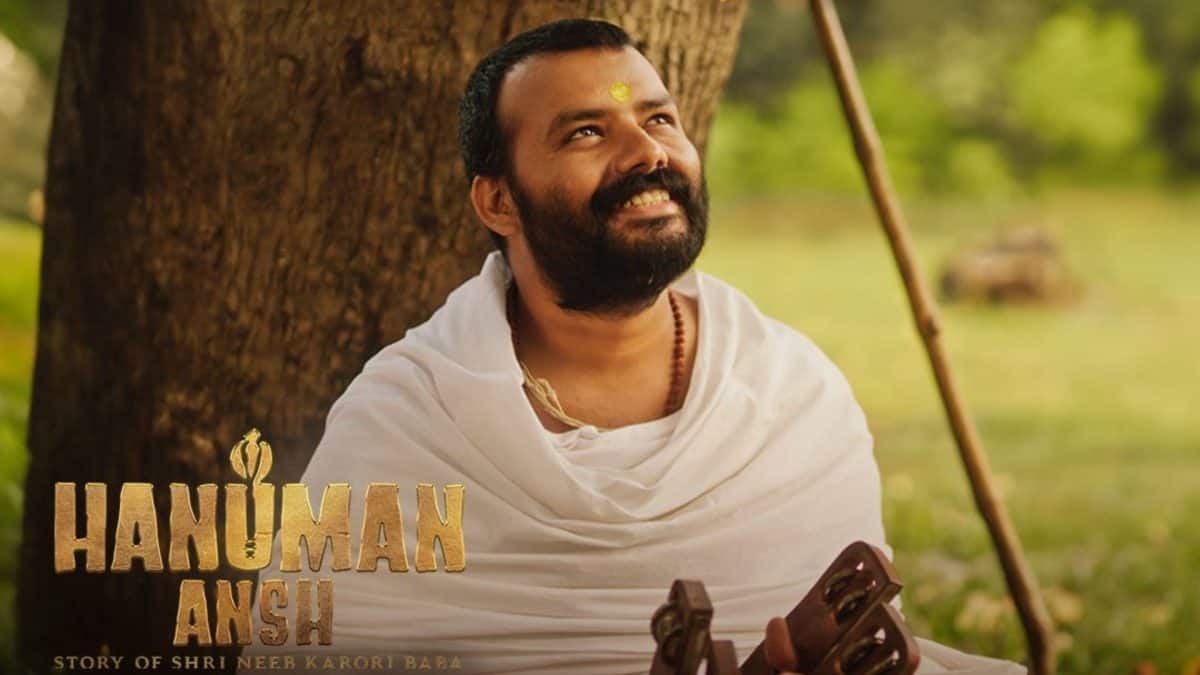
The Indian cinema landscape is witnessing a miracle at the box office. A film made on a limited budget of less than Rs 2 crore is redefining audience preference and scripting a historical trend. The cinema is already a blockbuster having been able to awe and inspire audiences with its simplicity and spiritual tonality. Hanuman Ansh, based on the life of Shri Neeb Karoli Baba, popularly known as Maharaj Ji among his followers, has laid a foundation to the divine stories of our unparalleled Sant Parampara. The film traverses multiple anecdotal records of people who knew Maharaj Ji and how he impacted their lives through his presence.
Advertisement
Many had already declared the cinema a flop after the initial two-week collection, but the cinema has surpassed its previous collections in the fifth week and is heading towards an all-time blockbuster collection of more than Rs 100 crore, proving the power of spiritual cinema and the audience's preference for watching the life tales of our gurus and sants on the big screen. Hanuman Ansh is a testament of how a story presented with utmost honesty connects with the audience for its sincerity and effort.
More from Opinion
More from Opinion
Hanuman Ansh brings to the big screen: the power of Bharatiya spirituality. It is, in fact, a lesson for the Hindi cinema industry which has long ignored the stories of our great saints, who have shaped the Bharatiya philosophy, thinking and the way of life. The industry, which earlier explored tales of our deities and produced movies like Jai Santoshi Maa, has gone astray and is very reluctant to explore such topics. In the age of Toxic, Animal, Marco and Mirzapur where violence and sex serve as the main ingredients for pulling audiences towards theatres, Hanuman Ansh stands as a breath of fresh air and demonstrates the power of Bharatiya spirituality and Sant Parampara which has guided humanity since time immemorial.
Advertisement
Unfortunately, Hindi cinema overlooked the incomparable Sant Parampara that has shaped Bharat's society, values and civilisational ethos. But it is never too late. The journey has finally begun — and with a blockbuster! May this be the first of many stories that bring the timeless legacy of our Sant Parampara to the screen.
This power needs to reach more and more people through cinema, and Hanuman Ansh has done just that. It has broken away from the current stereotypes and presented the tale of a sant and a guru, Neem Karoli Baba, with such purity and subtlety that it has resonated with people across the nation. The cinema captures the rural landscape and the struggles of its people. The cinema focuses on telling human stories of normal humans and how their lives changed on meeting Maharaj Ji.
The film's music is intriguing and it fuses the spiritual overtones with folk music. The songs 'Hey Kharari', 'Parvati' and 'Maine tere hi bharose Hanuman' clearly stand out and stay with the audience long after they leave the theatre. The director and writer of the cinema, Vishal Chaturvedi, has done an exemplary job in weaving a storyline which keeps the audience hooked. It is all to his credit that this story was brought to the celluloid even after several rejections, struggles and difficulties.
Advertisement
With such a small budget, the ability to capture the journey of the Sant across different regions and timelines while keeping the events in the story authentic is what makes this cinema stand out. Director Vishal Chaturvedi's Bhakti has displayed the Shakti and his Sadhna has exhibited Success. Though a doctor by education, he followed his passion for cinema and the way he told great stories about Bharat can be considered cinema in itself.
Another surprise is the casting and the performance of the lead actor, Shobhinaw Satyaa, who plays the role of adult Neem Karori Baba. His performance has a raw innocence and an aura that makes Maharaj Ji's presence believable in the cinema, which is a major positive. This makes the audience gripped to the divine presence. All the other actors have done a commendable job as well.
The cinema stands out, not just in its storytelling, but in its messaging as well. As one moves from one miracle to another, the cinema also recognises the importance of science and Karma in shaping our existence. Examples of some such moments are: the scene where a woman tells Maharaj Ji that her child is unwell, and he asks her to consult a 'Vaidya', focusing on the importance of science in treatment, and the scene where he tells the struggling people of the village, 'Karoge nahi toh hoga kaise', stressing on the importance of Karma for achieving a thing. Another such instance is the 'Tum Vidhwa hone wali ho' scene, when Maharaj Ji tells a woman her husband is about to die and she starts crying, he tells her that 'bacha bhi toh sakti ho', making her realise that crying over a possible event is of no use and if we act in time, we may be able to avert it.
These scenes clearly highlight how we shape our reality and how our Karma acts as a fulcrum of our existence where we can make things happen through actions. Our Adhyatma is not humbug; it's science beyond physical experiments, but achieved through mindful experiences. Also, the scene depicting a thief stealing watermelons: Maharaj Ji, after teaching a lesson to the thief, tells him that 'Fal khane ke liye hi hai bas dusre ka haq ka mat khao', highlights the importance of boundaries and the need to take care of other people's needs as well.
The cinema beautifully fuses in the importance of scientific temperament, spirituality and Karma through the tales of Maharaj Ji and his followers. The film also explores the taboos of society and puts forward a message that it is humans who create societal divisions while the divine sees all the same. The scene where young Maharaj Ji was given food while other children sitting beside him were not, shows us how he, through his siddhi, makes the person realise his mistake and serve food to all children, clearly highlighted how humans force divisions while divinity sees the divine in every being. Similarly, in the scene where Maharaj Ji scolds his sevak (like a brother) Gopal for hitting his wife during pregnancy: he tells him that taking care of her would bless him with a child who will eventually take care of his family and bring some respite to his struggles. The scene highlights how women are revered and respected in our Samskriti.
The cinema also explores manifestation. In the scene where Gopal sees the divine roop of Maharaj Ji in the cave and sees snakes wrapped around him like the manifestation of Shiv Ji, Maharaj Ji tells him that he can see Lord Shiv, because he is a devotee. The cinema wonderfully encapsulates beautiful scenes that capture our own spiritual heritage.
Hanuman Ansh showcases our Sant Parampara in the most divine light. Through its simplicity and honest storytelling, it touches the right chords with the audience and leaves us with many pearls of wisdom. The presentation of our heritage is pulled off beautifully. The scene where 'Hanuman Chalisa' creates a suraksha kavach is a true testament of storytelling grounded in our Samskriti and folklore. But most importantly, what the story truly captures, and what is a lesson for everyone, is how true and uncompromised Bhakti can lead to divine grace in our lives through purity in our thoughts and actions.
(The author is an advisor, Khajuraho Literature Festival, Prabuddha Bharat Belagavi, VESIM Literati Festival Mumbai. Views expressed are personal. He tweets @MODIfied_SKP)
Related Opinion
A note on cookies
Newshunt uses essential cookies to keep you signed in and to remember your language and country, so the site works the way you expect. With your permission, we'd also like to use analytics cookies to understand how people use Newshunt and improve it over time.
Accepting only affects analytics. To learn more, view our Privacy Policy or Terms & Conditions.
(0)Comments