


unknown
Lothal: The ancient port that connected civilisations

Lothal emerged as a vital maritime centre in the ancient world due to its advanced dockyard and trade links
The word 'Lothal' in Gujarati means "the Mound of the Dead". It is also interpreted as a place where the boats are moored and repaired. Lothal is widely considered as the world's oldest artificial dockyard. It dates to around 2400 BCE, during the Indus Valley Civilisation. Archaeologist S. R. Rao discovered this maritime architecture and sophisticated engineering in 1954 in Gujarat.
The tidal dockyard was a masterpiece of ancient hydrology. The basin of the dockyard is a trapezoidal enclosure built with high-quality bricks. It measures approximately 214–218 meters in length and 36–37 meters in width. Harappan engineers developed sophisticated systems for controlling tidal flows. Lothal was situated near the Gulf of Khambhat, a bay of the Arabian Sea known for its tidal range. The highly skilled Harappan engineers built sluice gates and spill channels. These systems helped the ships float in the dockyard during high tide and prevent them from becoming stranded in the deep, wet mud during low tide.
Advertisement
The burnt-brick structures of the dockyard were highly resilient to the water pressure and strong currents during high tides. The extraordinary water-locking device was an engineering marvel, unique in many ways. The Bhogava tributary connected the dock to the wider Sabarmati River ecosystem. This riverine connectivity helped establish a vital network for trade, transport and supply chains between Lothal and its hinterland.
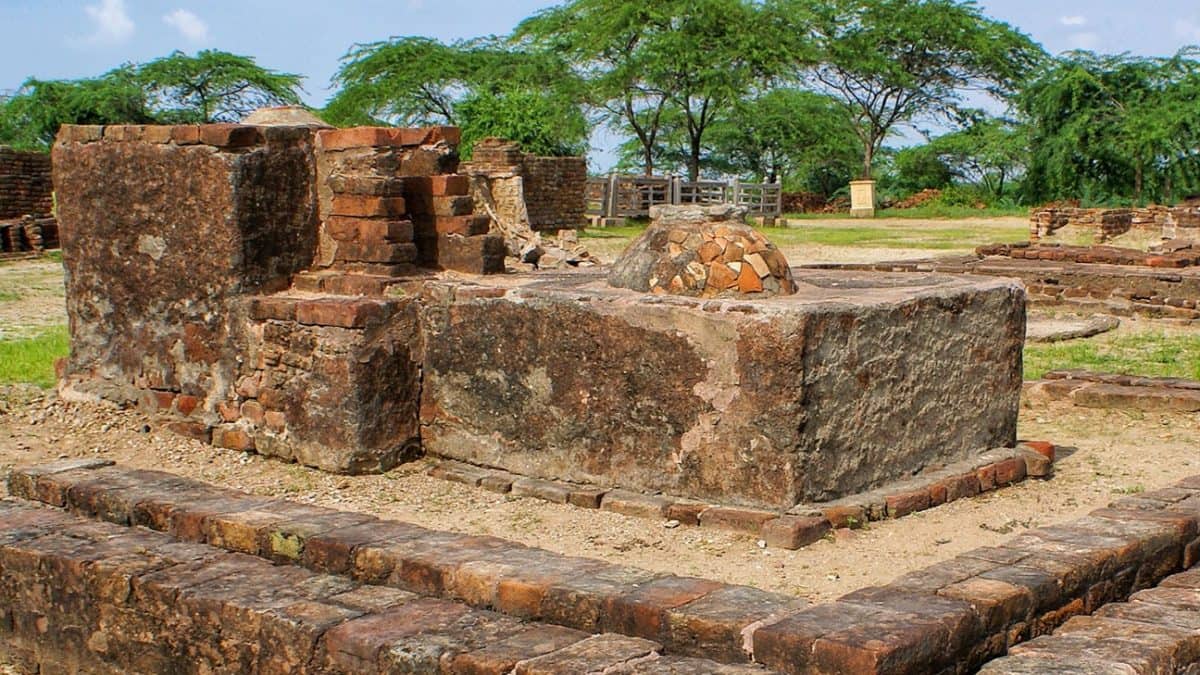
Lothal Dockyard, Jajati K. Pattnaik on his field visit to Lothal, 13 August 2026.
Lothal was an emporium and a critical artery of connectivity and trade, interconnected with the distant economies of the ancient world. Archaeological excavations indicate Lothal's trade interactions with the Dilmun, Mesopotamian and Magan civilisations of the ancient Orient. The material evidence, such as artefacts, seals, ivory, animal and human figurines, shells, bronze and copper objects, and other items found at the excavation sites, establishes Lothal's trade outreach to India's civilisational neighbours. The city circling the dockyard was a manufacturing hub. The most sought-after export items from Lothal were beads, valuable gems, carnelian ornaments, cotton, textiles, and ivory. Evidence of a robust logistics network is the discovery of a complex warehouse structure built on a high platform to protect cargo from flood damage. The prosperity of this Harappan town depended on the overseas trade, especially with West Asia. Trade contacts with West Asia are evidenced by material remains, such as Persian Gulf-origin articles, terracotta figurines of the Gorilla, and mummies discovered at the Lothal excavation sites. The Lothal township, civic organisation, infrastructural distribution, acropolis, drainage, water facility, brick-walled streets, residential complexes, etc., are extraordinary examples of early urbanisation.
More from Opinion
More from Opinion
Acropolis, Jajati K Pattnaik on his field visit to Lothal, 13 August 2026.
Lothal was a centre of urban development, maritime trade and commercial prosperity. Lothal's maritime trade network was also connected to ancient Sumer through the Arabian Sea and the Persian Gulf. It exported carnelian beads, spices, ivory items, cotton cloth, timber, etc. In return, it imported metals, wool, and other raw materials. Sumerian clay tablets depict trade contacts with 'Meluhha' which historians identify with the Indus region. Excavations in Lothal have uncovered circular button seals from the Persian Gulf, indicating trade links with Bahrain and Sumer. Sumerian merchants used to collect Indian goods from Dilmun Port (present-day Bahrain).
Bead Factory, Jajati K Pattnaik on his field visit to Lothal, 13 August 2026.
Lothal's maritime network with Dilmun (modern-day Al-Hasa Province in Eastern Saudi Arabia, Bahrain, Qatar, and Failaka Island in Kuwait in the Persian Gulf) and its trade contacts were established by archaeological finds and other verifiable material evidence. A circular, stamped Persian Gulf seal found at Lothal provides material evidence of possible trade contacts between Lothal and Dilmun. Other artefacts, including beads, bangles, and seals, found in Dilmun indicate the existence of longstanding trade links. Therefore, Lothal acted as a vital link between Harappa and the Persian Gulf and Mesopotamia. Dilmun served as an intermediary, facilitating the flow of imported items such as carnelian beads, etched stones, and ivory between the Indus Valley and West Asian markets.
Advertisement
Lower Town, Jajati K Pattnaik on his field visit to Lothal, 13 August 2026.
Lothal's Bronze Age maritime trade was connected with southern Mesopotamia (modern-day Iraq) via the Persian Gulf network. Mesopotamian cuneiform records from the Akkadian and Ur III periods illustrate trade with "Meluhha". Indus seals have been unearthed from the Mesopotamian sites such as Ur and Susa. Mesopotamian metals and goods were in demand in Harappa and were imported through the Lothal transit ecosystem. Lothal also had trade interactions with Magan (modern-day Oman and the United Arab Emirates). Merchants travelled between Lothal and Magan through the sea route. A Mesopotamian inscription from the time of Sargon the Great (2270-2215 BCE) refers to docking of ships from Meluhha, indicating trade between Lothal and Magan. Excavations in the Oman Peninsula have disclosed Harappan artefacts, pottery and weights. Copper, copperware, and artefacts from Magan were in demand in Harappa. Lothal, therefore, offers an early example the extensive maritime trade strategies and globalised marketing of the Indus Valley Civilisation.
Lothal's decline has been partially attributed to the change in the course of the Sabarmati River. Heavy silting of the river channels restricted maritime activity. The diminishing access to water and water channels reduced the dockyard's strategic importance. Its trade prominence was lost. Ecological change and environmental crisis marked the end of a thriving commercial city and trading centre in India's deep antiquity. A combination of factors, such as climate shifts, environmental catastrophes, volatility in the river ecosystem, vulnerability in the coastal behaviour, severe flooding and the collapse of the marine trade network, may have contributed to the decline of Lothal.
Advertisement
Tidal floods might have eroded the protective mud-brick walls. Tropical storms could have damaged the dockyard, warehouses, and other vital infrastructure. Siltation, tectonic activity and natural forces could have impeded the course of the Sabarmati River. The blockage of the river's inlet channels to the city might have made the passage for incoming ships difficult. A rapid fall in sea levels along the southwestern Gujarat coast may also have severely affected the dockyard coast ecosystem and the harmony and connectivity between the coast and the hinterland. The retreat of the sea may have disrupted Lothal's trading network and impeded vessels' passage. Lothal's supply chain ecosystem might have collapsed due to environmental concerns, leading to the loss of export-import, global market and economic activity. As the dockyard dried up, the city's economic purpose was lost. People abandoned the port city. Agriculture also became impossible due to the alternation in the climatic conditions.
(Jajati K Pattnaik is a Professor and Chairperson at the Centre for West Asian Studies, School of International Studies, Jawaharlal Nehru University, New Delhi. Chandan Panda is a Professor at the Central University of Karnataka, Karnataka. Views expressed in the above piece are personal and solely those of the authors. They do not necessarily reflect Firstpost's views.)
Related Opinion
A note on cookies
Newshunt uses essential cookies to keep you signed in and to remember your language and country, so the site works the way you expect. With your permission, we'd also like to use analytics cookies to understand how people use Newshunt and improve it over time.
Accepting only affects analytics. To learn more, view our Privacy Policy or Terms & Conditions.
(0)Comments