


Ian Pattison
‘Buy Canada' is on track with Via. National railway's biggest-ever order will roll off Alstom Thunder Bay's line

By Ian Pattison
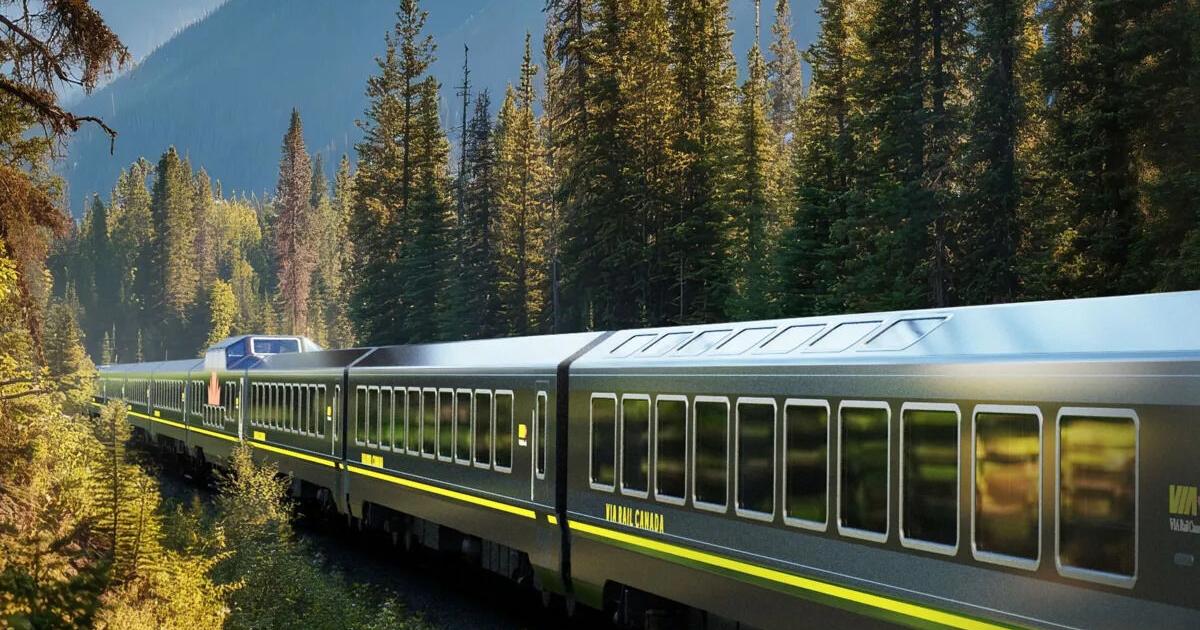
HERE'S a test. How many Thunder Bay politicians have gone to bat for the Alstom (nee Bombardier, nee Can Car) rail plant to keep it in business? Over 50-plus years in this business I can't remember all the names either but all those sustained efforts to get contracts to maintain a workforce with the expertise to build some of the finest rail cars in the world paid off. No more so than now with the largest contract in the history of Via Rail to build 313 state-of-the art cars at Alstom Thunder Bay, and rebuild a national railway worthy of the name.
Marcus Powlowski, the Liberal MP for the riding where the plant resides, is just the latest to lobby his own government on behalf of the company and its hundreds of its workers to keep Alstom top of mind as clean rail transportation enjoys a renewal in the era of climate change.
Speaking at the Alstom plant with Prime Minister Mark Carney during Thursday's announcement, Powlowski recalled that one of his first meetings on his first day on the job in 2019 was with Dominic Pasqualino, former head of the plant union, urging federal attention to the historic plant's survival against competition, much of it foreign.
Enter Carney with his signature priority to have Canada look inward to build itself out to the world. Thus, the government will spend $4.7 billion to replace the familiar stainless steel cars of The Canadian — average age 77 years — with a new generation of passenger rail cars.
The new trains will still feature sleepers, dining cars (fine china, heavy cloth napkins and white-coated waiters please) and the iconic dome cars — 25 of them — while improving reliability in bad weather (recall news stories of stuck trains stranding cold, angry passengers for days in snow storms).
Sustainability will be built in with energy-efficient lighting, automatic climate-control systems and onboard facilities supporting waste sorting and recycling. Technical specifications require that at least 90 per cent of the cars' materials are recoverable at the end of their useful life.
Together with a separate order for 45 hybrid battery-diesel locomotives at a Swiss firm's Canadian plant, the trains will be used by Via outside the Québec City-Windsor corridor (subject of a controversial high-speed train plan) for its eight long-distance, regional and remote services including through Northwestern Ontario.
MENTION of the northern transcontinental line prompted the event's first media question, from this newspaper, that drew laughter from Carney and perhaps nervous laughter from Mathieu Paquette, interim president and chief executive officer of Via Rail Canada.
Given this renewed federal attention to passenger rail travel, will the federal government work to have The Canadian returned to the southern line through Thunder Bay?
Via Rail passenger service here ended on Jan. 15, 1990 when the Conservative government of Brian Mulroney and Via slashed the national passenger rail network by 50 per cent to reduce operating subsidies. The train was permanently rerouted away from the southern Canadian Pacific route along Lake Superior through Thunder Bay to the more northern CN line.
Another raft of local politicians has tried in vain over the years to get Ottawa to restore passenger rail service to Thunder Bay, including former MP Iain Angus who actually twice sued the government to oppose the cuts to Via.
In a post following Thursday's announcement Angus recalled how cabinet declared that 11 communities that were captive to rail (no roads or air service) should retain rail passenger service. 'The majority of these were on the CN line and that is why the transcontinental was on the northern CN line,' he wrote.
One wonders how many people in these tiny communities use the train and whether they could instead be served by Budd cars, self-propelled three-car diesel units like the one that Via uses between Sudbury and White River. Would this not be a more sustainable option leaving the Canadian to return to the iconic scenery of Lake Superior's North Shore. If Canadian Pacific hadn't demolished its Port Arthur passenger station, perhaps the case for a train through Thunder Bay would be even stronger.
So, what about it, prime minister?
'Well, we just happen to have the CEO of Via here.'
Up stepped Paquette to the microphone with a nervous laugh to not answer the question. Here, in full, is what he did say, for what it's worth: 'This announcement today with those new equipments will give us more possibilities. So we're always exploring new routes and how we can connect more Canadians.
'It's probably a bit too soon to tell you if one day we are going to be connecting Thunder Bay but we're definitely looking at adding services and connecting more Canadians.'
For his part Carney said, 'What I will say is that for this government it's a priority, yes.'
So there's that and that's encouraging.
ALMOST LOST in the lengthy announcement was one from Michael Keroullé, president of Alstom's Americas Region, who said the company will spend $37 million to provide upgrades and renovations to the Thunder Bay facility, a fact that drew surprised cheers from plant workers assembled for the event.
Another detail perhaps pointed to past problems at the plant when it was run by Bombardier. While the new cars will be assembled in Thunder Bay, the steel components will be built at Alstom's La Pocatière, Que. plant, with design and engineering work taking place in Saint-Bruno-de-Montarville, Que.
A Bombardier contract in 2009 to build Flexity Outlook streetcars for the Toronto Transit Commission was bedevilled by lengthy delays in acquiring components. The Thunder Bay plant was responsible for the final assembly of the streetcars, but it relied on a global network of suppliers. The primary point of failure was Bombardier's manufacturing facility in Ciudad Sahagún, Mexico.
Parts arriving from Mexico, such as the massive metal under-frames, frequently suffered from poor quality control. Laminates failed to adhere, holes for bolts did not align, and components simply did not fit together properly.
Workers in Thunder Bay had to spend significant time diagnosing defects, tearing down shipments, and completely redoing weld and wiring work from scratch, putting the job well behind schedule.
With the plant's reliability in question, so was the chance of acquiring new contracts. Rounds of layoffs between contracts have always been an issue but this new contract cements the Thunder Bay plant among the wider world's best rail car suppliers.
As Keroullé noted, 'What makes us proud is that these 313 cars will be entirely and fully engineered, designed, manufactured, commissioned and tested here in Canada. And we can proudly say that they are made by Canadians for Canadians.'
THE MOST important part — an example of Carney's and Canadians' surging pride in the face of American impertinence and efforts to undermine us — is that, as Keroullé said, 'For generations rail has connected Canadians from coast to coast, and today we have the privilege of writing the next chapter of rail history here at home.
'Today is a powerful example of what Buy Canada stands for — a nation-building once-in-a-generation investment that will not only transform the way Canadians travel, but also strengthen our economy for years to come.' That comes in the form of 700 good preserved and new jobs in Thunder Bay and Québec, and more than $1.6 billion in economic benefits.
Take that, Trump.
FURTHER to that initial press conference question, someone called patsyd on Threads posted a series of observations admiring Carney's straightforward, bold approach to the issues facing his government during questions from the media.
'But perhaps my favourite part of the Q&A was the local press. Their questions felt genuinely curious and rooted in their community . . . Not soft questions. Inquiring questions. There's a difference.
'And then one local reporter from The Chronicle-Journal did something we don't hear very often.'
'First of all I'd like to say thank you for all your hard work and your intelligent approach to everything that's been happening,' said Sandi Krasowski.
Carney looked just a tad surprised and quickly smiled broadly to say 'thank you' before taking that natural first question of the day concerning Via Rail's long absence from Thunder Bay.
Scott Sumner from Thunder Bay Business wanted to know, in the face of 'a lot of negativity and hostility that emanates from the U.S., how are you personally dealing with it and your team? How do you cope with that?'
'Well,' declared Carney, 'thank you. Thank you for caring. The good people of Thunder Bay.'
He went on at some length to explain that 'We have the support of Canadians. We have the positive attitude of Canadians. It is a country that takes care of each other.'
Eventually, he got around to saying, simply, 'So in the end, I'm doing fine, just fine, thank you.'
It was a charming few moments that contrasted with the sharpness of most media scrums.
Then it was the national media's turn and Carney couldn't resist a bit of a jab as a Canadian Press reporter stepped up to the mic.
'Okay now here's the Ottawa Press gallery going to bring it right down. It's so different,' he laughed before taking a broad series of questions on the challenges he and his government are facing – tariff talks, Lutnick, Bessent, Putin at the G 20. Back to business, in other words, but not before an engaging interlude with local press getting to cover the biggest Canadian news of the day in ways that broke tradition quite nicely.
The entire 50-minute press conference is available via CPAC or CBC News. It's worth watching.
PS: It was nice to see photos of Carney with Bryan Adams — in town for Auditorium concerts (where he sang about never being the 51st state to uproarious applause) — scarfing down Persians at the Persian Man on Central, and posing at the Terry Fox Memorial on the highway — an enduring symbol of Canadian determination to succeed.
Ian Pattison is retired as editorial page editor of The Chronicle-Journal, but still shares his thoughts on current affairs. You can email him at iPatPoint29@gmail.com.
Related Opinion
A note on cookies
Newshunt uses essential cookies to keep you signed in and to remember your language and country, so the site works the way you expect. With your permission, we'd also like to use analytics cookies to understand how people use Newshunt and improve it over time.
Accepting only affects analytics. To learn more, view our Privacy Policy or Terms & Conditions.
(0)Comments