


SUSAN HAZLETT
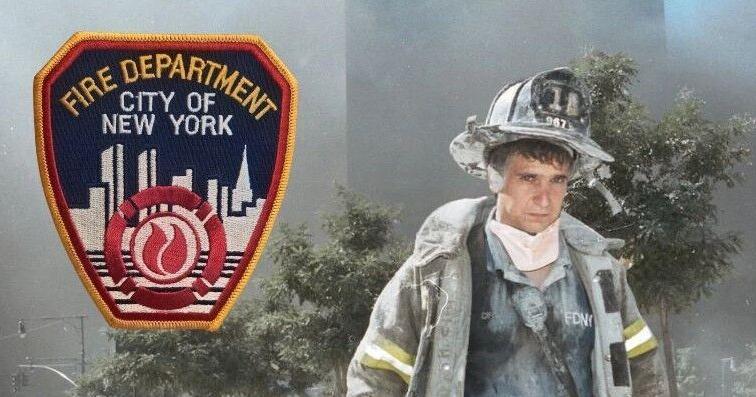
For Hazlett, FDNY patch precious relic of 9/11 pain, heroism

Not long after Sept. 11, 2001, I was in New York City for a business meeting, and I felt compelled to pay my respects at Ground Zero. A brief encounter with a firefighter became an unexpected yet powerful moment of shared grief. I wrote about it here in The Pantagraph.
I stood near Ground Zero and thought it was more horrifying than I ever could have imagined. Where two towers once stood, there was only a vast, open wound in the earth. What little remained of the mangled steel beams was still massive, and I could hear the crashing of twisted, falling metal.
Hundreds of people lined up at the perimeter fence to watch rescue efforts, mesmerized by the scene. Despite the noise and chaos, the site was sacred; a burial ground for the thousands that died in the attacks.
Standing next to me was a stoic-faced woman and her son, who looked to be about 14. The teenager was crying; they had lost a loved one here. Their grief was profound, and I felt like an intruder standing so close during an intensely private moment.
I turned away in my own sorrow and headed down a side street. Hundreds of posters were tacked to a chain link fence, many featuring smiling faces. But the messages were gut-wrenching.
"Looking for my best friend. Have you seen him?"
"Father and husband missing. Last seen on 84th floor."
"We are desperately searching for our daughter."
A bagpipe began to play, and its mournful strains brought the pain in my heart right up to my eyes. Crying, I walked to nearby St. Paul's Chapel, which was set up as a shelter for rescue workers. Sitting near the entrance was a firefighter, looking exhausted and heartbroken. His shoulders were slumped and his face was drawn, as if the weight of it all had settled into his bones.
The sidewalk was crowded, and I walked in pace with the masses. At that moment, the firefighter looked up and we locked eyes. In a silent exchange, shared grief passed between us.
I mouthed two small words, "Thank you."
What I wanted to say was, "Thank you for being a firefighter. Thank you for going into this hell every day to recover the dead. Thank you for not giving up. Thank you for being a hero."
But the crowd kept moving and I passed on. I could not deliver my full message of gratitude, but I knew he knew.
I never imagined the column I wrote that day would travel from Central Illinois to New York City. But five months later, Don Ford, retired Pontiac fire chief, stood at the door of my home.
Don and I knew each other from my early days as a reporter covering local news.
He was holding a plastic bag containing an embroidered shoulder patch, the kind a firefighter wears on their uniform sleeve to identify their department. The patch read, "Fire Department, City of New York," and featured the Twin Towers.
"I've been at Ground Zero and shared your article with some of the teams working there," he said, handing me the precious package.
"They want you to have this."
I was stunned and humbled to my core."Come in," I said. "Tell me what you've seen."
The 33-year fire services veteran had just completed his fourth "tour" as a volunteer at the disaster site. Back in September, he and two other members of Pontiac Fire Department had traveled to New York City to deliver donations.
The Pontiac team arrived at a fire station that had lost 11 men at the Twin Towers, and then they learned they were needed that day for a special assignment: To serve on the mutual aid funeral detail.
Firefighter funeral traditions are rich in history and deeply symbolic to honor a fallen member's dedication and sacrifice. But following 9/11 there were so many funerals, and so few available firefighters, a nationwide call was issued to report for services.
"It was our honor," Don said.
On Sept. 11, 2001, 343 firefighters were killed at the World Trade Center. It remains the largest loss of life for any single emergency response agency in American history. Out-of-state firefighters covered shifts or attended all "line of duty death" funerals.
After a second trip to New York City, Don felt compelled to contribute more. In early December 2001, he parked his car and walked to Ground Zero. At the first checkpoint, he told his story to security officers there.
"I want to do something," he explained. "I want to tell my crew back home what I saw."
Twenty minutes later, Don was standing at the very center of the 16-acre disaster site.
"I was taken aback by the scale of it. No television screen can capture the destruction. I was amazed at the total and complete devastation."
He could not recognize anything. Not buildings, vehicles or office equipment. Fires were still burning.
"I'll never forget the smell ... a combination of jet fuel, concrete dust and death."
Members of the Salvation Army escorted Don to a 35,000-square-foot tent where more than 9,000 daily meals were served around the clock. The first few days, he washed dishes and emptied garbage cans, but supervisors quickly realized the former fire chief would be more useful providing support to recovery teams.
"Some wanted to talk, others didn't," he said. Many firefighters wanted to relay every detail of their experience from the moment the alarm was called.
"Almost every one, to a person, feels guilty they are still alive."
During his fourth tour, Don experienced the recovery of bodies. He was working the midnight shift in the "hot zone" when, a few yards away, two bodies were discovered. He alerted the recovery team and located a chaplain.
"All machinery was shut off, all work was halted, and two U.S. flags were draped over the bodies. Everyone lined up and saluted."
The remains, he said, were treated with the utmost dignity and respect. He thought of the families who would receive the news that morning that their loved ones had finally been found.
"Our country has come through this ordeal," he told me. "I am proud of the fire service and support efforts. I'm proud to be an American."
The NYC firefighter patch sits in place of honor at my house. It's just a small piece of cloth, but it carries the weight of enormous sacrifice. Twenty-five years later, I humbly reflect on the bravery of those who died as well as the heroic efforts of the recovery teams. Their courage changed me, and I suspect it changed everyone.
God bless them all.
Hazlett
Contact Susan Hazlett at susanrhazlett@yahoo.com or write to her in care of The Pantagraph, 205 N. Main St., Bloomington, IL 61702-2907.
Get opinion pieces, letters and editorials sent directly to your inbox weekly!
Related Opinion
A note on cookies
Newshunt uses essential cookies to keep you signed in and to remember your language and country, so the site works the way you expect. With your permission, we'd also like to use analytics cookies to understand how people use Newshunt and improve it over time.
Accepting only affects analytics. To learn more, view our Privacy Policy or Terms & Conditions.
(0)Comments