


The Blade Editorial Board
Editorial: Labor at inflection

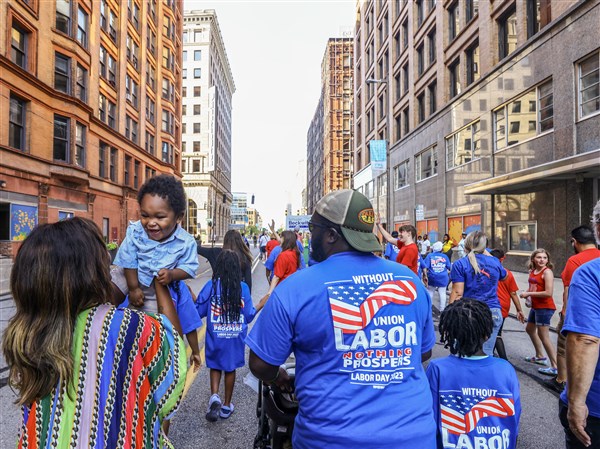
The history of the labor movement in America is one that justly is celebrated with a holiday on the first Monday of September every year.
Workers, backed up by Congress' support through the National Labor Relations Act, have fought for generations now for the right to organize in the work place and to have their negotiations and contracts upheld by law.
Read more Blade editorials
Advertisement
It's a relationship that often is marked by both collaboration and a certain amount of friction. Friendly ties are knotted through the mutual benefit of sharing in profitable business arrangements, or in the case of government, taxpayer support through levy votes, and supportive politicians.
Sometimes, though, the relationship breaks.
When that happens, both union leadership and management must be willing to review whether the business can support the hoped for labor contract.
Labor's overall share of the national labor market is on the decline, which raises the question whether the labor model has kept up with the times.
Advertisement
According to the Bureau of Labor Statistics, about 10 percent of workers in 2025 were represented by a union, compared with 20.1 percent in 1983, the first year for which numbers are available. In 2025, 14.7 million people belonged to unions. In 1983, that number was 17.7 million.
Interestingly, labor representation of government employees has increased while it has receded among private employers.
Among workers in public employment, 32.9 percent are represented by a union at the bargaining table compared with 5.9 percent in private employment.
It cannot be a coincidence that labor's biggest participation is in the arena where it holds the most sway over decisionmakers, through campaign contributions and endorsements.
Here in metro Toledo, 41.2 percent of public employees are covered by union contracts, while only 10.4 percent of nonpublic employees are covered by union contracts. Public employment accounts for 13,000 union jobs, while private employment accounts for 26,000 union jobs, according to a 2025 report by the Regional Growth Partnership.
The decline of private sector unions suggests the model of union representation hasn't kept pace with developments in private enterprise and the need for competitiveness. Yet unions are overtaking employment in the public sector where political power is more determinative than success in the marketplace.
Related Opinion
A note on cookies
Newshunt uses essential cookies to keep you signed in and to remember your language and country, so the site works the way you expect. With your permission, we'd also like to use analytics cookies to understand how people use Newshunt and improve it over time.
Accepting only affects analytics. To learn more, view our Privacy Policy or Terms & Conditions.
(0)Comments