


unknown
AI Companions Are Not Replacing Human Relationships — They're Revealing How Lonely We Already Were

The anxiety is understandable. But it may be aimed at the wrong target.
AI companions did not create a society in which millions of people feel lonely. They arrived in one.
People were already spending evenings alone, eating alone, working remotely, moving away from families, losing touch with friends and struggling to build relationships in cities that can be crowded without being connected. Dating apps turned intimacy into an endless catalogue of profiles. Social media gave people thousands of digital contacts while often leaving them without anyone to call at midnight.
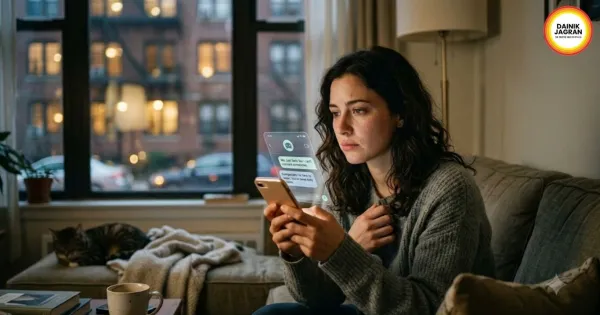
Then AI arrived and offered something remarkably simple: attention.
It responds. It remembers details within a conversation. It does not roll its eyes when someone repeats the same problem for the fifth time. It is available at 2 a.m. It does not demand that a person be interesting, attractive, successful or emotionally convenient before offering a conversation.
That should make us uncomfortable—not necessarily because the machine is winning, but because the comparison exposes what human relationships have sometimes stopped providing.
The uncomfortable advantage of an AI companion
Human relationships are complicated because human beings are complicated.
Friends get busy. Partners disagree. Families carry history. Colleagues have their own problems. Meeting someone requires time, effort and vulnerability. Maintaining a relationship requires even more of all three.
An AI companion removes much of that friction.
That does not make it equivalent to a human relationship. It makes it easier.
And that distinction matters.
A chatbot cannot genuinely share a life with someone. It cannot sit beside a hospital bed, help move into a new home, raise a child, remember the smell of a childhood kitchen or experience grief as another human being does.
But the fact that AI cannot replace those experiences does not mean people will not use it to fill smaller gaps.
Someone who has nobody to talk to may not be choosing an AI over a close friend. They may be choosing an AI over silence.
That is a very different story.
Loneliness existed before the chatbot
The modern loneliness crisis has many causes: changing family structures, migration, urbanisation, demanding work cultures, economic insecurity, declining participation in community institutions and the weakening of neighbourhood and social ties.
Technology has played a role, certainly. But it did not invent loneliness.
In many cases, technology simply made isolation easier to conceal.
A person can have hundreds of followers and still have nobody who knows they are having a terrible day.
They can participate in group chats all afternoon and still spend the evening alone.
They can post photographs from parties while privately feeling disconnected from everyone in the room.
AI companions are now making that contradiction harder to ignore.
The real danger is not friendship with machines
There are legitimate concerns about AI companions.
Companies can design systems to maximise engagement. Users may become emotionally dependent. Vulnerable people could be manipulated by poorly designed products. Children require particular protection. Privacy becomes especially sensitive when people reveal intimate details to an artificial system.
These are serious issues.
But declaring every emotional connection with an AI inherently unhealthy is too simplistic.
The more useful question is whether the technology is supplementing a person's social life or replacing it.
There is a meaningful difference between someone using an AI to practise a difficult conversation before talking to their partner and someone gradually abandoning every human relationship because the machine is easier.
The technology is the same. The outcome is not.
Convenience can become a trap
The greatest strength of AI companionship is also its greatest weakness.
Human relationships require negotiation. AI generally does not.
A machine can be endlessly patient because it does not have a bad day. It can adapt to the user's preferences because that is what it was built to do. It can provide affirmation without demanding much in return.
Real people cannot compete with that—and they should not have to.
If people become accustomed to relationships in which disagreement disappears, rejection is impossible and attention is always available, ordinary human interaction may begin to feel unnecessarily difficult.
That would be a genuine social problem.
But the solution is not to shame people for talking to machines. It is to make human connection worth choosing.
Perhaps the machine is asking us a question
The most revealing thing about AI companions may not be what they say to us.
It may be what their popularity says about us.
If millions of people find extraordinary comfort in a system that is available on demand, perhaps the central question is not, 'How do we stop people from loving machines?'
Perhaps it is, 'Why were so many people desperate for someone—or something—to listen in the first place?'
That question leads somewhere more uncomfortable.
It points toward workplaces that leave little time for community, cities where neighbours barely know one another, families separated by geography, relationships weakened by constant digital distraction and social environments where admitting loneliness can feel like admitting failure.
AI companions did not create that world.
They found a market for it.
We should fix the loneliness, not merely ban the mirror
The answer is neither blind enthusiasm for AI companionship nor panic about technological replacement.
We should regulate manipulative design, protect sensitive personal data, establish stronger safeguards for children and ensure companies cannot exploit emotional dependence simply because it is profitable.
But alongside that, we need something less technological: more opportunities for people to meet each other.
More community spaces. Better work-life boundaries. Stronger local institutions. Accessible social activities. More attention to elderly people living alone. More acceptance of friendships that do not revolve around productivity or status.
Because the ultimate test of AI companionship should not be whether it can imitate a human being perfectly.
It should be whether society remains capable of giving people reasons to seek one another out.
AI may eventually become extraordinarily good at sounding like a friend.
But perhaps its greatest contribution right now is more basic.
It is showing us just how many people were waiting for one.
Related Opinion
A note on cookies
Newshunt uses essential cookies to keep you signed in and to remember your language and country, so the site works the way you expect. With your permission, we'd also like to use analytics cookies to understand how people use Newshunt and improve it over time.
Accepting only affects analytics. To learn more, view our Privacy Policy or Terms & Conditions.
(0)Comments