


epimetheus
Aluminium in Tap Water, Expert™ Opinions, and Public Health™ Gaslighting

A not-so-brief update on what happened earlier this year in a small town in my neck of the woods, which is the perfect example of how rotten governance, public health™, and legacy media are. In Norway, of all places, which, for reasons honestly unknown to your humble correspondent,is ranked second in the UN's 'Human Development Index'.
Since 2011, it turned out, in a small town by the name of Høyanger, tap water was known to be contaminated with excessive levels of aluminium; the mayor in office since then knew about this (officially) since 2021 (and unofficially from the get-go). He didn't lift a finger until, in mid-June 2026, a resident mother had the tap water tested by a private company.
Then things moved quickly: in mid-June, a ban on drinking water was introduced; the Institute of Public Health, on 19 June, issued an 'assessment', long since 'revised' on 24 June, noting this:
Newborns, infants and young children are the age groups where the exceedance of the safe content of aluminium in drinking water is greatest, and these are the age groups that are also most sensitive to the negative health effects of aluminium. Here,average measurements of aluminium from the waterworks exceed the limit value for safe content by 4-18 times, while maximum measurements exceed the limit value for safe content by 6.5-28 times. An increased risk of this magnitude is not considered safe for these age groups, especially infants.
Thatoriginal assessment has been removedand replaced with 'a more precise version', which we'll look at below.
For reasons unknown to your humble correspondent, aluminium is apparently baaaaaaad™ in drinking water, but it is totally safe and effective™ as adjuvant in virtually all the poison/death juices. True story, sayeth public health officialdom:
We must go down this rabbit hole once more today, though, for last week, there was something happening in this case: while an emergency meeting (for political agit-prop purposes) was convened on 27 June, nothing came of it. I haven't bothered to report it at the time, mainly because of this core passage, found inNRK's follow-up rah-porting™ (source;archived):
Repentant is someone who acknowledges his sin and is willing to do penance.
It is a word that is hardly used anymore, but that does not disappear for that reason.
Even if no one uses it, it hangs and trembles, like an unspoken, cultural expectation: forgiveness awaits—for the one who makes amends.
This is the ABC of politics, and mayor Petter Sortland has good training: 'I'm ashamed', he says, adding, 'I throw myself at your feet.'
Needless to say, Mr. Sortland (Labour Party) has not offered his resignation, hence he is still in office.
[the Institute of Public Health (IPH)] have sincerevisedtheir own risk assessment.
'Thereis no great cause for concernfor the population', says IPH researcher Trine Husøy from the scene.
Thevalues arewithinthe safety margins, and there are higher occurrences of aluminium in the food we eat anyway[Italics in the original; aren't you re-assured by public health officialdom yet?].
Themunicipal doctor then takes the floor and warns that it is no longer necessary to examine the youngest children[that was offered in the heat of the moment days earlier, but I'm quite sure someone had second thoughts about, you know, studying a well-known case study across demographics and socio-economic indicators looking for developmental implications of aluminium consumption by children (perhaps even connecting these findings with autism, if you can believe it)]. The danger is apparently gone.
'It isnot appropriate to regularly follow up children. It is impossible to say exactly what symptom we should look for', she explains [trust the Science™, folks].
Among the parents in the room, heads are being shaken.
Is the water suddenly harmless?
Or is it the central government that cleans itself?
Among those who stand up is Kjersti Haugen: 'What is happening now with the children? What kind of symptoms should one look for?' […]
After the meeting, Mayor Petter Sortland is a little less penitent, and a little more out to take on the Norwegian Institute of Public Health:
'They have raised the anxiety levels', he says, adding: 'They have created fear, anger, unrest, and frustration among the residents, and have seen the municipality in a very bad light.' [never mind the fact that Mr. Sortland knew about these problems since he got into office in 2011, but he's blaming the IPH].
He adds that themunicipal psychologist can accept parents who are worriedabout their children [see: if you're a parent and concerned that your child was poisoned by 15-plus years of covering up, you're ready to depart for cuckoo land]
Trine Husøy from the Institute of Public Health: 'We take that criticism to heart, and will look into it afterwards. This makes communication a very complex area.' [nah, it ain't 'complex'; you fellas fucked up and you're using weasel words to keep your plush jobs and comfy lives]
'It is not certain that there is a health hazard for an individual. But this varies from one individual to the next, and that is why we have a margin of safety.'
[NRK] What danger is there to children in Kyrkjebø now?
[Trine Husøy] 'To know for sure, we would have to study a certain number of the population over time, and there are too few people in Kyrkjebø to do that.'
I'll stop here, for you get the gist.
All translations,emphases, and [snark] mine. If you read this and get pissed off, too, well, join me in venting.
Subscribe now
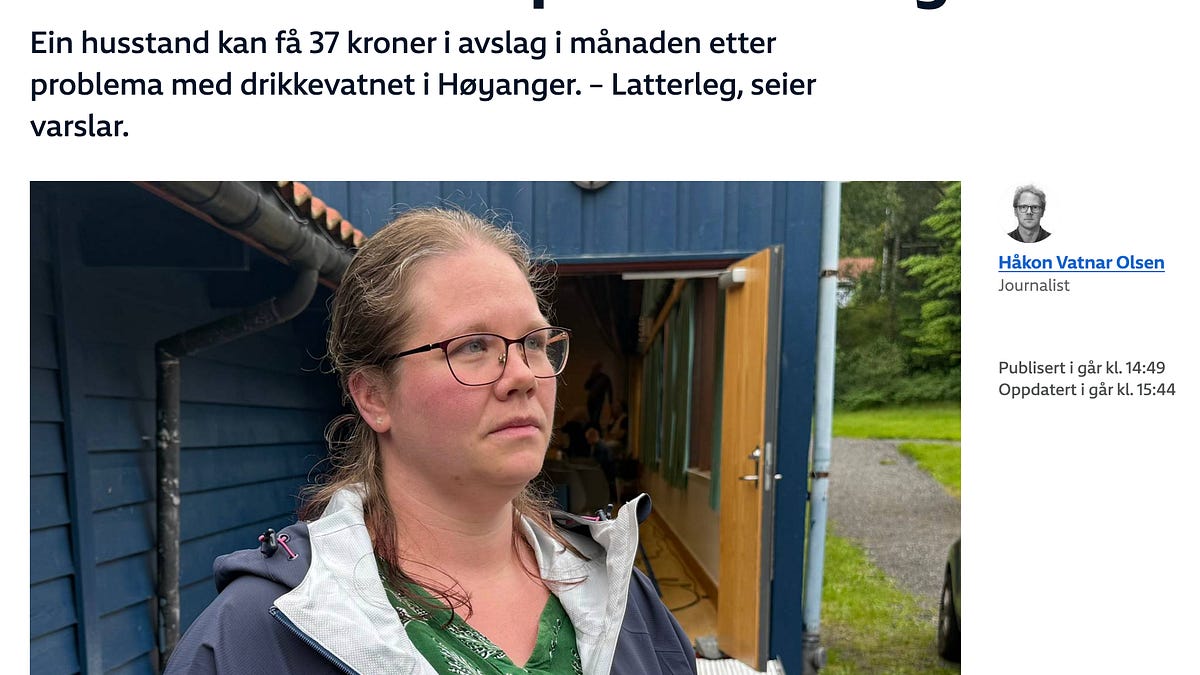
A household can get 37 Norwegian crowns [that would be about US$ 3.99 as of 4 Sept. 2026] in rebates a month after problems with the drinking water in Høyanger. 'Ridiculous', says the woman who publicised the issue
By Håkon Vatnar Olsen, NRK, 2 Sept. 2026 [source;archived]
For at least 15 years, the drinking water at Kyrkjebø in Høyanger has had too much aluminium in it.
In June, the news hit like a bomb [only to those who didn't know about the contamination since 2011 and didn't lift a finger, such as Mayor Petter Sortland].A drinking ban was immediately introducedin the village in the Sognefjord [fun factoid: as of 4 Sept.,via the municipality's website, the ban on drinking tap water is still in place, but the Institute of Public Health (sic) notified the residents on 1 July that the contaminated tap water 'can be used for cooking'. This is, obviously, an ill-informed advice™ that reeks of stupidity or evil, for cooking food with contaminated water merely transfers the (in this case) aluminium into the food while, if one simmers food in water (that evaporates over time), the amount of aluminium will merely concentrate in less water);see this website].
Now comes theproposal from the municipality for compensationto the residents:
NOK 37 a month [that would be US$ 3.99 rebate per month for the water bill].
'Such a price reduction is like a band-aid on the gushing wound', says Siv Helen Lillehauge Bjørsvik, who went public with the water quality issues in mid-June 2025.
Firdafirstwrote about the case[paywalled].
The proposal corresponds to a price reduction of 7.14 per cent on the water bill, which is normally NOK 6,174 a year [or some 514.50 Norwegian crowns a month].
The discount of NOK 37 is the municipality's example of a normal household, before VAT [ah, value-added tax is still slapped on the utility bill, though the drinking water™ must not be drunk: make it make sense, Norway]. This applies to 309 residents connected to Kyrkjebø waterworks [who, by the way, have no alternative water source].
The discount only applies to the time of the drinking ban, not to the many years with too much aluminium in the water[let's do some evil whitey stuff (math) here: the drinking water ban has been instituted on 1 July 2026, hence, the municipality's bill is now 309 residents x 37 crowns = 11,433 Norwegian crowns per month (times two > July, August); just imagine, for a moment, the amount of compensation if, speaking hypothetically, 'someone', perhaps a court, orders the municipality to fork over these amounts for the entirety of these 15+ years (that's an amount north of 2m Norwegian crowns), and, if appropriate tort packages would be forthcoming, too: the municipality would be bankrupt long before that, with the mayor's reputation (sic) in shambles, perhaps he would have been chased out of town; none of this is happening, and for whatever reason (sic), nothing like this looks like to be happening].
'The amount is ridiculous. They can keep these trinkets', says whistleblower Lillehauge Bjørsvik.
Many in the village are angryabout the proposal, according to her.
All summer residents have been filling cans with water from another water source. The proposal from the municipality does not even apply to a few decent water cans', Lillehauge Bjørsvik underlines [in neighbouring Høyanger, the local 'Extra' grocery storecurrently sells bottled soda (1.5l) for 10-18 crownseach; I'm unsure about prices for drinking water, but the point she makes is obvious].
'We are becoming acquainted to this', she says about the weekdays with water in cans.
The proposal for a 7.14 per cent discount is based on the share of water that goes to food and drink [this is yourNew Public Managementat-work].
In June [on the 19th, to be precise, as detailed above], the Norwegian Institute of Public Health said that the [contaminated]drinking water could cause irreversible damage to the nervous system[terms & conditions apply, i.e., aluminium in tap water = baaaaaaaaaaaad™ whereas if found in injectable products, it's totally fine: true story, sayeth the Science™].
Shortly afterwards [on 24 June, as shown above], the tone of seriousness was sharply lowered.There is now no cause for great concern, according to the IPH. It is now okay to use water for cooking[I've mentioned this above, too, so, who else is up for another round of Trust the Science™?].
The ban on drinking the water has nevertheless continued, and it is uncertain when it will be lifted[given that drinking water is shipped into the affected area in plastic containers, my guess is around mid-October at the latest when temperatures are dropping below the point where water freezes].
Financial managerKristian Ølmheim in Høyanger says the proposal addresses the consumer rightsof the residents.
The proposal for a discount has beenisolated to the water bill, not pain and suffering for the residents[because these aspects are, of course, unrelated to consumer rights, which means that someone else will deal with them (or, most likely, not)]. Thus Ølmheim:
We have assessed the case against the Consumer Purchase Act, and based figures from Norsk Vann on total consumption in a household, about how much of that consumption goes to drinking and cooking for food.
We think it is right to give proportionate compensation [while I kinda agree with that notion on a level strictly related to practical solutions, there has been so far not even anything resembling proportionateconsequencesfor anyone, to say nothing about a judicial review].
The municipality has also ensured that there are stations where people can collect water, Ølmheim underlines [as I mentioned above, this means it'll simply peter out due to 'cold temperatures' in a few weeks, is my best guess].
The case is an advice [orig.tilråding] from the municipal director. This means that thepoliticians in the municipality must take a position on the matter, and they can change the decision, if they wish.
The matter will be considered in the municipal council on Thursday [3 Sept.; I've not seen yet any follow-up rah-porting™ or the like (as of 4 Sept.)].
Subscribe now
First up, the revisedpress releaseandassessmentby the Institute of Public Health; from the 'change log' of the former:
Clarifications have been made in the attached assessment and in this news item on 24 June.
The changes include aclarification of the use of termsrelated to the action limit for drinking water, and the health-based tolerance limit.
Furthermore, thetotal exposure is described more preciselyin relation to the health-based tolerance limit.
The group 'newborns' is included in the description for the group 'infants' as they are covered by the calculations for infants.
As regards some particulars from the revised assessment, let's start with the added group 'newborns'; the below screenshot and translation is from the revised assessment:
Effects on the nervous system have also been observed in patientsundergoing dialysis andchronically exposed to high concentrations of aluminium[now, I'm not an expert™, but I suppose 15+ years thereof falls into that category].
The National Institute for Public Health in the Netherlands conducted a risk assessment of aluminium in 2020 (RIVM, 2020). They consider theeffects of aluminium on the development of the nervous system as the critical effect, and used the tolerable limit set by JECFA in their risk assessment. They conclude that there isno risk that the intake of the Dutch population exceeds the tolerable limit for any age group[good for the Dutch, I suppose; not good for the residents of Kyrkjebø (see below)]. Theexception is young children receiving infant formula, which may contain significant amounts of aluminium[but the IPH claims there's no problemo and no way one could study the population of Kyrkjebø because of their relatively small numbers].
And here's from the summary of that revised assessment:
The calculated tolerable content of aluminium in drinking water shows thateven when taking the action limit for aluminium in drinking water of 0.2 mg/L, the intake of aluminium can exceed the tolerance limitif the intake from other foods as calculated by VKM and EFSA …
For aluminium measured in the waterworks at Høyanger-Kjyrkjebø since 2021, the average value is 0.54 mg Al/L and the maximum value is 0.84 mg Al/L. With these values,all age groups are above the tolerable limit for aluminium…
Infants and young children are the age groups where the excess of aluminium content in drinking water is greatest, and these are the age groups that are also most sensitive to the negative health effects of aluminium. The content of aluminium above the action limit measured in Kyrkjebø will give an increased risk that the total intake of aluminium will exceed the tolerable limit for health effects of 2 mg/kg body weight per week.
But, hey, use that water for cooking, as per Høyanger municipality:
Kyrkjebø waterworks—update as of 1 July 2026
According toupdated information fromthe Norwegian Institute of Public Health, the water can be used for cooking. The water from Kyrkjebø waterworks is still prohibited for drinking.
But, hey, we just looked at this 'updated information' from the IPH, and I'll wrap this shit sandwich in a turd-wrap with one final quote from the IPH's expert™, Trine Husøy (as cited in the above-linked revisedpress release):
'Whatwe know from research, primarily from animal experiments, is that high levels of aluminium can have possible effects on the nervous system, such as reduced grip strength and cognitive effects', says Trine Husøy, researcher at the Department of Food Safety in the Norwegian Institute of Public Health.
This would be the same individual (Trine Husøy) and the same institution (the Norwegian Institute of Public Health, that is) who cite, in their above-related (revised) assessment™, the following report from Dutch public health officialdom from 2013. Entitled, 'Human health risk assessment of aluminium', that report bears the number RIVM report 2020-0001 and was authored by F. Affourtit, M.I. Bakker, M.E.J. Pronk; DOI 10.21945/RIVM-2020-0001.
It's English-language synopsis, found on p. 3 (of a total of 122 pages) I reproduce here to drive home one particularly pertinent point:
Since the municipality knew about the contamination since 2011/21 and didn't do a thing, here's the final quote from NRK's follow-up rah-portin™ in late June (aslinked above):
Lawyer Marius R. Gulbranson states that there may be a question of institutional punishment [orig.føretaksstraff, i.e., those parts of the criminal code dealing with legal persons, such as municipalities] in this case as well.
'It is a criminal offence for a water utility owner to sit on information about violations of the drinking water regulations. The breach of the rule is getting worse because so much time has passed', says Gulbranson.
He points to Title 112 of the Constitution, which states that Norwegian citizens have the right to environmental information in order to protect their own health [ouchie].
'The public sector has an extensive duty to protect citizens against environmental damage. If someone intentionally or negligently has been sitting on this information for a long time, punishment may be involved.'
While I'm not holding my breath about this, and I shall add that I welcome all such punishment, I've been here long enough1to understand that whatever fines may or may not transpire eventually, Mayor Sortland will long have since left office and all fines will be paid for by—the residents of the fined municipality.
It's literally turtles all the way down.
I fail to see how such things don't lead to a pitchforks at the ready moment, but then again, politicos™, experts™, and journos™ alike treat events like this as totally normal.
Sure, something™ will happen eventually; having served as mayor for 15+ years, Mr. Sortland will go away eventually (I suppose he's leaving the area); will we see an increased incidence of cognitive problems in a few years? Perhaps, but since them experts™ already said 'no problemo' and 'if there are issues, the sample size is too small anyways', the resolution™ of this kerfuffle is already baked into the (revised) assessment™.
Lastly, we shall note the massive gaslighting by the IPH's resident expert™, Trine Husøy, who held that we know stuff 'from research, primarily from animal experiments' after having based the revised assessment™—which she signed (electronically)—in part on that Dutch gov't report that is as clear as they come.
Hence, we add massive amounts of (potentially criminal) negligence to the laundry list of offences, to say nothing about the despicable disingenuous actions of these experts™—no surprise there, honestly, as these are the same people who shoehorned the populace into taking the Covid poison/death juices—that should be liable to judicial review, too.
I doubt anything will come of this shitshow, hence we're going to see the same shit all over again and again and again.
Thanks for reading Die Fackel 2.0! Subscribe for free to receive new posts and support my work.
In my neck of the woods, because we get our water from the cooperative water works (which we co-own with the other farmers co-owning, cooperatively, the watershed), when there are particularly heavy rainfalls, we get text messages and emails not to use tap water until the all-clear is communicated likewise. Of course, the municipality has long-sought to buy the water works (most likely, I think, to charge utility fees for water usage, which we as co-owners don't pay) and charge monthly fees. Here and there, turd sandwiches and turtles all the way down.
Related Opinion
A note on cookies
Newshunt uses essential cookies to keep you signed in and to remember your language and country, so the site works the way you expect. With your permission, we'd also like to use analytics cookies to understand how people use Newshunt and improve it over time.
Accepting only affects analytics. To learn more, view our Privacy Policy or Terms & Conditions.
(0)Comments