


Special To The Seattle Times
Trump's ideas for changes to childhood vaccines are dangerous

In February 1777, Gen. George Washington mandated the inoculation of all Continental Army troops for smallpox. This intervention is considered by historians to be one of the most important factors in our eventual victory over the British. Since then, every U.S. president has supported immunizations. Republican President Dwight Eisenhower publicly advocated widespread use of the Salk polio vaccine in the mid-1950s. Democratic President John F. Kennedy improved immunization access nationwide by signing the Vaccination Assistance Act of 1962. Republican President George W. Bush volunteered in 2020 to receive a COVID-19 shot to encourage public confidence. For over two centuries, immunizations have been a nonpartisan issue.
Until President Donald Trump.
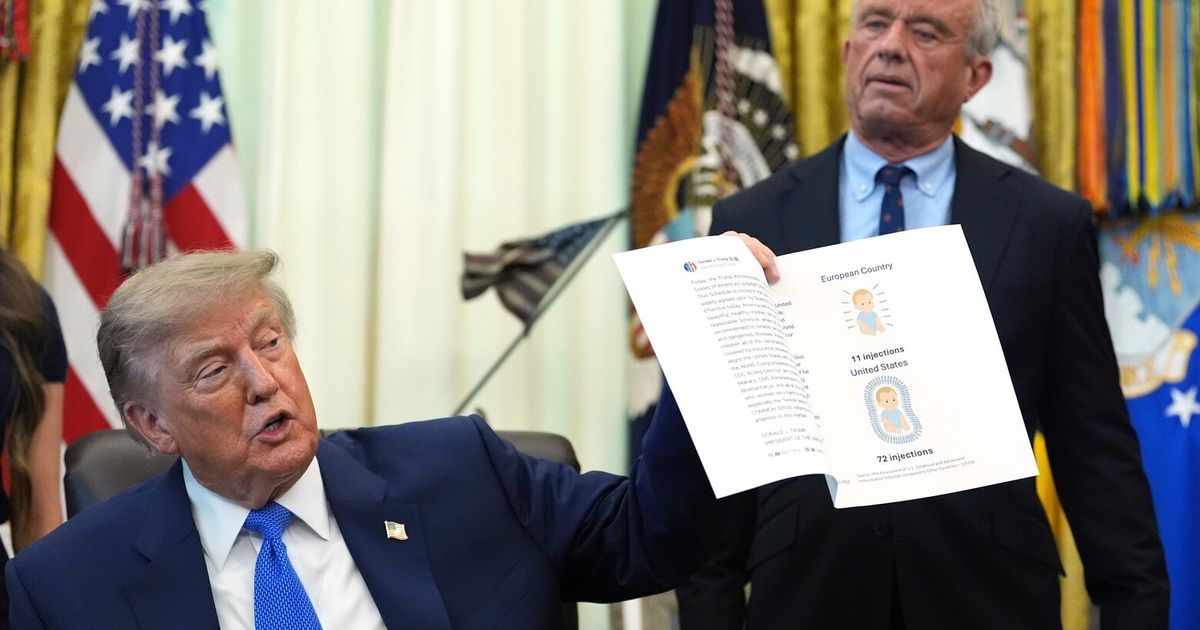
Time and again he has spread falsehoods and taken executive actions that have weakened our immunization program. His latest attack: On Aug. 10, Trump signed an executive order which would — if obeyed — drop the number of recommended childhood vaccines from 18 to 11, and split the MMR (measles, mumps, rubella) vaccine into three separate shots. While not legislation per se, presidential orders direct federal agencies on managing operations within the executive branch. We are now in uncharted regulatory territory, with potential for real harm.
As we have warned previously, removing vaccination for diseases including influenza, COVID-19, hepatitis A, hepatitis B, and meningococcal disease from the routine childhood immunization schedule will result in marked increases in illness and deaths from each of these infections.
Trump's approach to measles prevention is particularly maddening. Before the introduction of the measles vaccine in 1963, the U.S. averaged 3 million to 4 million cases of measles each year, causing tens of thousands of hospitalizations and hundreds of deaths. Thanks to widespread immunization, infections have plummeted by over 99%.
But the risk of measles remains. Herd immunity requires at least 95% of the population to be immune; below this threshold our population becomes vulnerable to rapid and sustained outbreaks. During the 2024-2025 school year, only 92.5% of U.S. kindergartners were vaccinated against measles, down from 95.2% in 2019-2020. This reduction in vaccinations has resulted in the current surge in measles cases. As of Aug. 6, 2,465 cases of measles have been reported to the Centers for Disease Control and Prevention in 46 states — the highest level in 35 years. The U.S. will probably lose its measles elimination status — which it has held since 2000 — which would be an entirely preventable embarrassment.
Advertising
In the Oval Office signing ceremony for this executive order, Trump stated in regard to the MMR combination vaccine, 'Together, there could be a possibility they're quite lethal.' Of course, he is wrong. Either he knows this statement is untrue, making him a liar, or he is cognitively infirm and actually believes these delusional conspiracies. Neither explanation is acceptable.
The introduction of MMR in 1971 was a triumph. There is no reason to split it into three single-antigen vaccines, and many reasons not to. Single-disease vaccines for measles, mumps, and rubella have not been available in the U.S. since 2009, and bringing individual shots safely back to market would require years and great expense. Given the difficulties of scheduling multiple visits, compliance will fall, leading to increasing rates of all three diseases. We moved to a combination for good reasons: fewer shots, fewer doctor visits, at lower cost. And parents love this. Problem solved.
Whom should parents, physicians and insurance providers trust: public health experts or political hacks? The answer seems obvious, but confusion and chaos are real when bad information flows from official channels. Fortunately, medical professional societies, including the American Academy of Pediatrics, continue to issue evidence-based vaccine recommendations. We advise our patients to use these sources instead of the CDC. This is a frustrating change, given the significant expertise of CDC professionals, whose insights should be trusted and amplified.
Indeed, the CDC has a new director, Dr. Erica Schwartz. One of her first challenges will be to decide whether to defy Trump's executive orders, thus honoring her oath as a physician and public servant, or to bend the knee and accommodate his madness. The nation and the world are watching her, and we hope she will choose wisely.
We are not alone. U.S. Sen. Bill Cassidy of Louisiana, a Republican and chair of the U.S. Senate Committee on Health, Education, Labor & Pensions, said of the executive order, 'I'm a doctor. This executive order is wrong. The president does not have the expertise to make these changes.' We concur. And we agree with Democratic Sen. Mark Kelly of Arizona, who said, 'Trump should stick to what he knows best: ballrooms, bankruptcy, and bullshit.'
Related Opinion
A note on cookies
Newshunt uses essential cookies to keep you signed in and to remember your language and country, so the site works the way you expect. With your permission, we'd also like to use analytics cookies to understand how people use Newshunt and improve it over time.
Accepting only affects analytics. To learn more, view our Privacy Policy or Terms & Conditions.
(0)Comments