


vietnam.vn
Meningococcal disease warning at the start of the school year.

Follow Vietnam.vn on
Children are particularly susceptible to meningococcal meningitis, which has a rapid progression, high mortality rate, and severe long-term consequences.
Small numbers, but significant risks.
On September 5th, the Ho Chi Minh City Center for Disease Control issued a warning about meningococcal disease, coinciding with the start of the new school year. According to surveillance reports from week 1 to week 14 of 2026, the country recorded 24 cases of the disease, including four deaths, compared to 14 cases during the same period in 2025.
Notably, children under 15 years old account for 46% of the total number of cases. Cases are currently scattered throughout the community and have not yet formed concentrated outbreaks. The risk of an outbreak remains a concern during the rainy season and the back-to-school period, when travel, social interaction, and large gatherings increase.
This information needs to be received with a clear mind. 24 cases is not enough to create panic among tens of millions of people, but four deaths show that the danger of the disease cannot be judged solely by the scale of infection.
Meningococcal disease is an acute bacterial infection caused by Neisseria meningitidis, primarily transmitted through direct contact with nasal and throat secretions from infected individuals or carriers. The incubation period is usually 2–10 days, most commonly 3–4 days.
What makes the disease difficult to control is that carriers of the bacteria may be completely asymptomatic but still capable of transmitting the disease. According to health warnings, approximately 5–25% of people in the community may unknowingly carry meningococcal bacteria. Schools, dormitories, barracks, and other crowded environments therefore pose a higher risk.
Given that students have just returned to school, the warning is not just for parents. It places responsibility on schools, school health systems, and local health facilities to monitor, detect, and handle suspected cases.
These signs indicate there is no room for delay.
Meningococcal disease can manifest in various forms, the most common being purulent meningitis and septicemia. The disease usually has a sudden onset with high fever, severe headache, nausea or vomiting, stiff neck, and photophobia.
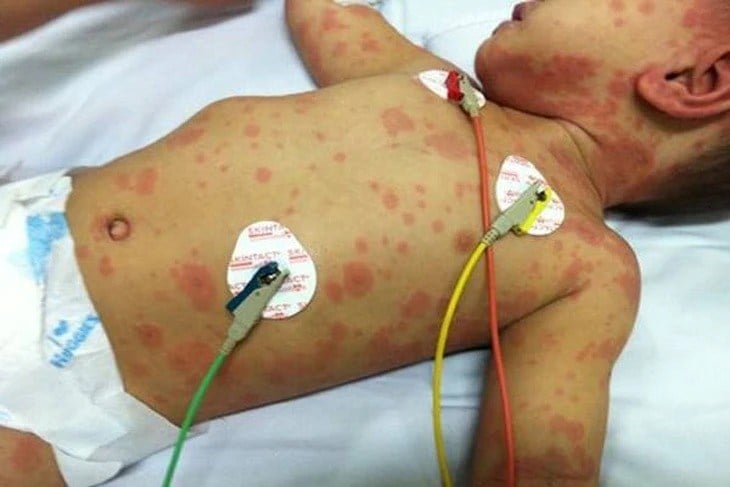
In young children, symptoms can be more difficult to recognize: refusal to feed, fussiness, lethargy, or a bulging fontanelle. When abnormally shaped petechiae appear on the skin, along with low blood pressure or altered consciousness, the disease may have progressed to a very severe stage.
In the most severe cases, patients are at risk of septic shock and death within 24 hours of the first symptom onset if not treated promptly. Even with the use of specific antibiotics, the mortality rate is still alarmingly high at 10–15%, and about 20% of survivors may suffer long-term sequelae such as deafness, nerve damage, brain damage, or limb loss.
With such a rapidly progressing illness, a delay of just a few hours can make a huge difference. Families should not wait until their child has all the symptoms before taking them to the doctor, and they certainly should not self-medicate when a child suddenly develops a high fever accompanied by headache, vomiting, stiff neck, lethargy, or a petechiae (small red rash).
The challenge lies in the fact that the initial symptoms are easily mistaken for the flu or common viral infections. A child with a fever after the first day back at school might lead parents to think it's just the change in weather or fatigue. This waiting game can lead to the loss of valuable treatment time.
The warnings need to be strong enough to prevent complacency, but also avoid creating a rush to get tested or vaccinated at all costs. Vaccine selection must be appropriate for age, health status, and exposure risk, based on advice from qualified healthcare professionals.
Schools need a time-based process.
The beginning of the school year is usually a time when schools focus on the curriculum, facilities, and student discipline. But school health services must also be given equal importance, especially in the face of infectious diseases that can spread rapidly.
Each school needs a clear procedure for detecting high fever or suspected symptoms in students: Who conducts the initial assessment, where the student is placed, how to contact the family and medical facilities, and how to notify the local health authorities? A procedure that only exists on paper is meaningless if the staff involved are not trained and do not know how to react in the first few hours.
Schools also need to monitor unusual student absences, improve classroom ventilation, disinfect frequently touched surfaces, and instruct children not to share personal items. Parents are responsible for truthfully reporting their children's health status and should not bring children with fevers or signs of illness to school simply to avoid disrupting their studies.
According to health authorities, people should wash their hands frequently, maintain nasal and throat hygiene, limit close contact with people who are sick or suspected of being sick, and ensure a well-ventilated living and learning environment. If sudden high fever, severe headache, vomiting, stiff neck, or petechiae occur, the patient should be taken to a medical facility immediately.
Source: https://baovanhoa.vn/doi-song/canh-bao-nao-mo-cau-dau-nam-hoc-262734.html
Related Opinion
A note on cookies
Newshunt uses essential cookies to keep you signed in and to remember your language and country, so the site works the way you expect. With your permission, we'd also like to use analytics cookies to understand how people use Newshunt and improve it over time.
Accepting only affects analytics. To learn more, view our Privacy Policy or Terms & Conditions.
(0)Comments