


unknown
The October 7 failure was strategic, military and tactical, but it was not betrayal

Three years after October 7
, Israel is still struggling to answer the simplest and hardest question of all: How did this happen to us? In the absence of a state commission of inquiry capable of producing an agreed factual account, the unanswered questions
have become fertile ground for theories about betrayal from within and claims that information was deliberately concealed from the political leadership
. But no conspiracy is needed to understand the disaster. What is required is an unflinching look at the strategic, systemic and tactical failures that accumulated over years, until they all collapsed together in a single morning.
Success has many fathers; failure, as the saying goes, is an orphan. But the October 7 disaster is not an orphan when it comes to responsibility. It was the result of a series of failures that developed simultaneously on three levels: the strategic-political level, the senior military-command level and the tactical level on the ground in the Gaza Division.
Gallery
נוסח ועדת החוק להקמת ועדת חקירה לטבח השבעה באוקטובר
The scale of the failure, the depth of the collapse, Hamas' ability to surprise and overwhelm the IDF's defensive system in southern Israel, and the many questions that have remained unanswered ever since have created fertile ground for conspiracy theories. Chief among them is the claim that senior security officials knew about the attack, concealed the information and deliberately refrained from preventing it. Alongside it is the claim that the military and Shin Bet excluded the prime minister and did not bother to update him during the night before the attack.
When the public has no agreed answers, it begins searching for others. And as long as no state commission of inquiry is established to present the public with a complete, authoritative factual picture, such theories will continue to gain strength. This is not merely an argument about the past. When a large segment of the public stops believing state institutions and the security establishment and begins to believe that senior officials conspired against it, the cohesion on which Israeli society depends is damaged.
Next month will mark three years since the Hamas attack on October 7 and the largest massacre of Jews since the Holocaust. Despite all the time that has passed, the Israeli public still has no complete, agreed answer to one question: How the hell did this happen to us?
Like many others, Giora Eiland tries to grapple with that question in his excellent recently published book. He opens it by quoting Avigdor Kahalani: 'There are three things beyond my understanding: the human body, the universe and October 7.' That sentence captures the feeling of many Israelis.
How did Hamas, a terrorist organization in Gaza, manage to surprise and overpower the strongest military in the Middle East for hours? How, 50 years after the Yom Kippur War, did it manage to execute a deception plan and surprise Israel's intelligence and early-warning systems? Where was the IDF during the hours in which residents of southern Israel were being massacred and abducted? And what was done, and above all what was not done, with the warning signs that appeared during the night before the attack?
As more time passes since that black Saturday, and certainly as the political system enters an election period, those question marks are not disappearing. On the contrary, they are becoming weapons in the battle over responsibility for the disaster.
When unanswered questions become fertile ground for conspiracy
According to a recently published survey, around 40% of Israelis believe some version of the 'betrayal from within' theory, the claim that senior security officials knew about the attack and refrained from stopping it in order to bring down the right-wing government. That figure should trouble every Israeli, regardless of political position.
Human beings find it difficult to live with uncertainty for long. We want clear explanations, causes and responsibility. In other words, we want exclamation marks instead of question marks. But when, nearly three years after the event, no agreed state body has presented the public with the complete picture, a vacuum is created. And in that vacuum, alternative versions, rumors and conspiracy theories flourish.
When political and other actors who have an interest in promoting a particular interpretation of events are added to the mix, it is hardly surprising that such theories gain traction. You cannot fight a conspiracy theory with a counter-conspiracy theory. The way to confront it is through facts, by explaining how the system actually works and determining the role each level played in the failure.
What actually warrants waking a leader in the middle of the night?
Alongside the betrayal theory, another claim has recently gained prominence, particularly among figures in the political leadership: During the night of October 6, the heads of the security establishment received unusual intelligence from Gaza but chose not to wake or update the prime minister. There is no question that determining who knew what, when they knew it and why they did not act differently requires a thorough investigation. But to examine that claim, one first has to understand how a military and security system operates in real time.
Throughout my years as a senior commander, I would make one very simple point clear to my people in our initial conversations: what they should wake me up for in the middle of the night. When my subordinates chose not to wake me and it later became clear that they had made the wrong call, I did not limit my criticism to them. I also examined myself. Had I clearly defined what I wanted to know and when?
A commander cannot expect his subordinates to read his mind. If particular intelligence or an operational event requires immediate notification in his view, he has to establish that expectation in advance.
Nights in which unusual intelligence emerged and late-night consultations were held were not exceptional in the IDF and the security establishment during the years before October 7. I personally know of dozens of such cases. Unusual intelligence emerges in a particular command. The commanding general asks to bring the chief of staff into a consultation. The head of the Operations Directorate and the head of Military Intelligence will generally join, and sometimes other senior officers as well, such as the Air Force commander or head of the Planning Directorate. A consultation takes place, and at its conclusion the chief of staff decides how to proceed and issues instructions. That is precisely the role of the senior military command.
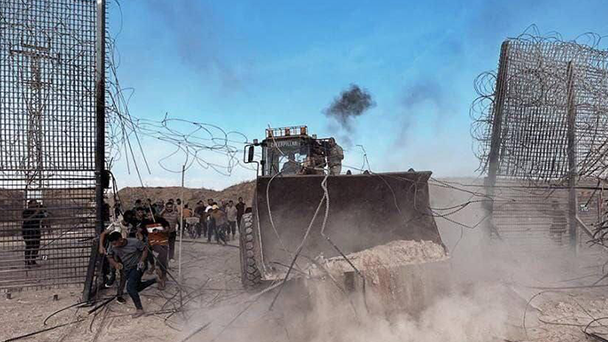
Terrorists enter Ein HaBesor
If a prime minister believes that he should be updated in real time about every such event, including during the night, he must make that clear to the military leadership. This principle has nothing to do with one particular prime minister. It is a basic management principle governing the relationship between the political and military levels.
For years, there was no established procedure requiring the prime minister to participate in every nighttime operational or intelligence consultation. There is logic to that. The prime minister's central responsibility is to manage national security at the strategic level, not to replace the chief of staff, regional commanders or division commanders in making operational and tactical decisions.
None of this absolves anyone of responsibility for what happened that night. Quite the opposite. A commission of inquiry must determine exactly what information each person possessed, how it was analyzed, what decisions were made and why. But the mere fact that a nighttime consultation took place without the prime minister does not, in itself, prove that he was deliberately excluded, and it certainly does not prove betrayal.
Anatomy of a collapse: strategic, military and tactical failure
Managing war is among the most complex human endeavors. The theoretical knowledge surrounding warfare has accumulated over thousands of years, but the greatest difficulty is not simply knowing that knowledge. It is applying it under pressure, uncertainty, danger and incomplete information. There is a reason it is called the 'art of war.'
That art operates simultaneously on three levels: the strategic level, where the political leadership defines the overarching objectives and directive; the operational level, where senior military commanders translate those objectives into a plan of action; and the tactical level, where forces on the ground determine how that plan will be implemented. One reason the October 7 failure was so severe is that it did not occur at only one level. It developed at all three, and at the decisive moment all three collapsed together.
The strategic-political failure:
For years, the Israeli government pursued a policy aimed at deepening the division between the Gaza Strip and the West Bank. In 2018, when the Palestinian Authority stopped paying salaries to employees in Gaza and Hamas found itself under pressure, Israel faced demands to prevent further deterioration and escalation. Fearing escalation, Israel turned to Qatar and allowed money to flow into the Strip. The policy was intended to stabilize the situation in the short term. In practice, it also helped sustain Hamas rule and its military buildup for war against Israel.
At the same time, substantial offensive military capabilities were developing for more than a decade in both Gaza and Lebanon. Hezbollah and Hamas built large commando forces designed to shift within hours from routine operations to attacks against communities in northern and southern Israel. This reality contradicted fundamental principles of Israel's security doctrine, yet the political leadership refrained from directing the senior military command to launch a preemptive war to remove the threat.
The systemic-military failure:
The senior military command operated for years within that policy but did not challenge it to the degree required. Contrary to military doctrine, a significant part of the defensive deployment along Israel's southern and northern borders relied on relatively limited forces and on the assumption that intelligence would identify a change in enemy intentions and provide sufficient warning.
Put simply, instead of building a defense capable of holding even if intelligence was wrong, the system became deeply dependent on warning. That was a systemic vulnerability. When the assumption about Hamas' intentions collapsed and intelligence failed to provide the necessary warning, it became clear that the defensive system itself had not been built to withstand Hamas' offensive capabilities on its own.
The tactical failure:
The tactical level, the forces of the Gaza Division responsible for protecting the border communities, was also captive to the same conception. The forces did not believe Hamas was capable of, or intended to carry out, an attack on the scale that ultimately took place. They relied on the same assessment of Hamas' intentions accepted by the levels above them. But even when an intelligence assessment is wrong, a military force must be prepared for the possibility that the enemy will surprise it.
On October 7, deep failures were exposed in the operational culture, readiness and alertness of some forces. At the decisive moment, systems that were supposed to defend the border and its communities were not sufficiently prepared for their mission.
Hamas identified the distortion at all three levels. This is evident from the 'Jericho Wall' document, Hamas' operational plan, and from enemy documents captured during the war. When the strategic, operational and tactical levels all acted in ways fundamentally contrary to what was required of them, everything collapsed like a house of cards at 6:29 a.m.
This was a military failure, not betrayal
October 7 was first and foremost a military failure. Even under a mistaken political and strategic conception, the IDF, through the Gaza Division, the Air Force and Military Intelligence, was obligated to fulfill its most basic purpose and defend the residents of the border communities. But there is still an enormous gulf between catastrophic professional failure and accusing the heads of the security establishment of betrayal.
Anyone deeply familiar with the flow of intelligence inside Israel's security establishment knows that the person with the most complete picture of what is happening in Gaza is the Gaza Division intelligence officer, just as the Galilee Division intelligence officer is the leading expert on Lebanon. Intelligence from all the relevant agencies, including Unit 8200, Shin Bet and Mossad, flows to his desk.
On October 7, the Gaza Division intelligence officer was an officer who came from the religious Zionist community and was also the son of one of the prime minister's closest security advisers. That intelligence officer, the IDF's leading expert on the Gaza arena, shared the assessment of the Southern Command intelligence officer that night: the warning signs did not warrant excessive alarm and did not indicate an anomaly requiring preparations for war.
Had that officer thought differently that night, no one in the security establishment could have, or would have tried to, 'silence' him. Quite the opposite. Everyone would have understood that if the senior expert on the arena was alarmed, the entire system needed to be alarmed.
The problem that night was not that someone knew with certainty and concealed it. The far more serious problem was that an entire system saw the signs but interpreted them through a conception that had become too deeply embedded at every level.
So how the hell did this happen to us?
October 7 may remain an event that many Israelis will struggle for years to comprehend. That is the nature of a failure on this scale. The gap between the power of the State of Israel and what happened during those hours is so enormous that it can sometimes seem easier to believe somebody wanted it to happen than to accept that large, professional and experienced systems can fail so completely.
But military history shows that they can. The collapse of the Maginot Line and the Atlantic Wall during World War II, Pearl Harbor, the conception that led to Israel's collapse at the outset of the Yom Kippur War, and 9/11 are only some of the examples. No betrayal is required to explain October 7.
There is more than enough already: a flawed political conception, a policy that was not adjusted in time, intelligence that misread the enemy, excessive dependence on early warning, defensive systems that did not match the threat, inadequate readiness, and failures in command and response.
These are difficult explanations. In some ways, they are even harder than a conspiracy theory because they force us to recognize that the failure was not the act of one person or a secret group. It was the product of an entire system.
But responsibility must be based on facts. As long as no state commission of inquiry is established to examine the political leadership, the IDF, the intelligence community and the decision-making process, and to present the public with a single, authoritative and comprehensive factual account, a vacuum will remain.
And inside that vacuum, conspiracy theories will continue to flourish.
Related Opinion
A note on cookies
Newshunt uses essential cookies to keep you signed in and to remember your language and country, so the site works the way you expect. With your permission, we'd also like to use analytics cookies to understand how people use Newshunt and improve it over time.
Accepting only affects analytics. To learn more, view our Privacy Policy or Terms & Conditions.
(0)Comments