


unknown
A fading fire: Calcutta's reckoning with WW2 is illuminating

On the morning of September 2, 1945, Japanese representatives signed the instrument of surrender aboard the USS Missouri in Tokyo Bay, formally ending the Second World War. Over eight decades later, the world's promise of 'Never Again' to war looks thinner with each new conflict. Calcutta's own reckoning with 1945 is, however, quieter and stranger.
For a city that has lived through empire, famine, Partition and rebellion, Calcutta has an oddly small acquaintance with war itself. Nearly every major city — London, Paris, Berlin, Tokyo, Moscow — has stood in conflict's direct path. In roughly three centuries of its modern recorded history, Calcutta has felt war on its own soil only twice: in 1756, when Siraj-ud-Daulah took Fort William from the British, and between 1942 and 1944, when Japanese bombers reached the city. The second of these has almost vanished from our recent memory. This is odd because it happened alongside the event Bengal remembers most bitterly of all — the Bengal Famine.
ADVERTISEMENT
By early 1942, Rangoon had fallen, and the Japanese advance through Burma had put Calcutta, the empire's largest eastern port, within the bombers' range, a threat that most other major Indian cities did not share. The first raids came on December 20, 1942, and continued till Christmas Eve, striking Kidderpore docks among other targets. A second, larger, daylight raid on December 5, 1943 hit the docks again, killing several hundred and cutting cargo capacity by two-thirds for weeks. Smaller raids continued all through 1944. An estimated 3,50,000 city residents fled in panic. Blackout drills, trenches
dug through public squares, and air-raid sirens became part of the city's daily life.
The bombing did not happen in isolation. It unfolded alongside the Bengal famine of 1943, and the two were more entangled than they first appear. The same fear of invasion that sent bombers over Kidderpore also drove Winston Churchill's 'denial policy': the deliberate confiscation by the British of over 50,000 boats and surplus rice stocks from coastal Bengal was meant to deny an advancing Japanese army the means to move or feed itself. The British also implemented inflation policies during the war that were aimed at making more resources available for Allied troops. The denial policy, wartime procurement, inflation, disruption of rice supplies, cyclone and crop disease — all these miscalculations, layered on administrative failure and speculation — led to the death of close to 30 lakh people. The same military logic that turned Calcutta into a bombing target turned the Bengal countryside into an acute famine zone: both were the price extracted by the British administrators for defending the eastern frontier with the people living in it as collateral damage.
The images that survive of this moment mostly survive by accident, and mostly through foreign hands. Wartime censorship in colonial India was strict around military installations, ports, railway stations, and troop movements, precisely the subjects that mattered most in Calcutta during the war. Indian newspapers and photographers worked under immense press restrictions that made it risky, often impossible, to photograph the docks, the damage, life in the city and in the suburbia, or the
famine's toll. Thus very few indigenous photographic records of these years survive.
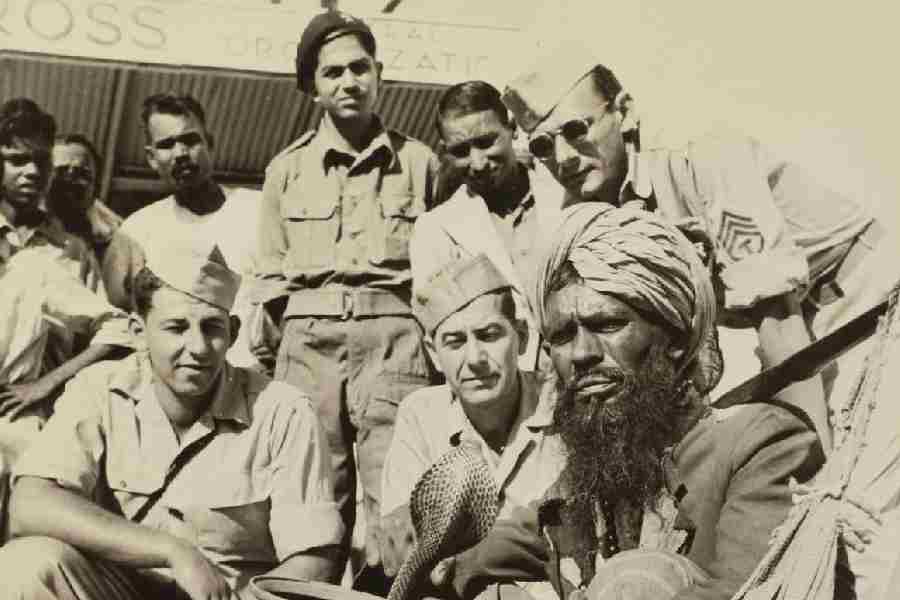
What exists instead comes largely from foreign servicemen-cum-photographers who had military clearance to be near the docks, railway stations, and the barracks and were allowed to photograph the city streets. Consequently, two American photographers — they were not part of the Indian press — ended up producing what may be the fullest surviving visual account of Calcutta during the Second World War.
Glenn S. Hensley (June 3, 1919 — January 23, 2018) was one such American serviceman who served in the 40th Army Photography Reconnaissance and was in British India between 1943 and 1945. Along with the official images he captured for the United States army, Hensley produced a series of personal photographs portraying his immediate surroundings and his experience of life during the Second World War in British India and in Burma. He had photographed Calcutta while the danger of war was very real, between 1943 and 1944. He gave away nearly 600 images to the University of Chicago Library where they now form the 'Hensley Collection', digitised through the Digital South Asia Library. Despite the size of his wartime contribution, Hensley remains almost absent in Calcutta's historical writings and museums and from our memory — an odd fate for his unique photographic record of the city was taken during, not after, its brush with the active years of the Second World War.
Clyde Waddell (June 20, 1915 — February 11, 1997) came to Calcutta slightly later. He was a bit more fortunate than Hensley. A Houston Press photographer inducted into the US army, Waddell was attached in November 1943 to the Public Relations Staff of South East Asia Command: a joint Allied, British-led command under Louis Mountbatten but staffed by Americans and British alike. Waddell served as Mountbatten's personal photographer before moving to the Phoenix magazine, a picture weekly run jointly by both commands. Waddell took his own Calcutta photographs while on leave in 1945 after the bombing had stopped. They include Chowringhee's trams, the Burra Bazar, Nimtolla's crematorium, opium dens in Tiretta Bazaar, GIs mixing with street vendors near the Tipu Masjid at Dharmatala crossing and the famine-stricken mother and child. Friends kept asking for copies until he self-published 60 of his photographs as A Yank's Memories of Calcutta in 1946. It's often called a nearly lost book, but that isn't quite right: documented copies survive at the University of Pennsylvania, Southeastern Louisiana University and the British Library besides others that have surfaced at auction over the years. Rare, yes; vanished, no; just scattered widely enough such that few people, in Calcutta or anywhere else, have seen it whole. However, his photographs have been plagiarised and reconfigured by
social media influencers in recent times.
Between them, the two men left behind something rare: one captured the city's fear, one its exhaled relief, months apart. Almost nobody alive remembers the sirens first hand now; what's left is second-hand: a grandparent's mention of trenches near a school, a scarred building in old Dalhousie Square, a photograph nobody in the family can quite place. That is usually how Calcutta's war memory ends: not with an event, but with the slow disappearance of anyone who can say 'I was there'.
Apart from Hensley and Waddell, there were at least three other American servicemen photographers — Frank Bond, Lewis Paltz, and Tony Mayo who had photographed wartime Bengal.
Calcutta is unusual among world cities for having so little war in its past. It is more unusual still for having let the one real brush it did have — bombed docks, a starving population, and a city in churn — slip almost entirely out of its own telling
or memory. Part of the reason is geography: the Hensley Collection sits in Chicago, Waddell's album is scattered across libraries and auction rooms abroad, and no Indian museum, archive or university, to the best of my knowledge, holds a complete set of either.
Recovering that record now is not nostalgia; it would mean bringing digitised copies home so that every Calcuttan can finally see what almost nobody photographed from the inside, before the last people who could say, 'I was there', are gone.
Devasis Chattopadhyay is a narrative history writer and columnist
Related Opinion
A note on cookies
Newshunt uses essential cookies to keep you signed in and to remember your language and country, so the site works the way you expect. With your permission, we'd also like to use analytics cookies to understand how people use Newshunt and improve it over time.
Accepting only affects analytics. To learn more, view our Privacy Policy or Terms & Conditions.
(0)Comments