


Joe Ejiofor
The Nigerian child and the right to education: Rhetoric or reality?

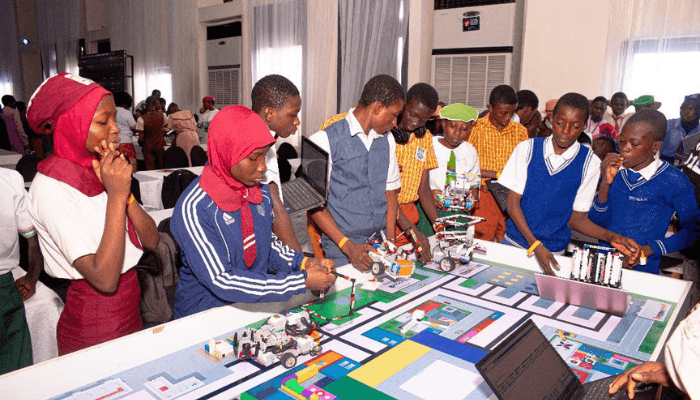
Cross-section of students displaying their robotic skills at the World Robotic Olympiad tournament in Lagos
As the world marks International Literacy Day, the occasion provides an opportunity to reflect not only on the importance of literacy but also on a fundamental question that Nigeria must confront: Is the right of the Nigerian child to education a genuine national commitment, or is it merely a recurring political rhetoric?
Education is universally recognised as a fundamental human right and a powerful instrument for individual and national development. For the Nigerian child, however, the journey from the constitutional promise of education to the reality of sitting in a functional classroom remains a difficult one.
Nigeria has repeatedly demonstrated its commitment, at least on paper, to ensuring access to education. The Constitution places a responsibility on the government to provide equal and adequate educational opportunities. Various governments have introduced policies and programmes aimed at increasing enrolment, reducing the number of out-of-school children, improving literacy and strengthening basic education.
Yet, despite these declarations, millions of Nigerian children still face barriers that keep them away from school or prevent them from receiving meaningful education.
This raises a troubling question: What does the right to education mean to a child who has no school within reasonable reach, whose parents cannot afford basic school requirements, who sits in an overcrowded classroom without adequate learning materials, or who is forced into street trading to supplement the family income?
The answer is obvious. A right that exists largely in policy documents but is inaccessible in practice remains an incomplete right.
Beyond school enrolment
One of the mistakes in discussing education in Nigeria is to equate access with enrollment. Getting a child into a classroom is important, but it is only the beginning.
The real question should be: What happens after the child enters the classroom?
Does the child have a qualified and motivated teacher? Is the classroom safe and conducive to learning? Are there adequate textbooks and instructional materials? Is there access to sanitation, water and other basic facilities? Does the child receive the quality of education necessary to read, write, reason, communicate and compete effectively in a changing world?
Literacy is not simply the ability to recognise letters and pronounce words. It is the foundation upon which individuals acquire knowledge, develop critical thinking and participate meaningfully in society.
A child who spends years in school but leaves unable to read and comprehend a simple passage has been physically present in school but educationally excluded.
The burden of poverty
Poverty remains one of the greatest threats to the educational rights of Nigerian children.
For many families, particularly in poor and vulnerable communities, education competes with daily survival. A child may be required to hawk goods, assist in family businesses, engage in domestic work or simply remain at home because the family cannot meet the costs associated with schooling.
Although public education is expected to reduce this burden, families still encounter expenses relating to uniforms, books, transportation, feeding and other school requirements.
The consequence is that education, which should be an equaliser, can become another mechanism through which inequality is reproduced.
A child born into a wealthy family may have access to quality schools, technology, private tutoring and a supportive learning environment, while another child of the same age may be struggling to find a seat in an overcrowded classroom.
Both are Nigerian children. Both have the same fundamental right to education.
The out-of-school child
The challenge of out-of-school children remains one of Nigeria's most disturbing educational realities. Behind every statistic is a child whose future is being compromised.
Some are excluded by poverty. Others are victims of insecurity, displacement, cultural practices, disability, inadequate infrastructure or the absence of schools in their communities.
In conflict-affected areas, schools themselves have sometimes become casualties of insecurity. Where parents fear for the safety of their children, sending them to school becomes an agonising decision.
The educational crisis therefore cannot be addressed by the education sector alone. It requires coordinated action involving security, social protection, health, poverty reduction and community development.
The teacher matters
No discussion about literacy and the right to education can be complete without talking about teachers.
Buildings do not educate children; teachers do.
Nigeria needs teachers who are adequately trained, properly motivated, professionally respected and continuously developed. It is unrealistic to expect excellent learning outcomes when teachers are poorly supported or when classrooms contain more learners than a teacher can effectively manage.
Investment in education must therefore go beyond constructing school buildings. It must include investment in the human beings who make education possible.
Government must move beyond rhetoric
The annual celebration of International Literacy Day should not become another ceremonial event filled with speeches, banners and photographs while the fundamental problems remain unresolved.
Governments at all levels must translate commitments into measurable action.
This means adequate and sustained funding for education; improved teacher recruitment and development; better school infrastructure; stronger monitoring of learning outcomes; targeted interventions for vulnerable children; and effective policies that address the social and economic conditions responsible for school exclusion. It also means accountability.
Education budgets should not merely be announced; Nigerians should be able to see what those resources have achieved.
Parents and society have a role
Government cannot carry the entire burden.
Parents have a responsibility to encourage their children to learn and to prioritise education within their means. Communities must protect schools and support children's education. Traditional and religious leaders must challenge practices that keep children out of school.
The private sector and civil society also have important roles to play through scholarships, infrastructure support, teacher development, literacy programmes and community interventions.
Most importantly, society must stop treating the education of the Nigerian child as a favour. It is a right.
From promise to reality
International Literacy Day should therefore serve as more than a celebration of literacy. It should be a moment of national self-examination.
Nigeria has no shortage of policies, declarations and educational programmes. What is required now is sustained implementation, political will and accountability.
The Nigerian child does not need another promise that education is important. The child needs a functioning school, a competent teacher, learning materials, safety and an environment where learning can take place.
The real test of Nigeria's commitment to education is not what is written in government documents or what is said at conferences. It is whether the child in a remote village, an urban slum, a displaced community or a disadvantaged household can actually access quality education without discrimination.
So, as we commemorate International Literacy Day, we must ask ourselves honestly: Is the Nigerian child's right to education a reality or merely rhetoric?
Our answer should not be found in speeches. It should be found in our classrooms, in our literacy rates, in the number of children in school and, most importantly, in what those children are actually learning.
The future of Nigeria is sitting in those classrooms.
We owe the Nigerian child not just the promise of education, but the reality of it.
Ejiofor is a Public Policy Analyst and Higher Education Administrator, currently working as a Deputy Registrar at Yaba College of Technology, Yaba, Lagos
Join BusinessDay whatsapp Channel, to stay up to date Open In Whatsapp
Related Opinion
A note on cookies
Newshunt uses essential cookies to keep you signed in and to remember your language and country, so the site works the way you expect. With your permission, we'd also like to use analytics cookies to understand how people use Newshunt and improve it over time.
Accepting only affects analytics. To learn more, view our Privacy Policy or Terms & Conditions.
(0)Comments