


unknown
MUGA: Only job creation can win gratitude in politics

With the benefit of having closely observed several Kenyan election cycles, I would say this: that the only thing which can win an elected leader enduring gratitude (manifest as votes cast in his or her favour) is job creation.
As such, when contemplating the many development projects that may be possible for a newly elected president, the only question he needs to answer is: 'Will this help create jobs?'
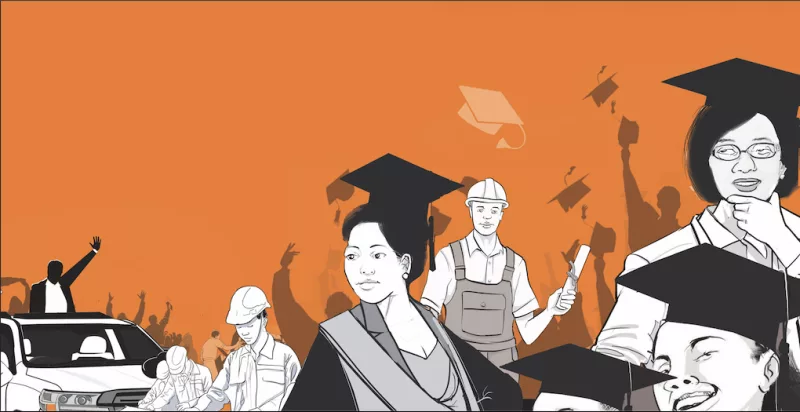
I did not arrive at this conclusion casually. Like others, for many years I believed that nothing mattered more than education. And that the many Kenyans who sacrificed so much to get their children through school and into a professional career were making a wise choice.
And it was not just ordinary Kenyans who had an unshakeable faith in the alchemy of college education. This unwavering belief went all the way up to State House, with President Daniel Moi (1978 to 2002) always giving serious attention to expanding opportunities for tertiary education; and President Mwai Kibaki (2002 to 2013) famously initiating a free primary education programme.
I am not so sure now that this obsession with education at every level is still valid.
There have been recent media reports of the substantial sums of money that young Kenyans and their families are willing to pay as a bribe to get a place on the staff of one of the public schools, via the Teachers Service Commission (TSC).
Also, reports that the average university graduate now has to wait for about five years to get into formal employment.
Finally, there are reports that some MPs walk around with TSC appointment letters, obtained goodness knows how, in which they only have to fill in a young graduate's name, to secure for them a much-coveted position as a classroom teacher in a public school.
All this seems to point to the fact that we have long passed the stage at which a university degree was the golden key to entry into the middle class.
If this is so, then why would any parent make such extraordinary sacrifices to get their son or daughter a college education?
I am well aware that I am asking a question that I have posed before in this column, but given the importance of this matter, this is a challenge worthy of endless discussion, even if there is no obvious solution to it.
In some countries where this same phenomenon has been observed, this conundrum has been defined as 'elite overproduction'. It describes a situation in which the number of skilled professionals within an economy substantially exceeds the capacity of that economy to absorb all of them.
But it does not only apply to college-educated elites.
The real tragedy in all this is that we have had at least two opportunities for spectacularly greater job creation for those who never quite made it into tertiary education (and who are the majority of unemployed youths), but somehow we missed out on both.
One was the outsourcing, by European countries and the US, of labour-intensive garment production, which led to about five million jobs being created in Bangladesh, starting from the 1980s.
In Kenya, we barely managed to create 200,000 jobs in this sector, despite being very well placed to take advantage of this opportunity.
Then there was the explosion of Business Process Outsourcing in the 1990s, which involved major Western corporations contracting Indian companies to handle a lot of 'customer service' work on their behalf. This too created around five million jobs.
I believe we were even less successful in this than we were in setting up giant garment factories on the Bangladesh model.
And now we are on the verge of yet another sweeping change in the way the world does business, this time the much-hyped Artificial Intelligence (AI) transformation.
However, in this latest opportunity, there is no promise of millions of new jobs that may be created. On the contrary, AI promises to make many jobs obsolete, including jobs currently done by writers like myself.
In this environment, can we really believe any presidential candidate who promises to help create jobs for our millions of unemployed youths?
Related Opinion
A note on cookies
Newshunt uses essential cookies to keep you signed in and to remember your language and country, so the site works the way you expect. With your permission, we'd also like to use analytics cookies to understand how people use Newshunt and improve it over time.
Accepting only affects analytics. To learn more, view our Privacy Policy or Terms & Conditions.
(0)Comments