


unknown
Antibiotics we take today could be losing their power tomorrow

Antibiotics we take today could be losing their power tomorrow
Victor Givens
Opinion
Sep - 07 - 2026 , 09:57
2 minutes read
Walk into a pharmacy in Ghana with a fever, a cough, or body pain, and you'll face a familiar temptation: describe a few symptoms, name an antibiotic, and walk out with a handful of tablets.
For many, the pharmacy has become the first port of call for diagnosing illness.
The problem is that fever is not always malaria and a cold is usually viral.
Antibiotics treat bacterial infections, not viral ones.
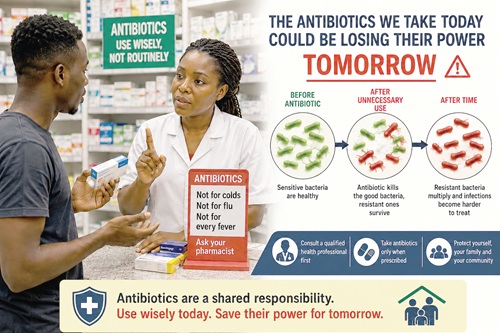
Unnecessary use exposes bacteria to drugs and Accelerates Antimicrobial Resistance (AMR).
This behaviour is rarely driven by carelessness.
Many Ghanaians avoid hospitals because of cost, time, or the belief that symptoms are too mild.
If an antibiotic worked before, it often becomes the default remedy the next time similar symptoms appear.
Pharmacies offer convenience. But every unnecessary exposure to antibiotics gives bacteria a chance to adapt and multiply.
Sensitive bacteria die, resistant ones survive.
Over time, common infections become harder to treat.
Ghana has a National Action Plan on AMR and has made progress in surveillance and stewardship.
In 2026, WHO recognised Ghana as the first country in Africa to pilot a people-centred approach to integrating AMR into primary healthcare.
Yet, the challenge remains a community issue. WHO has noted that inappropriate antibiotic use often happens when people take them for viral illnesses like the common cold.
Pharmacists can guide patients toward proper care, but antibiotics should not become routine remedies.
Ghana's Ministry of Health and WHO have repeatedly urged people to consult qualified professionals before taking antibiotics.
When bacteria become resistant, infections may require longer hospital stays and more expensive drugs.
Stronger antibiotics are not always better; the right medicine depends on the cause of the infection.
Taking antibiotics based on someone else's prescription is risky.
Public education must be clearer: antibiotics are valuable, but unnecessary use reduces their effectiveness for everyone.
Most colds do not need antibiotics and fever should not automatically lead to a prescription.
The next time someone walks into a pharmacy, the question should not be, "Which antibiotic should I buy?"
It should be, "What is causing these symptoms?"
That shift could protect both the individual and the community.
AMR is often called a silent crisis; it does not announce itself until treatment fails.
Ghana has made progress, but national action cannot succeed if inappropriate use continues in homes and medicine outlets.
The antibiotics we save today may be the medicines someone will need tomorrow.
The writer is a Biochemistry and Molecular Biology student at the University of Health and Allied Sciences (UHAS).
Related Opinion
A note on cookies
Newshunt uses essential cookies to keep you signed in and to remember your language and country, so the site works the way you expect. With your permission, we'd also like to use analytics cookies to understand how people use Newshunt and improve it over time.
Accepting only affects analytics. To learn more, view our Privacy Policy or Terms & Conditions.
(0)Comments