


ASHNEEL JAYNESL PATEL
Why I still write for Fiji

On September 4, The Fiji Times marks 157 years since its first edition appeared in Levuka in 1869. That is an extraordinary lifespan for a newspaper in a small Pacific nation that has lived through colonial rule, independence, coups, cyclones, migration and the digital age. Yet for me, this anniversary is not really about counting years. It is about counting mornings, memories and moments when a newspaper quietly entered somebody's life and stayed there. Long before I imagined seeing my own name printed in its pages, The Fiji Times was already part of the furniture of my childhood. My relationship with this newspaper began not as a writer, but as a curious boy watching someone read.
MY earliest memory of The Fiji Times is of my mama, my maternal uncle, in Natabua. Every morning he would sit with his breakfast and the newspaper, reading it from front to back, sometimes even returning to an older edition and reading parts of it again. I could never understand why yesterday's news still mattered today. I would walk down to the shop near his place to pick up the latest copy, feeling strangely important carrying it back under my arm. At first, I went straight to the advertisements, then the horoscopes, then sports, and only later did I begin reading the news. In hindsight, that progression feels like growing up on paper: First looking, then wondering, then caring, and finally questioning.
By high school, I had questions about almost everything and very few places to put them. I was a Fiji-Indian boy from Lautoka, still working out what it meant to belong to a country where history, race, religion, politics and identity often sat uneasily together. Adults tell young people to have opinions, but they are less comfortable when those opinions become inconvenient. The Fiji Times gave me somewhere to send mine. Slowly, seeing a letter published stopped feeling like a small thrill and started feeling like membership in something larger: a community of people who disagreed, argued, laughed and cared enough about Fiji to put their names beneath their words. For a teenager who often felt he had plenty to say but nowhere meaningful to say it, that mattered.
One person who shaped that journey was the late Allen Lockington. I knew him first through his letters, and I admired how he could make a point without hiding behind fancy language or pretending ordinary people had nothing worthwhile to say. He made the Letters to the Editor page feel less like a formal institution and more like a national conversation taking place across kitchen tables, buses, offices and verandahs. Years later, when he died, I wrote that I had looked up to him since my high school days, and I meant it. Allen helped me understand that writing did not require permission from the powerful; sometimes it simply required courage, clarity and the willingness to sign your name. A newspaper becomes truly national not only when it records what leaders say, but when it allows ordinary people to answer back.
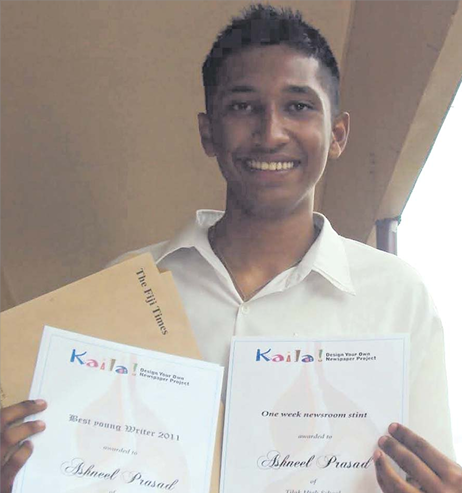
Then came 2011, when my relationship with the paper changed again. Through Tilak High School, I took part in the Kaila! Design Your Own Newspaper competition, and our school finished second that year despite, as I still remember with some amusement, submitting one fewer article than required. I was named Best Young Writer, and I was over the moon. To an adult, a school award may seem small; to a teenager, it can change the direction of confidence. Someone had read my words and decided they were worth recognising. I then spent a couple of weeks interning at The Fiji Times office in Lautoka, watching a newspaper move from idea to page. Suddenly the paper my mama read over breakfast had walls, desks, deadlines and faces.
The timing made that experience even more emotional. In December 2011, my family packed our lives into suitcases and left Fiji for New Zealand. I had just finished high school, and the move carried that strange combination of excitement and grief familiar to many Fijian families: You are told you are leaving for a better future while part of you is mourning the life you are leaving behind. Just before we left, I was still at the Lautoka office, typing and learning, surrounded by paper, ink and deadlines. Soon I was in Auckland, becoming the immigrant, the brown boy with the Fiji accent, the person repeatedly asked where he was 'really' from. But I kept writing back to Fiji. My physical address changed; the address of my imagination did not.
That is why The Fiji Times means something different to me now. I have written from Auckland, from the Middle East and now from Tokyo, but much of what I write still begins in Lautoka. It begins in school corridors, family conversations, memories of coups I was too young to fully understand, the ache of migration, the sound of Fiji Hindi outside Fiji, and the complicated experience of being Fiji-Indian while loving a country whose history has sometimes made belonging feel conditional. Writing has become my way of returning without pretending Fiji is perfect. Love of country is not silence. Sometimes the most patriotic thing we can do is ask the question that makes our country uncomfortable enough to examine itself.
Today, I think increasingly about who might be reading rather than only about what I want to say. Somewhere there may be a boy or girl doing exactly what I once did: Flipping past the serious pages, checking sport, laughing at a letter, then slowly realising that newspapers are not written by some mysterious species. They are written by human beings who once sat where that child is sitting. I want a brown boy to see my photograph or surname and understand that public conversation belongs to him too. I want children from every community and every corner of Fiji to know that their thoughts need not remain trapped in their heads. Representation is not vanity when it expands somebody else's idea of what is possible.
I also write for two boys much closer to my heart: My nephews, Aarav and Aarnav. I do not know exactly what Fiji will mean to them as they grow, especially when so many of our families now live across borders and carry home through food, language, music, memory and stories. But I want them to know their uncle did not only complain privately about the things he cared about. He put his thoughts into the public square and accepted that people could agree, disagree, challenge or dismiss them. That is part of citizenship too. Democracy becomes weaker when ordinary people start believing that only politicians, academics, celebrities or people with important titles are qualified to speak. A nation needs citizens who are willing to think, write, question and listen.
So congratulations to The Fiji Times on 157 years. My gratitude is not based on believing any newspaper is beyond criticism; no institution that scrutinises others should be frightened of scrutiny itself. My gratitude is more personal: This paper helped a curious boy carrying a newspaper home from a Natabua shop become a teenager who discovered his voice, then a young writer, an immigrant, a teacher and eventually a regular contributor still arguing with the country he loves. I began by reading advertisements and horoscopes. I stayed because I discovered the power of ideas. I now write because I want young Fijians to see that their voices matter, because I want Aarav and Aarnav to inherit a country where speaking thoughtfully is never reserved for the powerful, and because writing still gives me joy. At the end of the day, I write because I love my country very much.
Ashneel Prasad with his Kaila! certificates after winning the award for Best Young Writer 2011. Picture: SUPPLIED
Related Opinion
A note on cookies
Newshunt uses essential cookies to keep you signed in and to remember your language and country, so the site works the way you expect. With your permission, we'd also like to use analytics cookies to understand how people use Newshunt and improve it over time.
Accepting only affects analytics. To learn more, view our Privacy Policy or Terms & Conditions.
(0)Comments