


unknown
Wendell Berry Taught This Vegan How to Eat

Commentary
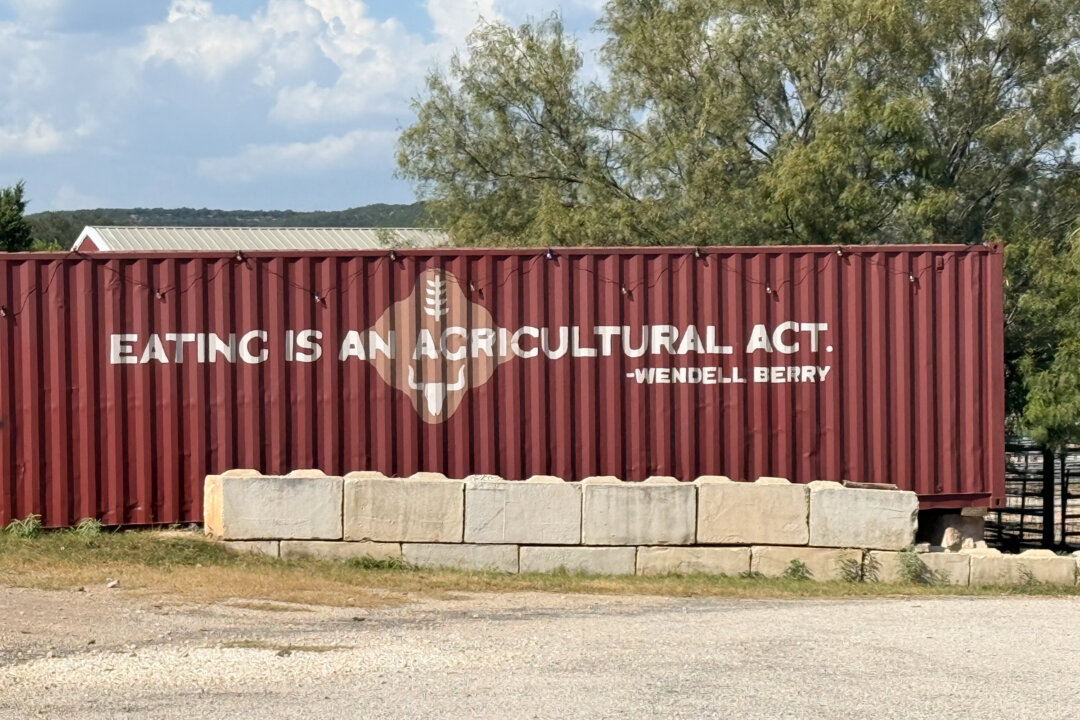
Wendell Berry's words are painted in enormous letters on the side of a shipping container outside my restaurant: 'Eating is an agricultural act.'
Customers walk past those words every day. My children have grown up around them. I have walked past them thousands of times on my way between the restaurant and the farm, moving through a life that looks almost nothing like the life I was living when I first encountered Wendell Berry.
I was a vegan chef then. Not casually vegan. I built restaurants around that conviction. I believed deeply that abstaining from animal products was one of the clearest ways I could reduce suffering in the world. I loved animals, and the moral equation seemed fairly simple: Animals wanted to live, therefore killing them to eat was wrong.
Then I read Wendell Berry.
There was one passage in particular that gave me goosebumps. I remember reading it and having that strange experience of encountering something that contradicted almost everything I believed and simultaneously knowing, somewhere deeper than belief, that it was true.
'To live, we must daily break the body and shed the blood of Creation.'
Berry went on to make the distinction that changed something fundamental in me. We can participate in that reality 'knowingly, lovingly, skillfully, reverently,' or we can participate in it ignorantly and destructively.
I had spent years believing there was a way out of the moral dilemma of eating. Berry was telling me there wasn't.
We eat life. Plants are alive. Animals are alive. Agriculture participates constantly in birth, death, decomposition, and renewal. There is no human diet that allows us to stand outside of that cycle. The question isn't whether something dies so that we can live. The question is what kind of relationship we have with the lives and deaths that sustain us.
It was almost the opposite of everything I had understood to be true, and I knew it was right.
Berry did not make me care less about animals. If anything, he demanded that I care more. His argument was never that animals don't matter or that their suffering should be dismissed because humans want to eat them. In 'The Pleasures of Eating,' Berry wrote that although he was not a vegetarian, he disliked the idea that an animal had been made miserable in order to feed him. He wanted his meat to come from an animal that had lived outdoors, uncrowded, on good pasture, with water and shade.
Some people, Berry acknowledged, would consider it bloodthirsty to eat an animal you had known throughout its life. His answer was that knowing the animal allows you to eat 'with understanding and with gratitude.'
Today, I know exactly what he meant.
I did not read Wendell Berry one afternoon, eat a steak that evening, and become a regenerative farmer the next morning. Transformations are rarely that tidy. But he opened a crack in a worldview that had previously felt complete, and through that crack came questions I could no longer stop asking.
If death is unavoidable in agriculture, then what does ethical agriculture actually look like? If grazing animals can build soil, cycle nutrients, and create fertility, is removing animals from agriculture necessarily kinder? If cattle can convert grasses humans cannot eat into nutrient-dense food while participating in the fertility of a landscape, is that morally inferior to a crop simply because the deaths involved in growing the crop are less visible to the eater?
Most importantly, I began to wonder whether my job was really to remove myself from the cycle of life and death, or whether my responsibility was to enter that cycle consciously.
Eventually, I did.
I went from being a vegan chef in Los Angeles to becoming a farmer and rancher in Texas. Today I raise animals that I love, and some of those animals eventually become food. There was a time when I would have considered that sentence an irreconcilable contradiction. Today, I don't.
Raising animals has not made eating meat less serious for me. It has made it infinitely more serious. I know what it means to bring an animal into the world and care for it. I know what it means to keep water in front of animals through a Texas summer, to watch the sky during a drought and pray for rain, to move cattle onto fresh grass, to notice whether an animal is thriving and whether the pasture is improving beneath its feet.
I know individual animals. I know their personalities and their habits. I know which cow will let me walk up to her and which one wants nothing to do with me. And I know what it means when an animal I have cared for becomes nourishment for my family or someone else's.
That intimacy is not a moral failure. Berry helped me understand that it could be precisely the opposite.
Modern industrial food has allowed us to confuse distance with innocence. We outsource the growing, killing, slaughtering, and processing and then encounter food beneath fluorescent lights, wrapped neatly in plastic. We have removed ourselves so completely from agriculture that we can imagine ourselves merely as consumers rather than participants.
Berry refused that abstraction. 'I begin with the proposition that eating is an agricultural act,' he wrote in 'The Pleasures of Eating.'
That sentence eventually became important enough to me that I painted it on a building.
What I did not understand when I was vegan was that avoiding meat did not remove me from agriculture's consequences. I could care intensely about the visible death of a cow while knowing very little about the mouse, snake, bird, insect, or soil organism affected by producing my plant-based meal. I could know whether an ingredient was vegan without knowing the farmer who grew it, the condition of the soil, how much water was used, what chemicals were applied, or what ecosystem had been displaced.
Farming destroyed that simplicity for me because the land itself is not simple.
A farm is birth and death happening simultaneously. Grass becomes cow. Manure becomes fertility. Dead plants become soil. Microbes consume and are consumed. A calf is born in the same pasture where something else has died. Everything is eating and eventually everything is eaten, including us.
Berry understood that the answer to this reality was not despair or denial. It was gratitude. He wrote that eating with full awareness of where our food comes from can reveal our dependence upon 'creatures we did not make and powers we cannot comprehend.'
That is a radically different way to think about food, and it changed my life.
When I first read Wendell Berry, I believed the most ethical relationship I could have with an animal was not to eat it. Today I believe my responsibility is much larger than that. I have to know the animals. I have to care for them. I have to care for the soil beneath them and the water they drink. I have to give them a life appropriate to their nature. And when their lives become nourishment for mine, I have to receive that nourishment without pretending nothing died.
That isn't less reverence for life than I had when I was vegan. It is more.
Wendell Berry died this week at 92 years old, at home in Kentucky. His words, however, are still painted on the shipping container outside my restaurant. They have become so familiar that sometimes I probably walk past without consciously reading them: 'Eating is an agricultural act.'
I understand those five words very differently today than I did when I first encountered them.
Berry gave me goosebumps all those years ago because he put words to something I had not yet learned from the land: Life does not exist apart from death. We cannot make ourselves innocent by refusing to look at that exchange. We can only decide how we will participate in it—knowingly or ignorantly, wastefully or carefully, with indifference or with gratitude.
I have spent much of my adult life trying to choose gratitude.
May I be worthy of my meat.
Views expressed in this article are opinions of the author and do not necessarily reflect the views of The Epoch Times.
Related Opinion
A note on cookies
Newshunt uses essential cookies to keep you signed in and to remember your language and country, so the site works the way you expect. With your permission, we'd also like to use analytics cookies to understand how people use Newshunt and improve it over time.
Accepting only affects analytics. To learn more, view our Privacy Policy or Terms & Conditions.
(0)Comments