


Times Union Editorial Board
Editorial: A quarter-century from Ground Zero

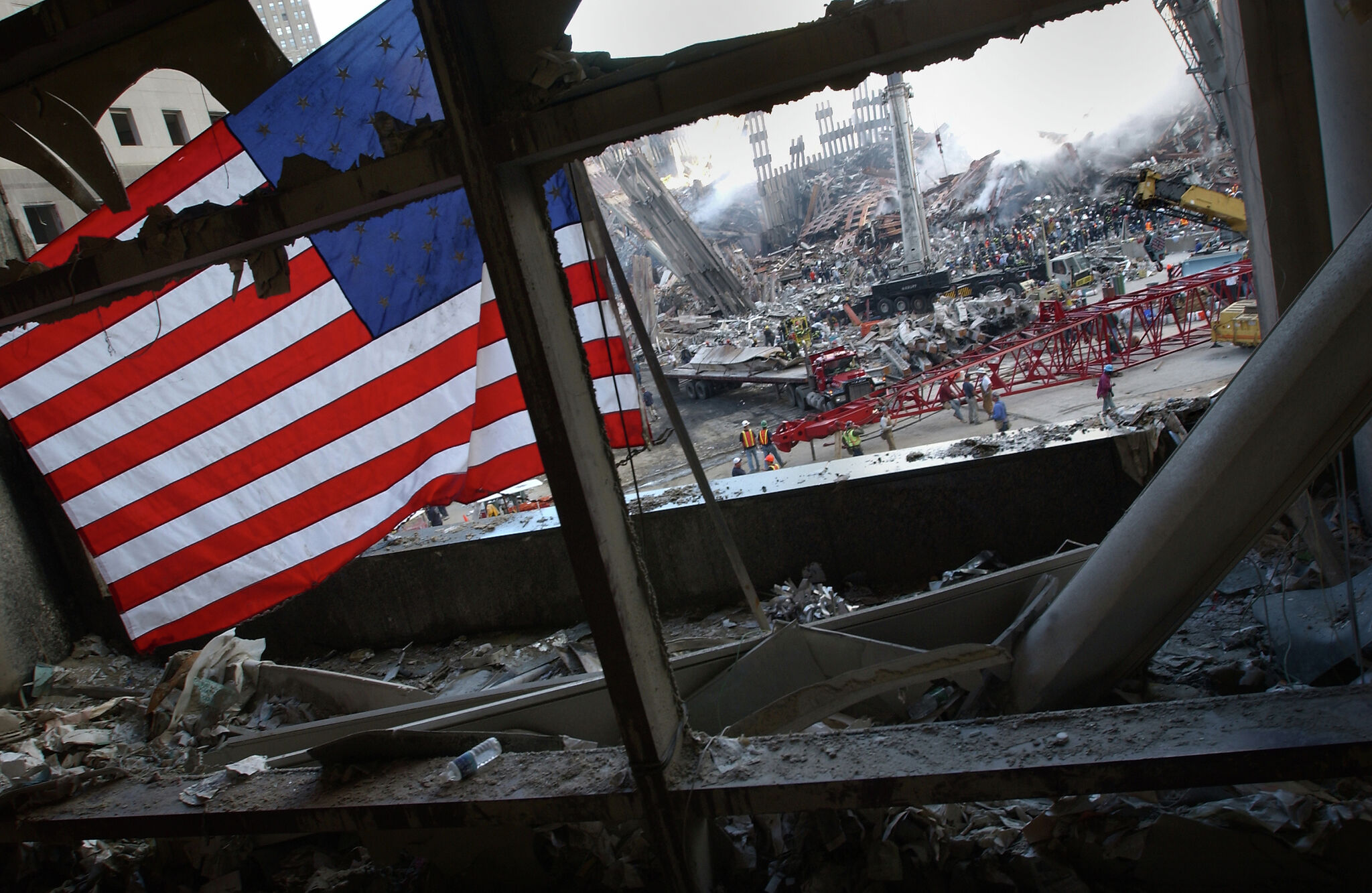
The World Trade Center site in Manhattan on Sept. 15, 2001.
U.S. Navy/Getty Images
'Nothing will ever be the same.'
That phrase echoed across the nation 25 years ago in the days and weeks following the terrorist attacks on America that came to be known simply and solemnly by their date: 9/11.
Advertisement
Article continues below this ad
More Information
We'd like to hear from you: How did the events of Sept. 11, 2001, and their aftermath change or shape your life? Go to timesunion.com/sept11 to share your thoughts.
A quarter-century later, it's worth taking stock of how true that prediction has proven to be.
Most noticeably, we remain a nation at war, particularly in the Middle East. The attacks touched off a 20-year-long war in Afghanistan over the ruling Taliban's refusal to surrender Al Qaida leader Osama bin Laden, the mastermind of 9/11. The war would end, however, with the Taliban back in power.
A series of conflicts followed in that region and beyond under the vague and potentially endless cause of a global 'war on terror,' stretching from an eight-year war in Iraq – premised on President George W. Bush's administration's disproven assertion that Iraqi President Saddam Hussein was developing and acquiring weapons of mass destruction — to President Barack Obama's effort to contain the Islamic State terrorist organization and President Donald J. Trump's current quagmire in Iran.
Advertisement
Article continues below this ad
That has come at a high cost to the nation — in blood and treasure.
At least 5,489 U.S. servicemembers have been killed in action since 2001, according to the Defense Casualty Analysis System. Another 7,445 service members took their own lives in that time period. The number of self-inflicted deaths rose markedly as the war on terror expanded, though how much the conflicts or other factors are to blame is unclear.
Defense spending has risen from $415.4 billion just before 9/11 to more than $1 trillion today, according to U.S. Bureau of Economic Analysis data compiled by Macrotrends. And to sustain a level of military spending not seen since World War II, the national debt has soared from $5.8 trillion to more than $40 trillion. While debt back in 2001 represented about 55% of the gross domestic product, it now amounts to about 125% of GDP, according to the Federal Reserve; the interest payments now consume roughly as much as the entire defense budget.
Advertisement
Article continues below this ad
With 9/11 came the formation of a secret terror court that allows spying on Americans, and the Department of Homeland Security, which unified much of the federal law enforcement, intelligence and immigration apparatus. It ushered in a new era of heightened surveillance that's evident in so much of our lives – and which many have come to tolerate in the name of national security or public safety. Security remains tight in airports. Metal detectors and other measures are common in public venues and even many private buildings. We're witnessing the ever-expanding proliferation of surveillance cameras.
And 9/11 intensified the xenophobia that has waxed and waned over the course of American history, bursting forth in the form of anti-Muslim rhetoric that spilled from right-wing media outlets into our public discourse. We still hear some lawmakers in state capitols and Congress warn, without proof or a rational basis, of strict Islamic Sharia law threatening to supplant our justice system, or of America being somehow conquered culturally and politically by immigration.
One week after 9/11, the esteemed former U.S. Sen. Daniel Patrick Moynihan of New York invoked a phrase that so many people were uttering as they watched, over and over, the images of the Twin Towers collapsing. 'The world out there is now in here, and nothing will ever be the same,' he wrote. He wrote, too, of how the conflict that had begun had deep roots in a century's worth of Western attempts to rule over that Islamic world: 'Now is the time of revenge; nothing will change this.'
But he also urged us to not grow isolated or sink into paranoia, but to 'keep in mind that you often have more friends than you think. The terrorists terrify them! So cultivate them. And keep in mind: We are a singularly successful multi-ethnic society. We have a vibrant Islamic community of emigrants from across the world. They will be heard in those parts of the world they come from, and they can speak out.'
Advertisement
Article continues below this ad
And he quoted, of all people, then-Defense Secretary Donald Rumsfeld, who would help usher in the seemingly endless war on terror: 'Do not allow terrorism to alter our own way of life.'
Sign up for the Observation Deck newsletter
Keep up with the latest editorials, commentary and letters to the editor about the issues that matter to you.
Sign up here
We can't undo our failure to heed such advice any more than we can bring back the nearly 3,000 people killed on 9/11, or those who perished in the years that followed from environmental ailments related to that day's destruction, or the thousands more who have died from war.
But we always have the capacity to consider how we will continue to deal with that national trauma: Will we remain stuck in a cycle of war, harboring fear and resentments for fellow citizens and foreigners simply because of their faith? Or will we work to heal old wounds and cultivate new friendships?
Advertisement
Article continues below this ad
Nothing will ever be the same. But we have the choice to mourn the past or, instead, to celebrate that we have the freedom to choose our path.
Related Opinion
A note on cookies
Newshunt uses essential cookies to keep you signed in and to remember your language and country, so the site works the way you expect. With your permission, we'd also like to use analytics cookies to understand how people use Newshunt and improve it over time.
Accepting only affects analytics. To learn more, view our Privacy Policy or Terms & Conditions.
(0)Comments