


unknown
OPINION: Beau Bayh is running a campaign 30 years out of date

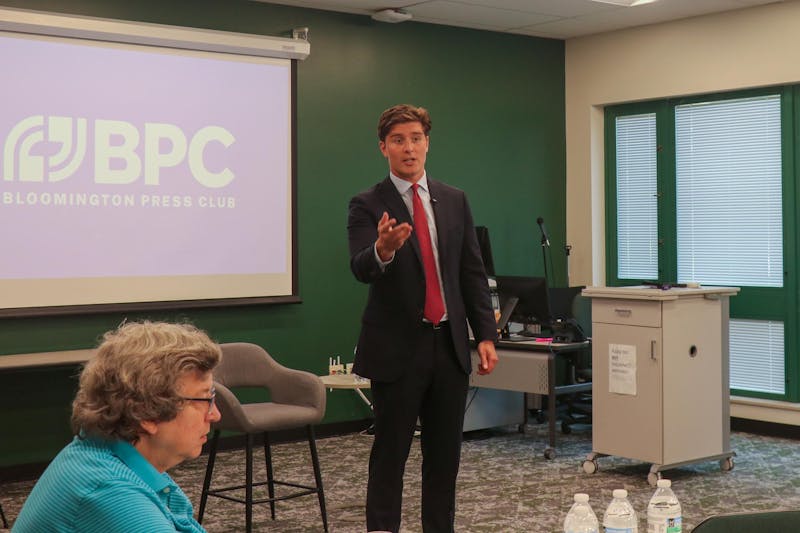
The Democratic candidate for Indiana secretary of state, Beau Bayh, is an almost lab-grown response to moderate Democrats' perceived shortcomings of the party.
Where party strategists once blamed 'racism' and 'sexism' for former Vice President Kamala Harris' 2024 loss, Bayh is a straight white man. Where Democratic representatives once bemoaned the perception of Harris as an 'uber-leftist,' Bayh takes a decidedly moderate stance. Where Democratic commentators once deemed Harris an 'elitist,' Bayh proudly proclaims his status as a military veteran and 'seventh generation Hoosier.'
Political correspondent Adam Wren described him as 'an increasingly strong candidate who could show Democrats how to win an election in Trump country.'
A Bayh win in November would prove Democratic strategists correct about what ails the party: that a white man who promises little more than the status quo can defeat Donald Trump-aligned candidates, that Joe Biden's failures were merely age and 'elitism' and that nothing needs to fundamentally change to win back middle America.
But Bayh's loss would add to the growing mountain of evidence that corporate-backed and 'Third Way' Democrats are in terminal decline within the party. Recent Democratic primaries have called into question the argument that moderate Democrats are more 'electable' in red states. Angie Nixon, a card carrying Democratic Socialist, won the Democratic Senate primary in Florida, a Republican stronghold. Abdul El-Sayed, a progressive who has made Medicare for All a centerpiece of his campaign, won the Senate primary in Michigan, a swing state which went red in 2024.
Bayh is running light on policy, but long in branding. Since this race is his first run for public office, he has little personal record to point to — relying instead on his family name. His father, Evan Bayh, was Indiana governor from 1989 to 1997 and senator from 1999 to 2011. Beau's grandfather, Birch Bayh, served as a Democratic senator from 1963 to 1981. The Bayh dynasty harkens back to a less divided time, when Indiana was considered a purple state and Democrats could survive statewide elections. Beau is counting on this association to win public office.
Bayh's strategy is nothing new. President Bill Clinton used it 30 years ago. After Democrats lost control of both the House and Senate in the 1994 elections, Clinton pivoted hard to the right, proclaiming 'the era of big government is over' in his 1996 State of the Union. He would go on to sign the Republican-drafted 'Welfare to Work' bill, which ushered in the reign of work requirements and an inadequate state-run welfare system which remains with us to this day. Clinton went on to win the 1996 elections, a win which is largely credited to his 'triangulation' strategy, where politicians follow the winds of public opinion.
The Indiana Democratic Party has tried this play before. In 2024, former State Superintendent of Public Instruction Jennifer McCormick launched a bid for the governor's mansion. McCormick, a former Republican, focused her campaign on the same talking points as Bayh: financial responsibility, protecting Hoosiers and her background as a 'proud military mom.' McCormick ultimately lost to Gov. Mike Braun by 13 points.
The glaring issue of this approach is that it assumes public opinion is largely immutable and legitimizes Republican narratives instead of challenging them. For example, Harris, who largely abandoned supporting transgender rights, claimed simply 'I will follow the law' in an October 2024 Fox News interview. Harris' relative silence allowed Trump to cast himself as a moderate, despite supporting both a ban on gender-affirming care for minors and codifying that the U.S. government only recognizes two genders, assigned at birth.
The narrative that children are pressured to transition by their peers and come to regret their gender-affirming care has gone largely unchallenged by Democrats, despite no evidence in support of this narrative. In Indiana, these misconceptions led to the passage of Indiana House Enrolled Act 1041 in 2025, which established that transgender girls and women are barred from joining K-12 and collegiate women's sports within the state. Despite mountains of evidence against this law, Bayh endorsed it — no doubt a continuation of Harris' 'I will follow the law' strategy, intended to court conservative voters.
Bayh's co-option of conservative talking points does not end there. As secretary of state, Bayh would oversee Indiana's election procedures and claims on his campaign website that he stands against illegal votes, but also for protecting the legal right to vote. The idea illegal votes pose a significant threat to election integrity is another debunked Republican talking point that has been used to suppress legal voting practices. But Bayh seems more than willing to act as if it is a crisis to appeal to conservative Hoosiers.
Bayh's affiliation with conservatism goes beyond his moderate policy. Trump-aligned donor Marc Rowan gave Bayh's campaign $25,000; Rowan also maintained a years-long relationship with Epstein that continued after Epstein was convicted as a sex offender in 2008. Bayh almost certainly became connected to Rowan through his father, who works as a senior adviser for Apollo Global Management, Rowan's company. Bayh's corporate connections are concerning, especially because he publicly opposes the influence of special interest groups.
Bayh seems like a Democrat in name only. He does not support transgender rights or pledge to govern for Democrats, and he accepts contributions from the same people he claims to oppose. This makes Bayh typical of the wing of the party that still bets on moderation winning elections. He's running his grandfather's name on his father's politics, updated for an electorate that already rejected McCormick in 2024.
A win in November could keep that bet alive a little longer. A loss will be one more sign that Indiana Democrats cannot win in red America by becoming moderate Republicans.
Spencer Robinson (he/him) is a junior studying public policy analysis and law and public policy. His commentary can also be found on his Substack.
Related Opinion
A note on cookies
Newshunt uses essential cookies to keep you signed in and to remember your language and country, so the site works the way you expect. With your permission, we'd also like to use analytics cookies to understand how people use Newshunt and improve it over time.
Accepting only affects analytics. To learn more, view our Privacy Policy or Terms & Conditions.
(0)Comments