


Dr Rajendran Govender
BRICS 2026: Why the New Delhi Summit matters to a changing world

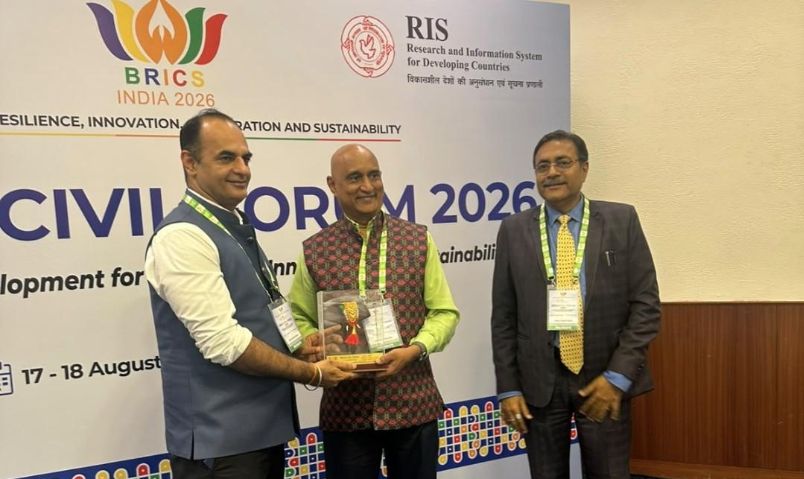
Dr Rajendran Govender, centre, with Professor Sachin Kumar Sharma, Director General of Research and Information System (RIS), India, left, and Dr Rajan Sudesh Ratna, Coordinator of DAKSHIN RIS, India.
Image: Supplied
WHEN the leaders of the BRICS nations gather in New Delhi on September 12 and 13, they will meet at a moment when the architecture of international relations is undergoing profound change.
Wars and geopolitical tensions, climate change, artificial intelligence, inequality, food and energy insecurity, disrupted supply chains and growing demands for reform of global institutions have created a world in which the old centres of power can no longer provide all the answers.
It is against this background that BRICS has assumed increasing significance.
For the ordinary reader, BRICS can sometimes appear to be another acronym in the alphabet soup of international diplomacy. Yet its evolution tells an important story about the changing balance of global power.
BRICS began as a grouping of Brazil, Russia, India and China, with South Africa joining in 2010. It has since expanded considerably, bringing additional countries into its membership and creating partnerships with other states. What began primarily as a platform among major emerging economies has evolved into a much broader mechanism for political, economic and people-to-people cooperation.
BRICS should not simply be understood as an organisation 'against' the West. That interpretation is too simplistic. Its deeper significance lies in the desire of emerging and developing countries to have a greater voice in determining the rules, institutions and priorities of the international system.
For much of modern history, institutions of global governance reflected a world very different from the one in which we live today. BRICS therefore represents part of a wider demand for a more representative, multipolar international order in which the Global South participates not merely as a recipient of decisions, but as a contributor to them.
For South Africa, this is particularly important. Our membership gives not only South Africa but potentially wider African perspectives an important platform in conversations about development, trade, finance, technology, climate change, health, culture and reform of multilateral institutions.
India assumed the BRICS Presidency for 2026 under the theme 'Building for Resilience, Innovation, Cooperation and Sustainability.' Its Presidency has emphasised a people-centred and 'humanity first' approach.
What has impressed me particularly about India's Presidency is that the September summit has not been treated as an isolated two-day meeting of political leaders.
The summit is the culmination of months of engagement.
Across India, ministers, officials, academics, business leaders, young people, women, civil society organisations, researchers and specialists from BRICS member and partner countries have participated in meetings and working groups covering a remarkable range of sectors.
The BRICS architecture now extends far beyond heads of state. People-to-people cooperation includes mechanisms involving civil society, youth, business, women, academics, think tanks, cities and other sectors.
We have seen this approach during India's Presidency in practical terms. The BRICS Youth Council Meeting and Youth Summit, for example, brought together young leaders, innovators, entrepreneurs and changemakers, with recommendations feeding into the wider BRICS process.
Environmental meetings brought BRICS countries together around climate change and sustainable development. Similar engagement has occurred across numerous other areas.
I experienced this process personally when I participated in the BRICS Civil Forum 2026 in New Delhi on August 17 and 18, including in the Culture Working Group and discussions on community-led resilience.
The Civil Forum brought civil society, scholars, specialists and institutions together around seven working areas, including health, culture, education, finance, ecology, technology, entrepreneurship and social welfare. Importantly, the recommendations emerging from these deliberations are intended to be presented through the BRICS process.
This illustrates something fundamental about international relations that is often overlooked.
Diplomacy does not begin when presidents enter a summit hall.
By the time leaders sit around the main table, an enormous ecosystem of diplomats, officials, researchers, specialists and civil society actors have already debated problems, identified areas of agreement and developed recommendations.
This makes the preparatory forums important because they bring lived experience and specialised knowledge into international decision-making.
At the Civil Forum, for example, we discussed how development could be localised so that communities become active participants rather than passive beneficiaries.
My own contribution argued that as we embrace Artificial Intelligence, we must not lose what I described as Ancestral Intelligence - the accumulated indigenous knowledge, cultural memory and wisdom that communities have developed over generations.
This is precisely the kind of conversation BRICS should encourage. The Global South should not enter international forums only with its problems. It must also arrive with its knowledge and solutions.
Africa, for example, brings extraordinary indigenous knowledge in agriculture, biodiversity, traditional medicine, community resilience and environmental stewardship. It brings the philosophy of Ubuntu and centuries of experience in community-based systems. Our linguistic and cultural diversity should similarly be regarded as an asset rather than an obstacle to development.
This is where BRICS has enormous potential.
It can become a laboratory for South-South cooperation countries with different histories and political systems exchanging solutions to challenges they often share.
But BRICS must also guard against becoming merely another layer of international bureaucracy.
Its success should not ultimately be measured by the number of declarations issued, meetings held or photographs taken. It should be measured by whether cooperation improves people's lives.
Can BRICS help create greater trade and investment opportunities? Can it improve food and energy security? Can it strengthen responses to climate change? Can it make technology and AI more inclusive? Can it support multilingualism and indigenous knowledge? Can it create opportunities for young people? Can it strengthen cultural exchange and tourism? Can it give developing countries a stronger voice in global institutions?
These are the tests that matter.
The expansion of BRICS also brings challenges. A larger grouping means greater diversity of national interests and geopolitical perspectives. Consensus will sometimes be difficult. The credibility of BRICS will therefore depend on whether diversity can be transformed into constructive cooperation rather than paralysis.
Yet perhaps that is also BRICS' greatest opportunity.
In an increasingly divided world, nations do not have to agree on everything in order to cooperate on something.
The New Delhi Summit should therefore be understood as more than another diplomatic gathering. It represents another step in an ongoing conversation about what the international order of the 21st century should look like and whose voices should help shape it.
India's Presidency has demonstrated the value of preparing for that conversation from the ground upwards - bringing governments together, but also creating space for experts, civil society, youth, women, researchers and communities.
As leaders gather in September, they will inherit the collective work of these many preparatory engagements. The challenge will be to turn those ideas into action.
BRICS will have justified its growing global influence when its impact can be felt not only in summit declarations and diplomatic corridors, but in the everyday lives of the people it ultimately exists to serve.
That is the real promise of a people-centred BRICS - not simply a new balance of power, but a broader sharing of voice, knowledge, opportunity and responsibility in shaping our common future.
Govender is a Social Anthropologist and Researcher; Commissioner in the Cultural, Religious and Linguistic Rights Commission; and Board Member of the Pan South African Language Board. He was appointed Co-Chair for the 2026 BRICS Civil Forum, which was held recently in New Delhi. He writes in his personal capacity.
** The views expressed do not necessarily reflect the views of IOL or post.co.za
POST
Related Opinion
A note on cookies
Newshunt uses essential cookies to keep you signed in and to remember your language and country, so the site works the way you expect. With your permission, we'd also like to use analytics cookies to understand how people use Newshunt and improve it over time.
Accepting only affects analytics. To learn more, view our Privacy Policy or Terms & Conditions.
(0)Comments