


Kantipur Media Group
When the ground disappears, the sky must be organised

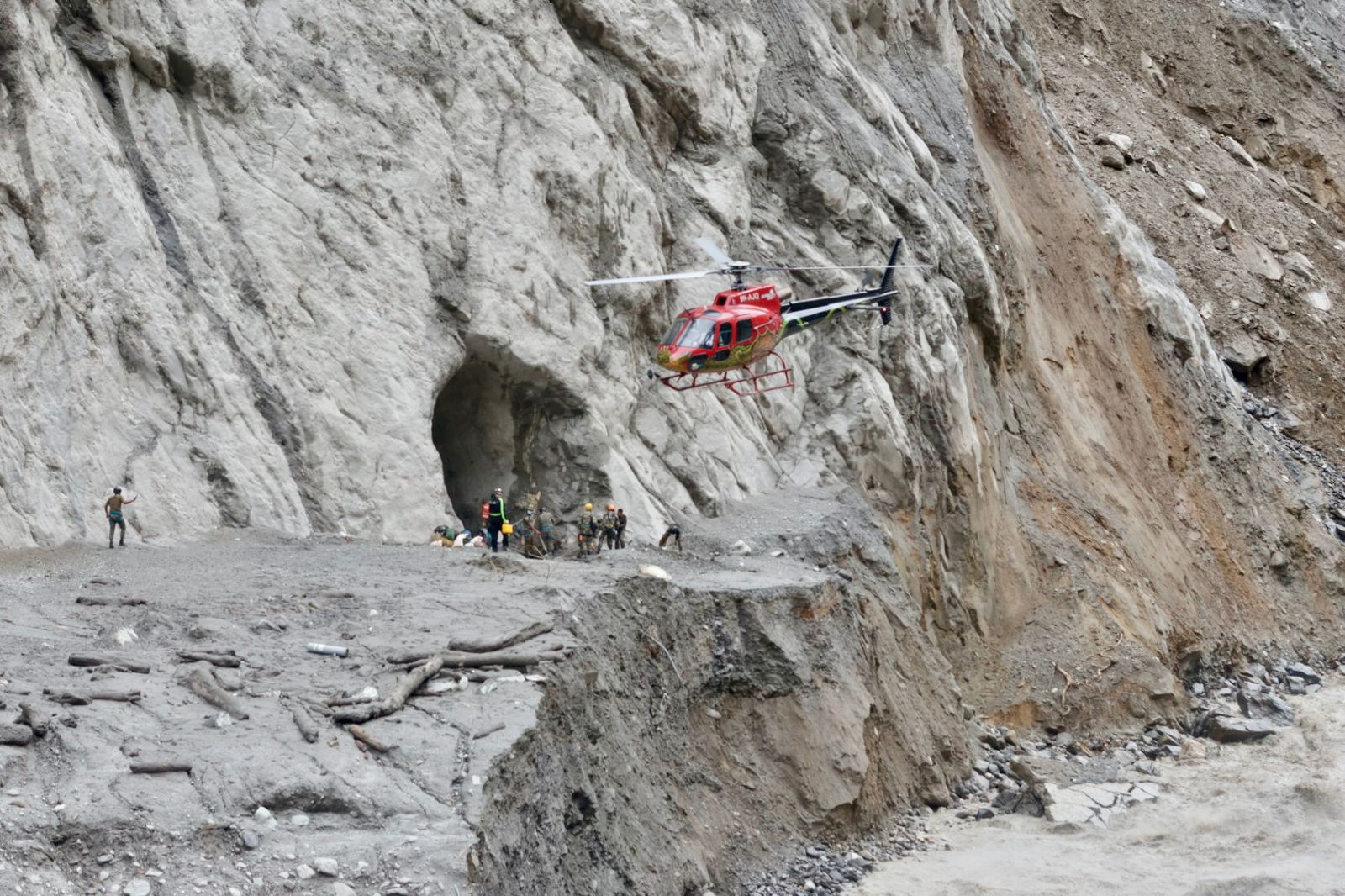
On August 26, Bhotekoshi did something Nepal's disaster system is still not designed to handle. It erased roads, swallowed bridges into brown water and reshaped riverbanks. For the people trapped on the other side, there was no means to get out. The sky was the only route undisturbed. While drones provided assessment and the scale of destruction initially, helicopters were the main means to support rescue and airlift capabilities.
In the first hours after the flood, helicopters became the only practical way to reach cut-off areas. Army and private choppers flew into narrow valleys where radio coverage is patchy and formal air traffic control is often absent. Pilots scanned for landing spots that no longer matched their mental maps. They negotiated rotor clearance against newly unstable slopes. They managed density altitude, fuel margins and payload limits while carrying injured survivors, medical teams and emergency supplies. In some places they hovered low enough to lower baskets or place skids on debris-strewn clearings that had never been intended as helipads.
This was not routine flying but high-stakes mountain aviation under extreme pressure. Radio calls overlapped. Weather cells moved through the valleys with little warning. Aircraft from different operators shared the same confined airspace with limited shared information. Pilots relied on continuous position reports, informal traffic deconfliction and pure flying discipline to keep everyone safe. That is not a sustainable system. It is an ad hoc response held together by individual skill.
Nepal already possesses the raw ingredients for a far stronger capability. The Nepal Army has aircraft, trained crews, logistics and the ability to surge large numbers of personnel. Private operators maintain helicopters, and experienced mountain pilots are distributed across the country. Together, these assets are powerful; alone, and activated only after a disaster, they remain fragmented.
What Nepal needs is not more helicopters, but a permanent National Disaster Aviation Unit. This unit should not own its own fleet and become another large bureaucracy. Its role is to coordinate every available military and civilian machine before, during and after a crisis.
Before any disaster, the unit would maintain a live inventory of aircraft, their exact payload and passenger capacities, operating bases, crew readiness, and technical limitations. It would establish common communication frequencies and standard dispatch procedures so that every pilot knows who is controlling the airspace and how tasking is prioritised. It would identify and prepare emergency landing zones in vulnerable districts, including simple marked pads, known wind patterns and clear approach paths. It would define cost-sharing arrangements in advance so that no operator hesitates over payment during an emergency. And it would run regular joint exercises involving the Army, private operators, police, Armed Police Force, hospitals, local governments, and disaster authorities, so that the first time these groups work together is not in the middle of a crisis.
When disaster strikes, the unit would take operational lead. It would function as a central dispatch cell, assigning missions, sequencing aircraft into the same valleys, updating weather and terrain information, and maintaining a shared operational picture. In remote Himalayan terrain, formal air traffic control is often limited or non-existent. A well-run dispatch cell fills that gap. It reduces radio congestion, prevents two helicopters from competing for the same confined landing zone, and ensures that medical teams on the ground know exactly when an aircraft is inbound. After each operation, the unit would conduct structured debriefs, capture lessons, and refine procedures, so that the next response is sharper than the last.
During the Bhotekoshi response, private and army aircraft were already operating through an ad hoc integrated dispatch arrangement. That temporary coordination proved useful. It also proved that the model works. The task now is to make it permanent rather than leaving it to be reinvented under pressure every time the rivers rise.
Rasuwa exposed the limits of the current approach with painful clarity. Pilots flew over terrain that had been rewritten by water and debris. Radio links failed in the deeper valleys. Ground-based air traffic support was thin, relying on continuous radio calls, shared position reports, and their own judgement to stay safe.
A country should not depend on individual pilots improvising coordination while flying one of the most demanding missions on earth. A dedicated aviation unit can give them a common picture: which valleys remain open, which landing sites are still usable, where other aircraft are operating, which areas need immediate evacuation, where medical teams are waiting, and where weather or fresh landslides have changed the picture again. With that information, pilots can focus on the single hardest task in mountain rescue: flying the aircraft safely.
Rescue itself is only the first phase. The harder work begins only after the immediate evacuations end. Food, medicines, communications equipment and engineers must still reach communities that remain cut off. Aerial assessments are needed to understand the full scale of damage. Remote villages require sustained supply until roads can be restored. Helicopters remain essential in this phase, yet their effectiveness depends on the same coordination that was missing at the start.
There is also a fundamental safety truth that must be protected—disaster response creates enormous pressure. When people are trapped, the demand is to launch immediately, but mountain aviation does not obey that demand. Weather can close a valley in minutes. A landing site can become unusable. Dust, rain, cloud and shifting debris can turn a simple approach into a high-risk manoeuvre. A system that pressures pilots beyond safe limits is not a rescue system. A national unit must provide better information and clear tasking while leaving the final go or no-go decision with the pilot in command. The goal, rather than to fly more sorties, is to fly the right ones safely.
The Bhotekoshi flood is still unfolding. I have spent much of my career in aviation— 15 years at Airbus across Europe, the US and India before returning to Nepal and serving as the CEO of a Nepali helicopter operator, flying the very mountains that Bhotekoshi tore apart. That experience has changed how I see our geography. In many countries, emergency response can rest primarily on roads, ambulances and ground teams. But in Nepal, a single landslide can block a road. A bridge can disappear in minutes. An earthquake can isolate several districts at once. A glacial lake outburst can send water and debris down a valley before ground teams arrive. In those moments, aviation is not a luxury. It is an alternative form of access.
The immediate priority remains saving lives and supporting those affected. Once the acute phase passes, Nepal should not simply rebuild what was destroyed and move on. This disaster exposed the vulnerability of our ground infrastructure, the gaps in communications, the difficulty of coordinating across devastated terrain, and the real value of the country's helicopter fleet. The lesson is not that Nepal needs more helicopters. The lesson is that Nepal needs to know how to use the helicopters it already has before the next disaster arrives.
A permanent National Disaster Aviation Unit that coordinates the Nepal Army, private operators and other emergency agencies is a practical and achievable step. It would turn scattered capability into organised national capacity. Bhotekoshi has shown us what happens when the ground disappears. Next time, the response from the sky should already be organised.
Related Opinion
A note on cookies
Newshunt uses essential cookies to keep you signed in and to remember your language and country, so the site works the way you expect. With your permission, we'd also like to use analytics cookies to understand how people use Newshunt and improve it over time.
Accepting only affects analytics. To learn more, view our Privacy Policy or Terms & Conditions.
(0)Comments