


Noah Feldman Bloomberg Opinion
The Supreme Court's ballroom decision is about more than the ballroom

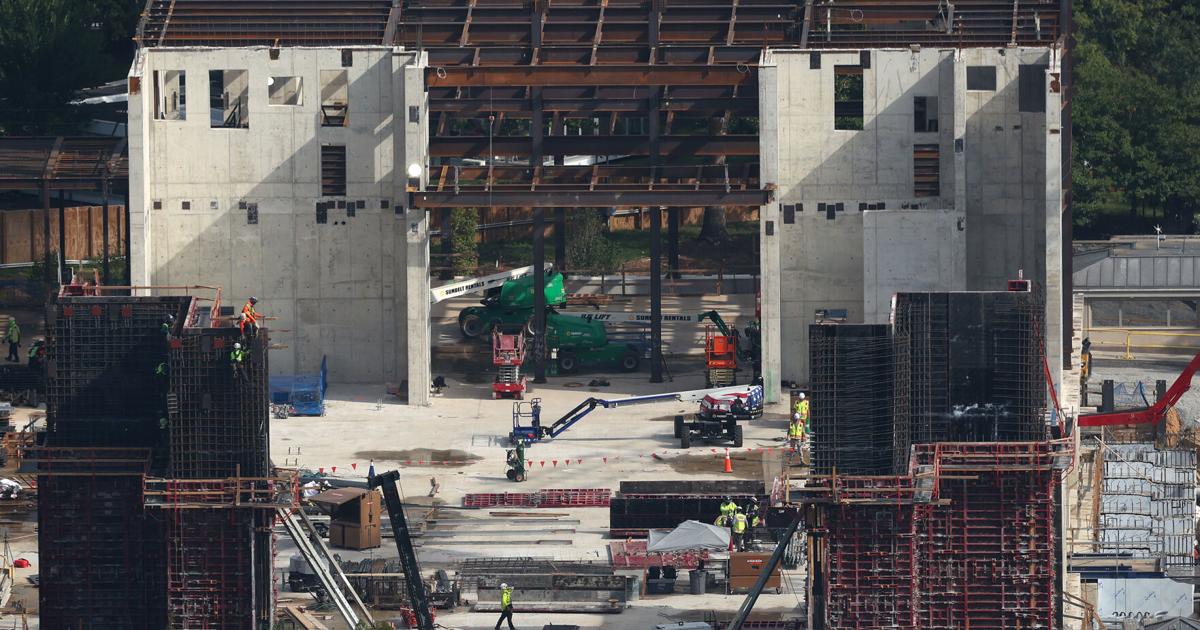
Construction of the new ballroom continues at the White House on Sept. 1, 2026, in Washington, D.C. A divided U.S. Supreme Court allowed construction of the project to continue in a ruling issued yesterday.
In a genuinely surprising decision, the Supreme Court has dismissed a lawsuit against President Donald Trump's congressionally unauthorized ballroom construction project. Over a dissent by Chief Justice John Roberts, who was joined by the court's three liberals, the court's five conservatives said that the National Trust for Historic Preservation lacked standing to challenge the ballroom being built where the East Wing of the White House used to be.
The unsigned opinion raises an obvious question — if the National Trust for Historic Preservation can't challenge the destruction of a historic building, who can? — and a less obvious one: How is the White House like a crocodile?
I'm not being facetious — Roberts actually does raise that second question. And the consequences of the first go beyond the narrow issue of who has the legal authority to challenge Trump's architectural imperialism. More than any other Supreme Court decision in recent memory, this one narrows the grounds for federal lawsuits by watchdog groups. It's so extreme, it goes much further to deny standing than even the late Justice Antonin Scalia did.
The leading precedent in the area is Scalia's opinion for the court in the 1992 case of Lujan v. Defenders of Wildlife. The basic idea of standing is that the federal courts only rule when there is a live 'case or controversy' under the Constitution. Scalia wrote that this requires 'an injury in fact,' which in turn requires 'concrete, particularized harm' to the party bringing the lawsuit.
The Lujan case involved a challenge to an EPA regulation that limited the consultation government agencies were required to do under the Endangered Species Act to when they took action in the U.S. The challengers argued that the statute should apply to projects the U.S. funded abroad which potentially harmed endangered species — such as the Nile crocodile.
Scalia's opinion held that the environmental groups lacked standing because their injury was not concrete and particularized enough. In the course of explaining what would have qualified, though, Scalia wrote that a 'desire to … observe an animal species' such as a particular crocodile, 'even for purely esthetic purposes,' was 'undeniably a cognizable interest for purpose of standing.' In a 2009 case, the court reaffirmed that statement, noting injury to a plaintiff's 'mere esthetic interests' could count as 'concrete and particularized.'
As Roberts observes in his dissent, if 'an environmentalist can sustain a concrete, particularized aesthetic injury from the extinction of a particular animal or the transformation of a particular forest or river that he regularly enjoys,' then a preservationist 'can be aesthetically injured in a concrete, particularized way by the transformation of a historic building that she frequently enjoys.'
The majority dismissed this idea, interpreting the Lujan precedent to mean that the observers' aesthetic reaction did not count as concrete and particularized but should be understood as mere 'distress at or disagreement with' the government's actions. To hear the majority tell it, if mere aesthetic objections were sufficient to bring a lawsuit, anyone could bring a lawsuit against the government any time for anything that the plaintiff disagreed with.
The vote that surprises me most in this case is that of Justice Amy Coney Barrett, who clerked for Scalia and ordinarily takes pains to make sure the court interprets his views correctly.
It's certainly true that if you read Scalia's opinion in its entirety, his statement about the cognizability of aesthetic injury is what is known as 'dicta,' which means words not technically required to reach the outcome in the case. But Scalia most certainly did not reject the plaintiffs' standing in the Lujan case on the grounds that they were merely expressing disagreement with government policy. Instead, he was careful to say that they hadn't shown that they had firm plans to visit the endangered species in question. In context, Roberts's interpretation of the Lujan opinion is superior to that of the majority.
The reason the current case is so distressing is that the conservative majority used it as an opportunity to make it still harder to sue the federal government in an emergency docket case that did not benefit from full oral argument or briefing. More than any other president, Trump delights in exceeding the bounds of congressional authority. In practice, that means it's up to ordinary citizens to bring lawsuits. The court is making it far more difficult to bring such lawsuits.
Trump's desire to act like an emperor, marring the Washington cityscape with disproportionately large triumphal arches and ballrooms, is offensive both aesthetically and symbolically; these are not monuments to democracy. The court's ballroom decision is disappointing for deeper reasons: It weakens the capacity of the judiciary to keep the president within the limits of his legal authority. In so doing, it undermines the rule of law itself.
This column reflects the personal views of the author and does not necessarily reflect the opinion of the editorial board or Bloomberg LP and its owners.
Noah Feldman is a Bloomberg Opinion columnist. A professor of law at Harvard University, he is author, most recently, of 'To Be a Jew Today: A New Guide to God, Israel, and the Jewish People.'
The Daily News-Miner encourages residents to make themselves heard through the Opinion pages. Readers' letters and columns also appear online at newsminer.com. Contact the editor with questions at letters@newsminer.com or call 459-7574.
Community Perspective
Send Community Perspective submissions by mail (P.O. Box 70710, Fairbanks AK 99707) or via email (letters@newsminer.com). Submissions must be 500 to 750 words. Columns are welcome on a wide range of issues and should be well-written and well-researched with attribution of sources. Include a full name, email address, daytime telephone number and headshot photograph suitable for publication (email jpg or tiff files at 150 dpi.) You may also schedule a photo to be taken at the News-Miner office. The News-Miner reserves the right to edit submissions or to reject those of poor quality or taste without consulting the writer.
Letters to the editor
Send letters to the editor by mail (P.O. Box 70710, Fairbanks AK 99707), by fax (907-452-7917) or via email (letters@newsminer.com). Writers are limited to one letter every two weeks (14 days.) All letters must contain no more than 350 words and include a full name (no abbreviation), daytime and evening phone numbers and physical address. (If no phone, then provide a mailing address or email address.) The Daily News-Miner reserves the right to edit or reject letters without consulting the writer.
The Daily News-Miner encourages residents to make themselves heard through the Opinion pages. Readers' letters and columns also appear online at newsminer.com. Contact the editor with questions at letters@newsminer.com or call 459-7574.
If you're interested in submitting a Letter to the Editor, click here.
Sorry, there are no recent results for popular collections.
Let us know what you're seeing and hearing around the community.
Related Opinion
A note on cookies
Newshunt uses essential cookies to keep you signed in and to remember your language and country, so the site works the way you expect. With your permission, we'd also like to use analytics cookies to understand how people use Newshunt and improve it over time.
Accepting only affects analytics. To learn more, view our Privacy Policy or Terms & Conditions.
(0)Comments