


unknown
Mecca pact: More smoke than fire

By trying to evolve a broad Islamic security framework rather than a tightly defined alliance, the pact risks sacrificing strategic coherence for political symbolism
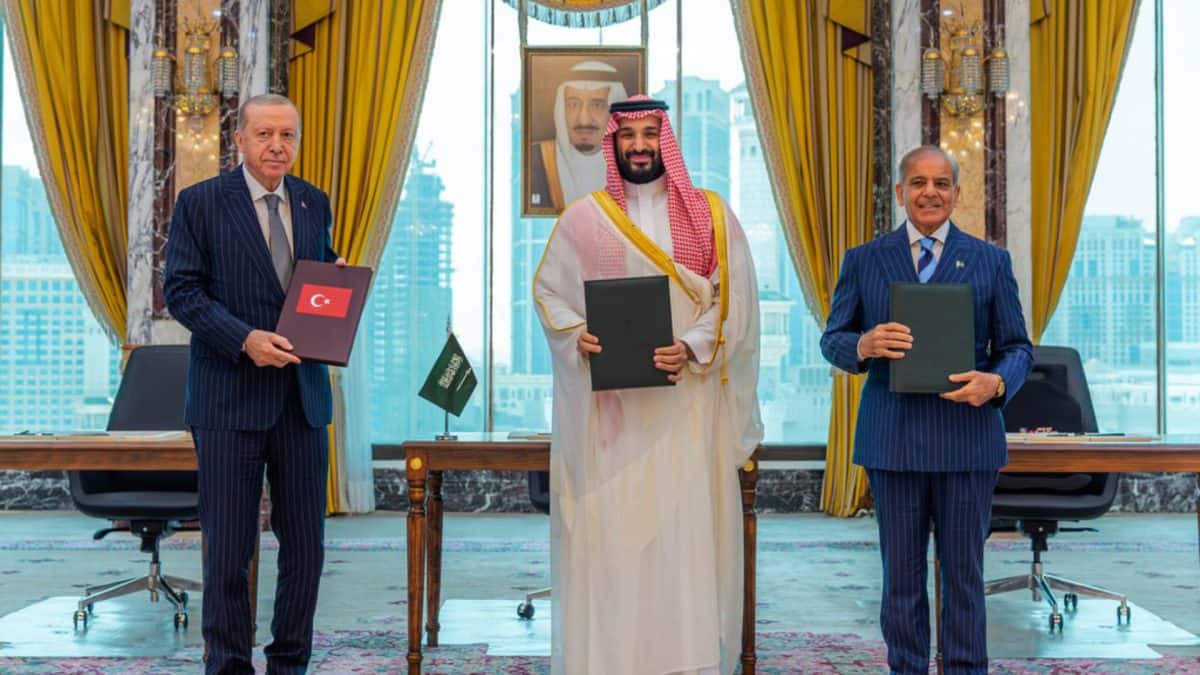
The Mecca Joint Defence Agreement has created a buzz because it suggests that an attack on any one of the three — Turkey, Saudi Arabia and Pakistan — constitutes an attack against all. It has also fuelled speculation about a new collective security arrangement in West Asia at a time when the US security architecture appears challenged by the ongoing conflict with Iran, now in its sixth month. However, a defence pact that cannot clearly define either its geographical scope or common threat represents less an institutionalised security architecture than an exercise in strategic signalling and deterrence.
The pact raises several questions. First, how is the 'region' defined for the purpose of mutual security? Pakistan is neither part of West Asia nor the Gulf. Pakistan has long been drawn towards Turkey and Saudi Arabia as leaders of the Islamic world. If Bangladesh joins, the 'region' would include both ends of South Asia. Malaysia, despite being geographically distant in Southeast Asia, has also expressed interest.
Advertisement
The problem is not that the pact has no geographical outline, but that its geography is potentially elastic enough to undermine the concept of a regional security organisation. Such a pact would be incapable of effectively addressing challenges faced by members across several regions.
The second issue is that the pact is being seen as a collective-deterrence arrangement, though not directed against any specific country. Does it nevertheless possess a sufficiently convergent threat perception to make collective defence credible?
More from Opinion
More from Opinion
Security challenges for Saudi Arabia stem from Iran and the Houthis of Yemen, apart from radicalism. Turkey, a NATO member, countenances threats from Syria, Iraq and Kurdish militant groups. Terrorism, the flow of refugees and instability on its southern borders add to the problem. These do not amount to being at risk of war with a regional adversary. Turkey's objective is to use its securitised relations with potential buyers to sell defence equipment and expand its geopolitical footprint.
Pakistan's motivations are different. It has long provided troops to Saudi Arabia to guard against internal security threats. In 2015, when the Houthis attacked Saudi cities, Islamabad made clear that it would not get involved. It was a similar situation in 2019, when the energy infrastructure at Abqaiq and Khurais in eastern Saudi Arabia was attacked.
Advertisement
Following the bilateral defence agreement with Saudi Arabia in September 2025, Pakistan is reported to have deployed a squadron of fighter aircraft and an air defence system earlier this year, but its effectiveness is far from clear. If the existing Saudi-Pakistan mutual-defence agreement did not produce an automatic Pakistani military response, what makes the trilateral commitment materially different?
Conversely, when Pakistan and the Taliban engaged in a border conflict last year, Saudi Arabia did not extend any military aid to Pakistan. In Turkey's case, Ankara has consistently supported Pakistan, politically and militarily, during its conflicts with India, including, more recently, during Operation Sindoor. The likelihood of the Mecca pact providing the foundation for a meaningful regional security architecture is low. The more the group expands, the less cogent or convergent it is likely to become.
In fact, it risks becoming yet another Islamic grouping without a clear roadmap for common military action. Reports suggest that the Istanbul meeting on August 31 agreed to establish a secretariat in Riyadh, with a Pakistani Secretary General at the helm for the first three years. If experience with the Riyadh-based IMCTC (Islamic Military Counter Terrorism Coalition), led by a retired Pakistani Chief of Army Staff, is any guide, not much can be expected.
Advertisement
Beyond signalling, the pact has limitations. Turkey and Saudi Arabia are historical competitors for the mantle of regional leadership. Turkey's association with NATO can be expected to constrain its military options under the pact. Saudi Arabia and the Gulf states seek greater regional collective security, but that is not tantamount to relinquishing the US security umbrella.
Can decisions that impact regional security be taken without consulting the US?
The pact's greatest weakness may lie in its ambition. By trying to evolve a broad Islamic security framework rather than a tightly defined alliance, it risks sacrificing strategic coherence for political symbolism.
Pakistan's economy is in dire straits. It frequently seeks financial bailouts from wealthy Islamic nations. The Mecca pact may provide yet another platform for Saudi Arabia to rescue Pakistan from economic collapse. Yet, Turkey's growing military relationship with Pakistan cannot be ignored, whether joint exercises, military-industrial collaboration or intelligence sharing.
The important question is not whether India should be concerned by an 'Islamic NATO'. The real question is whether the pact constrains India's choices following a cross-border terrorist attack.
India's new doctrine of retaliation is now a fact, regardless of any pact.
(The author is the Director General of the Manohar Parrikar Institute for Defence Studies and Analyses. The views expressed in this piece are personal and solely those of the author. They do not necessarily reflect Firstpost's views.)
Related Opinion
A note on cookies
Newshunt uses essential cookies to keep you signed in and to remember your language and country, so the site works the way you expect. With your permission, we'd also like to use analytics cookies to understand how people use Newshunt and improve it over time.
Accepting only affects analytics. To learn more, view our Privacy Policy or Terms & Conditions.
(0)Comments