


Ap Yonhap
China's semiconductor push narrows Korea's memory chip lead

Columns
As Chinese memory makers gain ground under U.S. sanctions, Korea needs a long-term strategy to preserve semiconductor leadership.
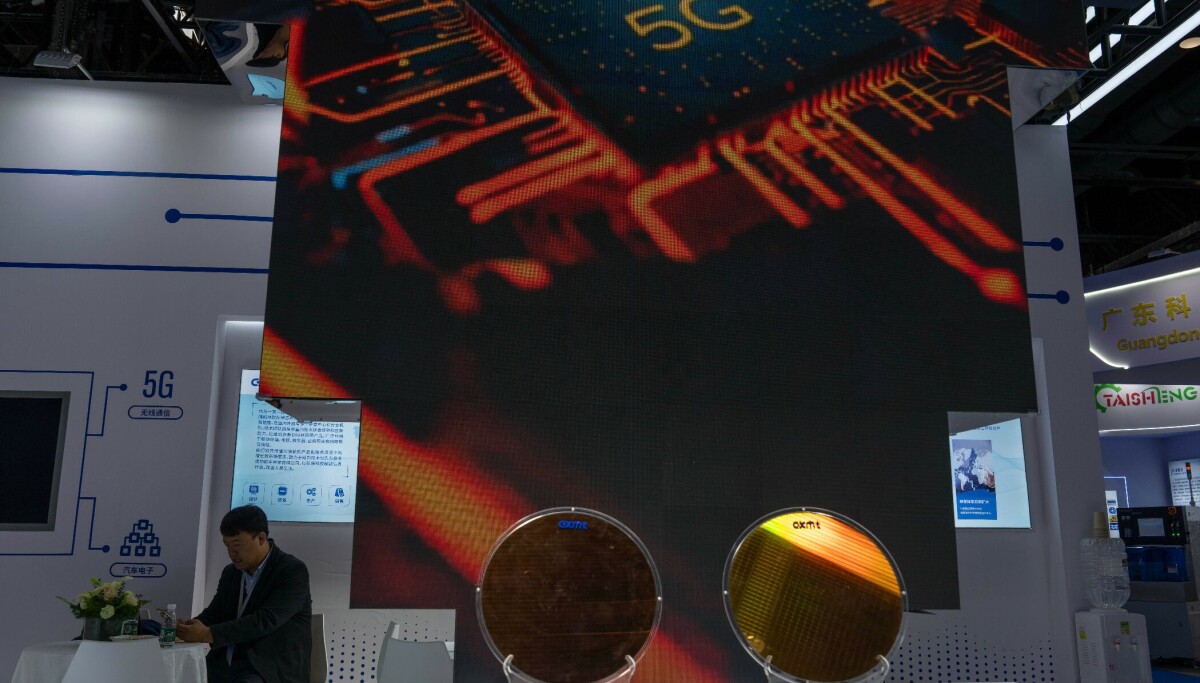
A man rests at the booth for Chinese DRAM producer ChangXin Memory Technologies, also known as CXMT, during the 21st China International Semiconductor Expo in Beijing, Nov. 20, 2024. AP/YONHAP
Baek Seo-in
The author is a professor at Hanyang University.
The global semiconductor market is enjoying an unprecedented boom as AI drives explosive memory demand, but Chinese chipmakers are making moves that deserve attention. ChangXin Memory Technologies, or CXMT, which listed in July and became China's most valuable semiconductor company, has begun supplying next-generation LPDDR6 memory for Xiaomi's new foldable phone. Yangtze Memory Technologies, or YMTC, which plans to go public this year, has declared that it will overtake Samsung Electronics and SK hynix to become the world's leading NAND manufacturer by the end of 2027.
Huawei, meanwhile, has unveiled its 'Tau Scaling Law' as an alternative to Moore's Law. A clear technology gap still offers some reassurance. Yet Chinese experts consistently insist that 'memory semiconductors have no technological barriers,' stirring fears that Korea could relive the painful experience of batteries and displays. How far has China's long march toward semiconductor self-reliance advanced?
U.S. sanctions have clearly hurt Chinese semiconductor companies' revenue, operating profits and innovation. But they have also handed China's semiconductor ecosystem an unexpected gift: stronger links between Chinese Big Tech companies developing world-class AI and domestic chipmakers only beginning to establish themselves.
Foreign 'catfish' have long helped spur China's advanced manufacturing ecosystem. Volkswagen and GM played that role in automobiles, Apple in smartphones and electronics and Tesla in electric vehicles. In AI and semiconductors, however, Chinese technology giants Alibaba, ByteDance and Huawei are replacing foreign companies as demanding customers that need high-performance chips for world-class services.
Without sanctions, they would have rushed to buy products from Nvidia, Samsung Electronics, SK hynix and TSMC. Now imports are difficult, forcing them to find domestic alternatives. They have little choice but to teach, pressure and work with Chinese semiconductor companies until they produce viable products.
In my research on Chinese semiconductor innovation, I analyzed more than 170 listed Chinese semiconductor, materials, parts and equipment companies. Although their financial and innovation performance clearly deteriorated after U.S. semiconductor restrictions, their strategic commitment to achieving technological self-reliance actually strengthened.
An analysis of academic papers on Chinese AI semiconductors over the same period also showed a noticeable increase in research produced exclusively by China-based researchers and engineers. As in most areas of China's technological rise, talent remains a critical driver.
Tsinghua University tackles scientific, technological and industrial challenges confronting the semiconductor sector. Its research spans 2.5D and 3-D stacking, chiplets, hybrid bonding, glass substrates, co-packaged optics, nonvolatile computing devices and next-generation transistors intended to overcome the physical limits of silicon scaling. These technologies address both today's bottlenecks and the next semiconductor paradigm.
A strong vocational education system supports commercialization. Jiangsu Vocational College of Information Technology, China's first vocational institution to establish a semiconductor-device major, operates training facilities and research centers while running programs with domestic chipmakers including China Resources and Hua Hong. It has produced more than 16,000 skilled workers in electronics and information technology. Their tacit knowledge circulates between schools, companies and laboratories, helping bridge basic research and commercialization.
Only a year ago, experts estimated that China lagged Korea by more than five years in conventional DRAM. Now they put the gap at three years. Korea still holds an advantage in high bandwidth memory, or HBM, but how quickly China may catch up remains unsettling.
Vigilance is appropriate as artificial general intelligence approaches and the international order changes rapidly. But Korea must also focus on the foundations of its competitiveness. Its semiconductor industry combines outstanding process capabilities with global networks Chinese competitors lack. Few semiconductor companies worldwide have accumulated as much experience in the Chinese market as Korean firms.
The government has also announced large investment plans, including three semiconductor megaprojects. Money and space are no longer the primary constraints.
Korea must now prepare for a prolonged semiconductor contest. Rather than concentrating on piecemeal regulatory changes or the next election, it should build a strategy looking toward 2045. Korea must consolidate its current position while using its resources to secure leadership in the next semiconductor paradigm.
China's long-march strategy is built on patience, accumulation and endurance. The only reliable way to withstand such a campaign is to prepare for an even longer contest, strengthening the capabilities that make Korea difficult to displace while investing early enough to lead whatever technological paradigm comes next. This article was originally written in Korean and translated by a bilingual reporter with the help of generative AI tools. It was then edited by a native English-speaking editor. All AI-assisted translations are reviewed and refined by our newsroom.
Related Opinion
A note on cookies
Newshunt uses essential cookies to keep you signed in and to remember your language and country, so the site works the way you expect. With your permission, we'd also like to use analytics cookies to understand how people use Newshunt and improve it over time.
Accepting only affects analytics. To learn more, view our Privacy Policy or Terms & Conditions.
(0)Comments