


unknown
The right to protest has launched movements toward ‘a more perfect union'

(Editor's note: This column is part of a Seattle Times Opinion series exploring the First Amendment and its five freedoms.)
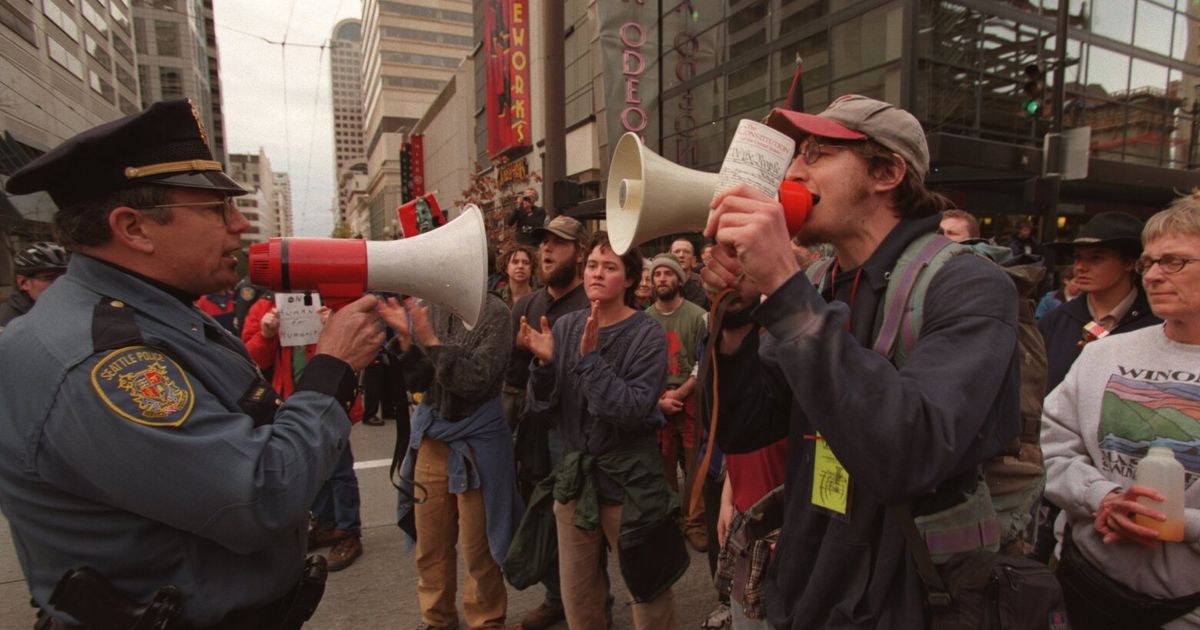
From 1919 when Seattle workers became the first in the nation to participate in an official general strike, to the Battle in Seattle 80 years later when anti-globalization demonstrators disrupted the World Trade Organization Conference, to the No Kings protests after President Donald Trump was elected to a second term, our region has played a role in protests with national and international repercussions.
The First Amendment and its five protections, particularly freedom of assembly and of the press, has helped move America into becoming a more perfect union.
The protections afforded those who live in America — not just citizens, as some would have us to believe — show up in everyday living; from student protests at the University of Washington, to those extolling Black Lives Matter in the streets of Seattle to the 70-year-olds occupying street corners to protest brutal immigration enforcement.
Lately, the right to protest — protected by the First Amendment — has been widely tested.
Advertising
Summer 2020 was filled with protests following the deaths of several Black people at the hands of police.
On March 3 of that year, Manuel Ellis, 33, was stopped by Tacoma police officers while walking home from a store. He was beaten, shocked with a Taser and hogtied before dying from his injuries in the street.
Ten days later, police in Louisville, Ky., fired upon Breonna Taylor's apartment late at night, killing the 26-year old EMT and injuring her boyfriend while they were in their bed. Turns out, Taylor was not a suspect and the police warrant had been fraudulently obtained.
That May, George Floyd was killed by Minneapolis police officer Derek Chauvin after he pressed his knee into Floyd's neck until life left his body. His death, while other officers and bystanders looked on, supercharged the Black Lives Matter movement into a global awakening.
… 'Or the right of the people peaceably to assemble'
In Seattle, some BLM protesters landed in court. As crowds got bigger and bigger during a string of protests, some people broke store windows, vandalized vehicles, looted stores and threw objects at police. Protesters eventually took over and vandalized the Seattle Police Department's East Precinct. Protesters also established and occupied the Capitol Hill Organized Protest zone, a six-block protest area around the intersection of 12th Avenue and East Pine Street, including Cal Anderson Park. The occupation continued for 23 days.
That tested law enforcement's response, exposing some failings in policies around crowd control and excessive force.
Advertising
'The city's response with violence — and indiscriminate violence — was not the correct response,' said David A. Perez, who represented the BLM protesters in a lawsuit against the city.
U.S. District Judge Richard Jones issued a temporary restraining order against the police department in its use of pepper spray and blast balls. A few days later, the police violated that order and the city was found in contempt.
'The First Amendment protects your right to speak. It also protects your right to show up. Those aren't the same rights and only one requires a crowd,' said Perez, now a partner at Morrison Foerster. 'The government doesn't get to punish you simply because 99 other people were breaking the law. There are going to be bad apples in protests. Arrest the bad apples — the people throwing rocks, the people breaking windows.''
Margaret Channon went beyond just protesting. The Tacoma woman was convicted of destroying several Seattle police cars using fire and aerosol cans on May 30, 2020, during a BLM protest.
She went too far. Such destruction is not protected by the First Amendment.
'The right to protest, gather, and call out injustices is one of the dearest and most important rights we enjoy in the United States,' then-U.S. Attorney Nick Brown said in a news release when Channon was sentenced to five years in prison in 2022. (Brown was elected state attorney general in 2024.)
'Indeed, our democracy depends on both exercising and protecting these rights,' he continued. 'But Ms. Channon's conduct was itself an attack on democracy. She used the cover of lawful protests to carry out dangerous and destructive acts, risking the safety of everyone around her and undermining the important messages voiced by others.'
As a result of the legal case, in which the city had to pay $81,000 in legal fees of the lawyers who brought the case, the city re-evaluated its policing policies when it comes to the use of crowd control devices. A new ordinance was created that, among other things, requires the mayor to declare a state of emergency before tear gas and blast balls can be used by police.
Advertising
'You can be loud, noisy and disruptive, but you can still be peaceful and not destroy property and your message will thank you for it,' said Perez. 'Your message will not come across if you're setting fires and breaking glass.'
Time, place and manner
'Assembly is still alive and well, you just have to look at the No Kings protests and the extraordinary number of people who participated in those to appreciate that taking a stand on a city street still has tremendous impact,' said Ken Paulson, director of the Free Speech Center at Middle Tennessee State University.
But he has found that many younger people, especially on college campuses, are more likely to protest via social media. It's easier — and safer — to shout discontent through a post than on the street.
That trend hasn't surfaced at the University of Washington.
A Hamas-led attack on Israel on Oct. 7, 2023, led to Israel's full-scale invasion of the Gaza Strip two weeks later. Demonstrations began on many college campuses, including at the UW.
'This is a place where students and faculty and staff are learning. They are encountering new ideas, they're meeting people from around the world. They're seeing headlines and things happening in their own community that they as young adults feel strongly about and they want to raise their voice,' said Sally Clark, UW's vice president for campus community safety.
'That's a great thing where people are exchanging ideas in the best sense when it's going really well. Our job is not to necessarily police that content, but the university does have rules for time, place and manner in terms of that freedom of expression and assembly,' Clark said.
Sponsored
It was students' decision to occupy the wrong place and use the wrong manner — barricading the entrance to the UW's Interdisciplinary Engineering Building and causing $1 million worth of damage. The protesters refused to leave for hours as part of their protest against UW's financial backing from Boeing. Dozens of students were arrested. The students wanted UW to cut ties with Boeing because of its federal contracts to manufacture weapons protesters said are used by Israel's military against Palestinians.
Most of the UW protesters were charged with first-degree trespassing, and were eventually suspended from school for violating the student code of conduct. Clark said they were allowed back on campus after a few quarters.
Protests such as this make it difficult for law enforcement to thread the needle between protecting protesters' rights while also protecting the public and institutions from illegal actions.
'Our goal is to preserve the constitutional right of anyone to peacefully assemble and protest. The key word there that comes to the centerpoint of whether that occurs is the word 'peacefully,'' said Kent Police Chief Rafael Padilla, who is president of the Washington Association of Sheriff's and Police Chiefs and was not involved in the UW incidents. 'The First Amendment provides the right to protest; it doesn't create the right to commit crimes, particularly acts of violence.
'What's good about Washington is that our law enforcement officers, through laws and policies, are held to very high standards when it comes to managing events and demonstrations, most of which are peaceful,' said Padilla, who's been with the KPD for 29 years. Among those guidelines are requirements to de-escalate situations and to deploy alternatives to the use of force.
When assemblies become violent it often occurs when counter protesters arrive to emotionally charged events, such as abortion rights demonstrations and rallies by political candidates.
History of change
Some protests, coupled with press coverage, have been powerful enough to change opinions and policies.
Every major social movement in this country has been buoyed by freedom of assembly. From the founding of the nation and creation of the Bill of Rights, to the abolishment of slavery and granting women's suffrage, all the way to the Civil Rights Movement, freedom of assembly, speech and petitioning government have been, and will continue to be, the cornerstone of positive change.
Advertising
'While assembly today is valuable, it was extraordinarily valuable to those who had no influence or power otherwise,' said Paulson.
'The women's movement began with them assembling in 1848 in Seneca Falls, N.Y., to plan a long-term fight for women's rights. It began with assembly and was perpetuated with the launch of suffrage newspapers,' Paulson said.
During the 1950s and '60s when civil rights activists took to the streets and lunch counters, they were often met with baton-wielding police officers, police dogs and fire hoses. Protest planners knew the crowds would draw the media and the media would home in on the violence that erupted in otherwise peaceful demonstrations. It was those images that captivated lawmakers and clergy members across the country and worldwide, which ultimately resulted in the Civil Rights Act of 1964.
But it took hundreds of gatherings, in public and in basements; violence; and deaths to inch the nation toward justice.
'The First Amendment is first for a reason,' said Perez. 'Assembly is a uniquely American concept that requires you to put your body somewhere that government would rather you wouldn't. Before there were ballots there were bodies in the town square and the government had to reckon with those bodies. Assembly is still the most powerful Constitutional right.'
Even with the popularity of social media versus sit-ins, marches and rallies, the power of protest goes beyond merely the right to do so. The right to assemble is in America's DNA and ignites the power of communion behind common goals and purposes.
Related Opinion
A note on cookies
Newshunt uses essential cookies to keep you signed in and to remember your language and country, so the site works the way you expect. With your permission, we'd also like to use analytics cookies to understand how people use Newshunt and improve it over time.
Accepting only affects analytics. To learn more, view our Privacy Policy or Terms & Conditions.
(0)Comments