


unknown
Honour minus rights - why increasing pay of anganwadi and ASHA workers still deprives them of rights

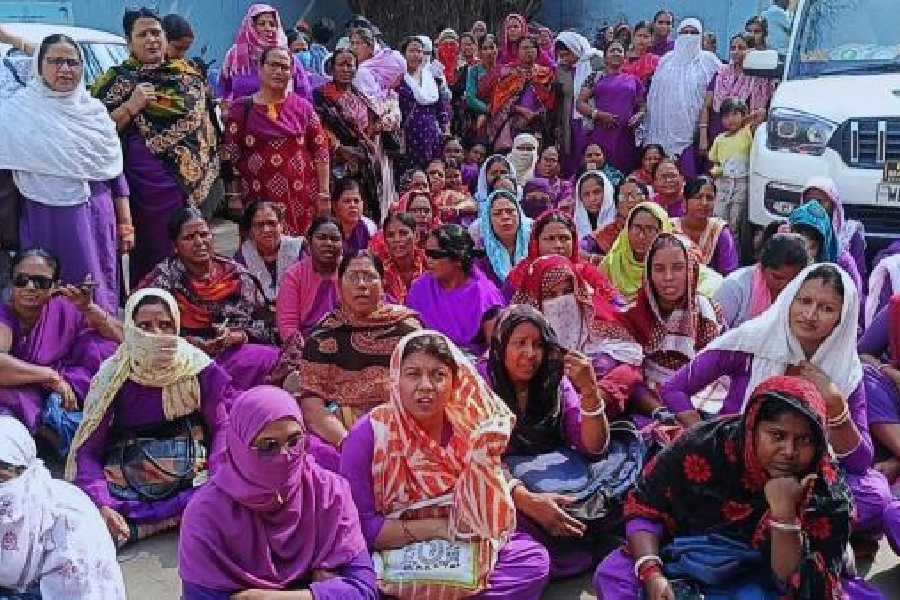
This year's budget by the Bengal government raised the monthly 'honorarium' of anganwadi workers by Rs 5,000. Yet, no one chose to think about what an honorarium is, and why it is not called a salary.
The word has a long and rich history. It originally comes from the Roman honorarium, a gift given not out of obligation but out of esteem — for instance, to the grammarian who had corrected your Latin or to the poet who had written your epitaph. An honorarium is something that is not legally binding by nature. It suggests that one's actions have been met with thankfulness and not with a sense of obligation; in other words, it is an act of generosity rather than a claim to a right. Thus, when the government refers to what it pays anganwadi workers as an honorarium, it is not only arbitrarily determining the value of their work but is also making a philosophical statement about the nature of the work.
ADVERTISEMENT
According to government data, India's anganwadi and ASHA workforce numbers approximately 34 lakh: 13.48 lakh anganwadi workers and 10.23 lakh anganwadi helpers (ministry of women and child development data, as of December 2023), and 10.47 lakh ASHA workers. These workers form the delivery team through which the Indian government fulfils its constitutional promise under Article 47 to improve nutrition and public health. They administer vaccines to babies, provide guidance to mothers who are breastfeeding, maintain nutrition records for households, and conduct schooling for young children who are not familiar with private schools. In 2022, the Supreme Court emphasised that it could not accept that these workers be given part-time, voluntary status. They, the court argued, are doing full-time jobs. The Bengal budget also recognises that their services are vital. However, the term, 'employee', is still missing on paper.
There is something particular, and peculiarly Indian, about this arrangement. Almost the entire frontline workforce of the country's child nutrition and primary healthcare systems is female. All anganwadi workers are women. All ASHA workers are women. Women also do the mid-day meal cooking. The irony is that they are all paid honorariums; in other words, they are considered volunteers. Reetika Khera, an economist who has widely researched and written on these schemes, has framed this as such: a gendered division of labour whereby care work is seen as something women are naturally good at and, hence, is not work in the legal or economic sense.
Bengal's Rs 5,000 hike is a raise. However, a raise that takes place within an honorarium framework is a raise without rights. The anganwadi worker gets more money, but still does not have any legal recourse, is not entitled to a minimum wage floor, does not have job security, and cannot claim social protection. The Code on Wages, 2019 states that an employee is a person who is working "on wages" for "hire or reward". By calling the anganwadi workers' remuneration an honorarium, the State continues to evade this definition and, consequently, every duty that comes with it.
It is worth recalling what Bengal's budget also said: that these workers supply "vital services": vital services that are carried out every day, in both villages and city slums, primarily by women who have no employment status, no minimum wages, no EPF or ESI, not even the right to challenge their removal before a labour tribunal. The state honours them generously. It is the recognition it withholds.
Related Opinion
A note on cookies
Newshunt uses essential cookies to keep you signed in and to remember your language and country, so the site works the way you expect. With your permission, we'd also like to use analytics cookies to understand how people use Newshunt and improve it over time.
Accepting only affects analytics. To learn more, view our Privacy Policy or Terms & Conditions.
(0)Comments