


Bill Britt
From Eden to Alexandria to artificial intelligence

Human beings have always wanted to know.
We have also always feared what knowing might make possible.
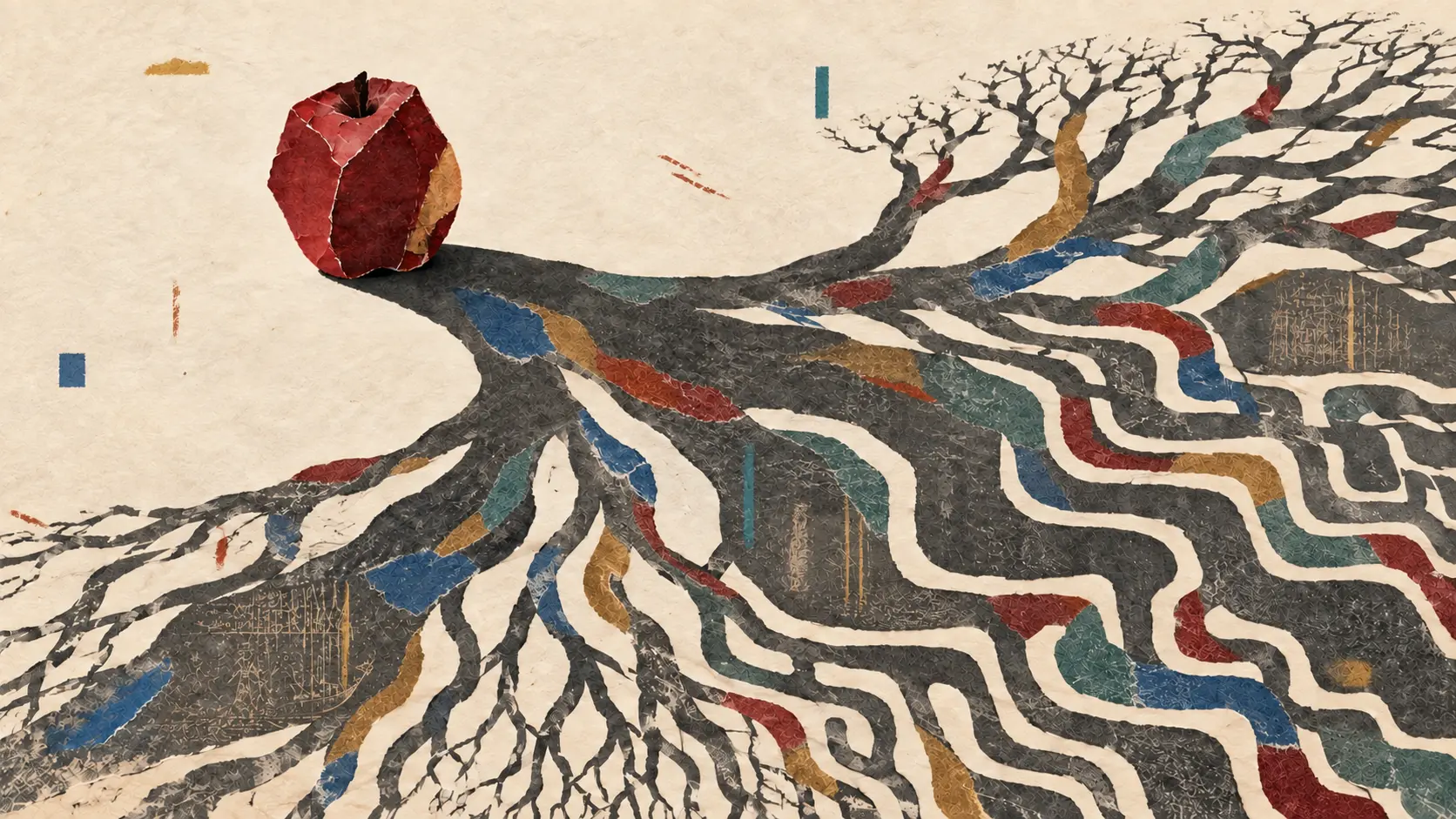
That tension is older than science, older than philosophy and older than the written word. It appears near the beginning of the biblical account of humanity, in the Garden of Eden, where Adam and Eve eat the forbidden fruit from the tree of the knowledge of good and evil.
It would be too simple to read Genesis as a warning that knowledge itself is evil. Scholars have interpreted 'the knowledge of good and evil' in different ways: moral discernment, maturity, comprehensive knowledge or the authority to judge what is good and evil.
Whatever interpretation one accepts, the story unmistakably joins knowledge with consequence. Human beings reach for a form of knowledge that carries power with it. They want their eyes opened. Their eyes are opened, but knowledge does not bring innocence, contentment or wisdom. It brings consequences they did not understand when they reached for it.
The problem was not simply that they wanted to know. It was that they sought the power attached to knowledge without possessing the wisdom to govern it.
We have been repeating some version of that story ever since. Advertisement. Scroll to continue reading.
Every great expansion of human knowledge has brought hope and fear together. Fire could warm a home or burn it. The printing press spread Scripture, science and political thought beyond the control of kings and clergy. It also spread propaganda, fanaticism and lies with a speed the handwritten world had never experienced.
The splitting of the atom revealed something fundamental about the natural world. It also placed in human hands the ability to destroy cities in an instant.
Knowledge is rarely innocent once it becomes power.
That may be why the Library of Alexandria still holds such a powerful place in our imagination.
The great library in ancient Egypt sought to gather the written knowledge of its world. Its scholars studied mathematics, astronomy, medicine, geography, literature and language. It became a symbol of civilization's determination to preserve what humanity had learned and build upon it.
The familiar story says the library disappeared in one catastrophic fire, perhaps during Julius Caesar's fighting in Alexandria in 48 BCE, and that the loss set human progress back by centuries.
The history is more complicated. Advertisement. Scroll to continue reading.
Ancient accounts conflict. Caesar's fire probably destroyed books stored near the harbor, but there is no convincing evidence that every collection disappeared in a single night. The Serapeum, which may have held a subsidiary collection, was destroyed centuries later. The story blaming Muslim conquerors in the seventh century did not appear until hundreds of years after the alleged event and is widely rejected by scholars.
The more likely explanation is less dramatic and perhaps more troubling. As The Open University's examination of the evidence explains, Alexandria's collections and scholarly institutions appear to have suffered through fires, warfare, political upheaval, declining support and long periods of neglect.
The library was probably not erased in one great act of destruction. It was gradually allowed to disappear.
Books written on papyrus did not preserve themselves. They had to be protected and recopied. That required money, institutions and generations of people who believed the work was worth doing. When that commitment weakened, works vanished.
Alexandria represents more than the destruction of a building. It represents an ancient human fear: that knowledge accumulated over centuries can be lost when the institutions entrusted with preserving it fail.
Artificial intelligence presents us with almost the opposite fear.
For most of human history, knowledge was scarce. It was held in fragile manuscripts, expensive books, distant universities, government archives and institutions that many people could never enter. Even after the internet made enormous amounts of information available, finding the right material, understanding it and connecting it to other sources still required time and expertise. Advertisement. Scroll to continue reading.
AI can bring scattered information together, translate difficult language, identify patterns and explain complicated subjects in seconds. A student, small-business owner, physician, journalist or ordinary citizen can begin exploring questions that once required specialized researchers and extensive collections.
That possibility should not be dismissed. Wider access to knowledge can redistribute power.
A citizen can examine a public budget. A patient can better understand the questions to ask a doctor. A reporter can search thousands of pages of government records for connections that might otherwise remain hidden. A person without wealth, status or an elite education can gain a starting point for understanding subjects once guarded by distance, cost and specialized language.
But AI is not a new Library of Alexandria.
It is not a neutral storehouse containing everything humanity knows. It is a set of systems created by people, trained on selected material and shaped by decisions most users cannot see. It generates responses by finding patterns and predicting what should come next. It can produce something remarkably insightful—or something entirely false with the same calm assurance.
The National Institute of Standards and Technology calls this risk 'confabulation'—confidently presenting erroneous or false information. NIST also warns about bias, privacy, misinformation, overreliance and the danger of institutions becoming dependent on the same models.
That is not an abstract concern for journalism or democracy. Advertisement. Scroll to continue reading.
A technology that helps a reporter analyze public records can help a dishonest actor manufacture evidence. A system that explains a complicated public issue can generate thousands of persuasive falsehoods. A tool that gives citizens greater access to information can become an unseen gatekeeper, influencing which sources are emphasized, which facts disappear and which version of events sounds most credible.
The same instrument can distribute knowledge and distort it.
The public senses that something consequential is happening. In a June 2026 Pew Research Center survey, 52 percent of Americans said the increased use of AI made them more concerned than excited. Seventy-one percent believed it would lead to fewer jobs during the next two decades.
Those fears should not be treated as ignorance or resistance to progress.
People are right to worry about losing their livelihoods. They are right to fear deepfakes, fraud, surveillance, political manipulation and machines making consequential decisions without meaningful accountability. They are right to ask who owns these systems, whose work was used to create them and whose interests will determine how they are deployed.
They are also right to wonder what happens to human ability when we begin delegating memory, writing, judgment and eventually thought itself.
But fear carries its own danger. Advertisement. Scroll to continue reading.
Throughout history, those who controlled knowledge often claimed that restricting it was necessary to protect society. Kings, governments, religious authorities and political movements have all found virtuous-sounding reasons to decide what other people should be allowed to read, hear or know.
The danger of AI cannot become an excuse to place this extraordinary capacity exclusively in the hands of governments, corporations or a technological priesthood that ordinary citizens are expected to trust but cannot question.
Neither should its promise become an excuse to release powerful systems without transparency, responsibility or restraint.
The real work lies in governing a technology that will continue to change while our laws, institutions and ethical understanding struggle to keep pace.
That requires transparency about how consequential systems are built and used. It requires protections for privacy, intellectual property and human dignity. It requires people—not algorithms—to remain accountable for decisions affecting employment, justice, health and democratic government.
UNESCO's international framework for the ethics of artificial intelligence places human oversight at the center and warns that AI must never displace ultimate human responsibility.
No machine can relieve us of moral responsibility for what we ask it to do. Advertisement. Scroll to continue reading.
Alexandria teaches us that knowledge can disappear when we fail to preserve the institutions that protect it. Artificial intelligence may teach us something equally important: Knowledge can lose its value when we surrender our responsibility to question, verify and understand it.
Information is not judgment. Intelligence is not wisdom. An answer is not necessarily the truth.
The story that began in Eden was never only about the desire to know. It was about the temptation to possess the power of knowledge without accepting its moral weight.
The story of Alexandria was never only about fire. It was about how much can be lost when human beings stop tending what they have inherited.
And the story of artificial intelligence will not ultimately be written by machines. It will be written by the choices human beings make about who controls them, how they are used and whether we remain willing to think for ourselves.
We have always pursued knowledge. We have always feared its consequences.
The question now is whether human wisdom can grow quickly enough to govern the power knowledge has placed in our hands. Advertisement. Scroll to continue reading.
Related Opinion
A note on cookies
Newshunt uses essential cookies to keep you signed in and to remember your language and country, so the site works the way you expect. With your permission, we'd also like to use analytics cookies to understand how people use Newshunt and improve it over time.
Accepting only affects analytics. To learn more, view our Privacy Policy or Terms & Conditions.
(0)Comments