


Shruthi Rajesh
Opinion: Brennan Marion's ‘Go-Go' debut was more grind than glamour

13
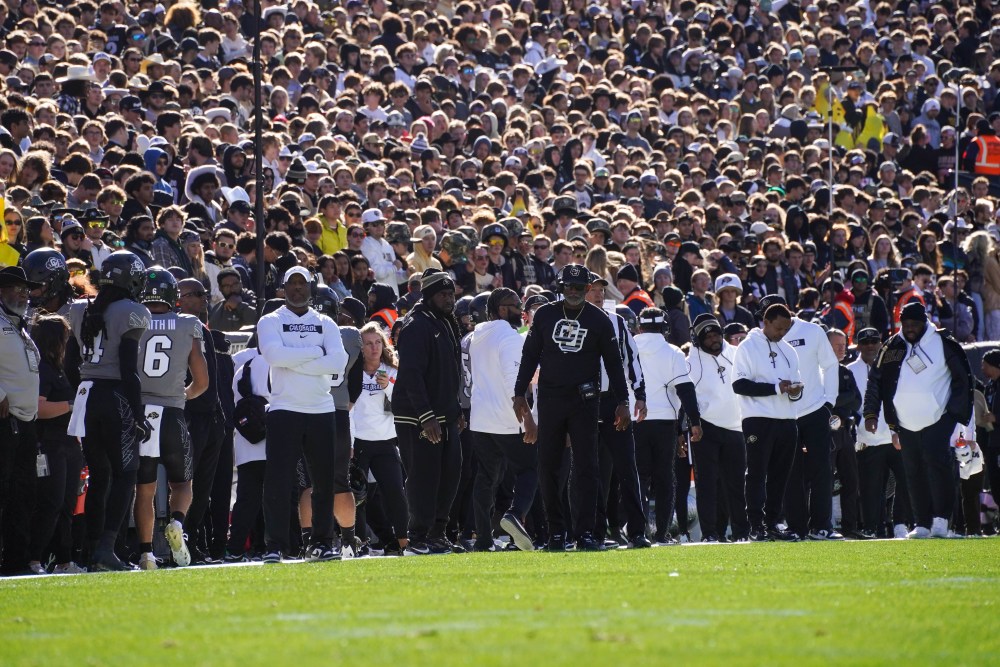
Head coach Deion Sanders paces along the sidelines during the first quarter of the game against Utah on Nov 16, 2024. (Rachel Glazer/CU Independent)
This piece is from the CU Independent's opinion section. Any opinions or views do not represent the CU Independent.
Brennan Marion's first game as Colorado's offensive coordinator gave a pretty clear look at the kind of play-caller he might be.
His debut wasn't a showcase of everything the 'Go-Go' offense can become. Instead, it offered a first look at how Marion manages a game: stay committed to the run, spread the workload around and keep pressure off a young quarterback. That approach was good enough to win, but Colorado's lack of explosive plays and struggles finishing drives showed there is still plenty for Marion to figure out.
For all the offseason talk about Marion's 'Go-Go' offense, he didn't spend Thursday night trying to roll out every formation and motion package in the playbook. Colorado kept coming back to something simpler: running the ball.
The Buffs handed it off 49 times for 183 yards in a 14-13 win over Georgia Tech. 13 of their 21 first downs came on the ground, and they held the ball for 34 minutes.
That fits with what Marion has done elsewhere. At Sacramento State University last year, his team averaged 262.6 rushing yards per game and ran the ball 568 times, compared to just 222 pass attempts. Before that, his 2024 University of Nevada, Las Vegas offense averaged 251.2 rushing yards and 36.2 points per game.
For an offense that gets plenty of attention for its formations and backfield movement, Marion's debut was surprisingly straightforward.
Fourth-year running back Damian Henderson II, who followed Marion from Sacramento State University, led the way with 62 yards on 12 carries. Micah Welch had 58 on 13, JaQuail Smith added 42 on 10 and DeKalon Taylor chipped in 22 on four. Nobody completely took over the backfield.
That distribution fit the way Colorado had talked about its running back room before the season. Running backs coach Johnnie Mack described a group with different skill sets, from Henderson's power to Smith's speed and Taylor's versatility, and said the Go-Go offense's variety of formations and plays gives those backs different ways to contribute.
Four backs got involved, each giving Georgia Tech something a little different to deal with, and Marion kept returning to the run without becoming dependent on one player. That matters in an offense built around multiple backs and different backfield looks. The Go-Go may get attention for when everyone lines up before the snap, but against Georgia Tech, Marion used all of those pieces to accomplish something much less complicated.
Colorado averaged only 3.7 yards per carry, so the ground game was hardly ripping the Yellow Jackets apart. Most of the night was four yards here and five there, enough to stay out of obvious passing situations, but it remained consistent.
The play-calling showed just how willing Marion was to live with those smaller gains. On Colorado's 17-play drive that stretched from the third quarter into the fourth, the Buffs ran the ball on 15 consecutive plays after an opening completion.
Even without many explosive gains, Marion kept making Georgia Tech defend the run. In the process, he took some of the burden off second-year quarterback Julian Lewis.
That became more important because Lewis and the passing game never fully settled in. He finished 14-for-27 for 124 yards, with one touchdown and no interceptions. His longest completion went for 20 yards. There were flashes, but there were also missed connections and stretches where Colorado struggled to generate much through the air.
Marion could have responded by putting more of the game on Lewis's shoulders. Instead, he kept the 19-year-old's workload manageable and let the running game carry more of the burden.
Marion is also CU's quarterbacks coach, which makes that approach worth watching. He didn't hide Lewis, and when Colorado needed throws late, the freshman made them. But Marion never seemed interested in asking him to become the entire offense just because the game was tight.
That restraint may have been one of the more encouraging parts of the debut.
It also fit the basic idea behind the Go-Go. Colorado describes the system as a high-tempo attack built around two-running back sets and a physical downhill running game. Players talked throughout camp about the different formations and looks it could create. Marion even wrote a 68-page book on the system in 2019 covering its philosophy, personnel, play design and play-calling.
Against Georgia Tech, he didn't need to show every page.
Head coach Deion Sanders said afterward that Colorado kept running because of what it was getting up front.
'We know we're big up front. We know these guys can move bodies,' Sanders said.
Marion saw an area where Colorado had an advantage and kept going back to it, even when the results weren't spectacular. The bigger problem came once the Buffs moved the ball.
Colorado ran 76 plays and finished with 307 total yards that resulted in just 14 points. The Buffs punted six times and scored on just two of four trips into the red zone.
Marion showed he could sustain drives. He didn't consistently show how the offense was going to finish them.
Starting at its own 5-yard line in the third quarter, Colorado went 57 yards in 15 plays and burned 7:32 off the clock before punting. Its next possession lasted even longer: 61 yards in 17 plays and 9:07, only for Daniel Gerlach's 38-yard field goal to be blocked.
That was more than 16 minutes of possession across two drives with zero points to show for it.
It felt a little like spending forever putting together a piece of IKEA furniture, getting to the end and realizing there are still three screws sitting on the floor. You know you did a lot of work. You're just not totally sure what you have to show for it.
That is probably the biggest issue Marion has to solve moving forward.
Colorado can live on three-, four-, and five-yard gains for stretches, but drives built that way require more snaps and leave more room for something to go wrong. A penalty, a missed block or one bad throw can wipe out a lot of good work.
The next step is finding more easy yards. A run that breaks into the secondary. A play-action throw created by all those carries. A formation that gets somebody open without requiring the offense to execute 15 straight plays.
The running game should help create those opportunities. It just has to produce more of them.
Colorado's final possession showed what Marion's patience can look like when it works. Georgia Tech took a 13-7 lead with 1:40 left. Colorado got the ball at its own 25 with no timeouts and suddenly had to move.
Lewis hit Taylor for 17 yards on the first play. After a sack and an incompletion, he found Joseph Williams for 16 on third-and-11. Williams caught another pass for seven before Lewis threw an incomplete pass on second-and-3.
Then came third-and-3 from the Georgia Tech 36.
With the clock running and no timeouts, a pass seemed obvious. Marion went back to the run instead, and Taylor burst up the middle for 16 yards.
One play later, Lewis found Charlie Williams for a 20-yard touchdown.
Eight plays. 75 yards. 63 seconds.
It was a good example of how Marion handled Lewis throughout the night. He didn't make the freshman throw it 45 times just to prove he could, but when the game finally demanded throws, Lewis was still in a position to make them.
Sanders said afterward that one thing stood out about both of his new coordinators.
'There was no panic on the headsets,' he said.
That description fits Marion's debut pretty well. He didn't abandon the run when it was averaging less than four yards per carry. He didn't force the passing game when Lewis was struggling to find rhythm, and he didn't suddenly throw out the plan when Georgia Tech took the lead late.
Marion kept trusting what Colorado had shown it could do.
That doesn't make the offensive performance great. Fourteen points won't be enough most weeks, and drives that eat seven or nine minutes off the clock need to end with more than a punt.
There are still plenty of questions waiting for Marion. How much more will he use the two-back looks that define the Go-Go? Can he turn the threat of the run into explosive passing plays? How aggressive will he become as Lewis gets more comfortable? And what happens when a defense finally takes the ground game away?
Thursday didn't answer all of that.
What it did show was a coordinator who seemed more interested in calling what gave Colorado its best chance to win than proving how clever his offense could be.
For a first game with a young quarterback, there were worse things than being a little boring. The Go-Go didn't go crazy in Atlanta. It mostly kept grinding, and for one night, that was enough.
Colorado gets its next chance to build on that identity at home on Saturday, when the Buffs welcome Weber State University to Folsom Field. Kickoff is set for 1:30 p.m. MST on ESPN+.
Contact CU Independent Sports Editor Shruthi Rajesh at shra3446@colorado.edu
Related Opinion
A note on cookies
Newshunt uses essential cookies to keep you signed in and to remember your language and country, so the site works the way you expect. With your permission, we'd also like to use analytics cookies to understand how people use Newshunt and improve it over time.
Accepting only affects analytics. To learn more, view our Privacy Policy or Terms & Conditions.
(0)Comments