


Vanessa Rudman
Share the love of reading, one book at a time

Books have the unique ability to transport you through time to worlds that exist only in your imagination.
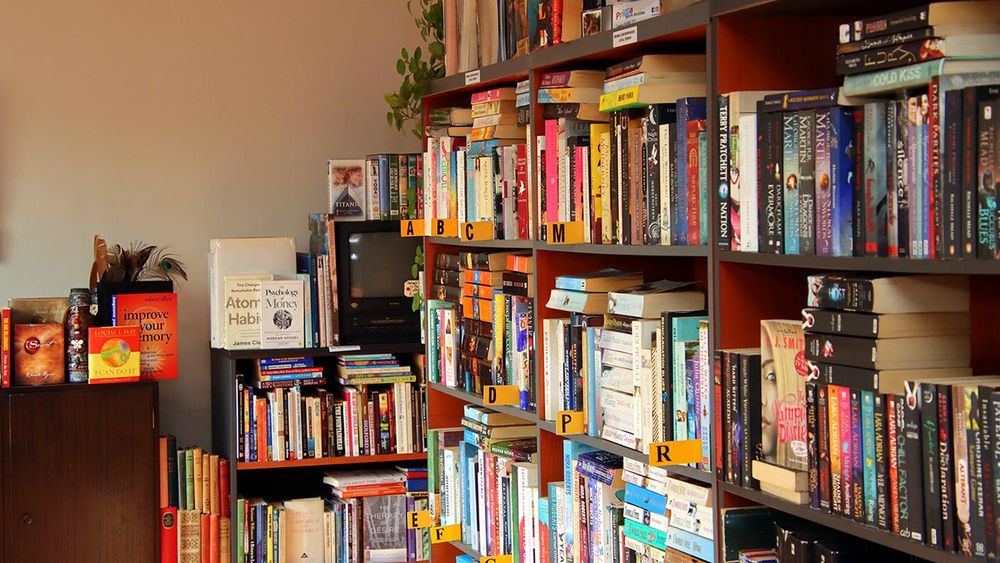
Image: Supplied / Books & Collectables
Undisputedly, for thousands of years, millions of people were locked out of the sensual indulgence of reading. That feeling of picking up a physical book, smelling the pages, and – for a while at least – being alone, opening a book and disappearing privately into somebody else's world for hours is indescribable.
Even better; if the book is second-hand, it brings with it a richness of history that sensually emanates from the page. The smell of paper, the thickness of pages in older books, the inscription from someone's mom, daughter, husband, son, other relative, or friend. The hope that, whoever they are, they enjoyed the book enough to want to put it back into circulation so that someone else can also enjoy it.
As the owner of a small bookstore that specialises in rare finds, I love when books cycle through people's hands, creating the possibility of an amazing find. A first edition with illustrations by Thomas Pringle, a signed copy of a book written by Anne Frank, a very old edition of the dictionary for the Afrikaans language.
I've had all these come through my door, and more such as a first edition Angela's Ashes. Happiness is when they go back out of the door in the arms of someone who has exclaimed great delight when they spotted them.
Turning pages
There's something uniquely different about reading from hearing a storyteller. You control the experience. You supply the voices and faces. You can stop, reread, race ahead, spend six hours somewhere that doesn't exist, and return to exactly the same imaginary world tomorrow. It's intensely private.
Reading for pleasure only became a recognisable cultural phenomenon in the 1700s, when the novel took off with Defoe's Robinson Crusoe (1719), Richardson's Pamela (1740), Fielding and Sterne. Circulating libraries followed, meaning you no longer had to own an expensive book to devour it.
The 1800s brought a boom. Industrial printing, cheap paper, railways, rising literacy and public libraries combined to make books accessible to ordinary people. By the mid-to-late 1800s, reading was properly competing for people's leisure time.
Dickens is the obvious example, with readers waiting for the next instalment of his novels the way audiences wait for a TV series. But Dickens didn't invent imaginative escape, he's part of the point at which it became available to millions rather than thousands.
That whole flourishing of accessible reading, however, had one origin point. Johannes Gutenberg, who began experimenting with movable type in Europe in the 1440s. His printing press was put to weightier work at first, most famously the Bible, but that same technology went on to do something less solemn.
It put stories into more hands, drove down the cost of books, and turned reading from the preserve of the wealthy, the clergy and the educated into something millions could do simply because they wanted to.
Yet five centuries after Gutenberg, 739 million adults aged 15 and over still lack basic literacy skills, one in nine people worldwide, according to UNESCO. Almost two-thirds are women, and 40% of children don't reach minimum reading proficiency.
UNESCO estimates 739 million adults aged 15 and over still lack basic literacy skills.
Image: AI Generated
A composite image from Dolly Parton's Imagination Library. The late Dolly Parton was instrumental in bringing books into lower-income American homes.
Image: Composite Image / Imagination Library
Enter Dolly
That's why people like Dolly Parton are heroes. She took Gutenberg's democratisation a step further and provided hundreds of millions worth of books, with her Imagination Library sending out more than three million books every month to enrolled children over the past 30 years.
In 1995, inspired by her father, Robert Lee Parton, who could neither read nor write, she launched the Imagination Library in her home county of Sevier County, Tennessee. Her concept was not complex, nor was it controversial, all she wanted was for every enrolled child to receive a free, age-appropriate book in the post every month from birth until the age of five, regardless of their family's income.
The first order was for just 1,760 books, but it grew, expanding across the US and then internationally to Canada, the UK, Australia and Ireland.
Parton once described the programme as one of her proudest achievements, and so it should be. She gave millions of children something her father never had. A home in which books simply belonged.
Gutenberg gave the world the means. Dolly Parton gave millions of children the chance. Now it's our turn. Pick up a book. Hand one down. Gift one to a child who's never owned one. Loving reading isn't just a private pleasure, it's a shared duty, and any of us can be somebody's Imagination Library.
Vanessa Rudman, founder of Books & Collectables.
Image: Supplied
* Rudman has been in the book industry, managing retail outlets for almost three decades, and recently opened Books & Collectables.
** The views expressed do not necessarily reflect the views of IOL.
Related Opinion
A note on cookies
Newshunt uses essential cookies to keep you signed in and to remember your language and country, so the site works the way you expect. With your permission, we'd also like to use analytics cookies to understand how people use Newshunt and improve it over time.
Accepting only affects analytics. To learn more, view our Privacy Policy or Terms & Conditions.
(0)Comments