


unknown
Digital divides - Distrust of technology transcends class divisions

When did you last visit the post office? I last went over two years ago. Yet before the advent of courier services, and even more of email, WhatsApp and mobile banking, the post office was a hub of the locality. We would queue for hours to send a money order or registered letter, or pay our telephone bill. As with any sarkari institution, it had a penumbra of informal operators. Prominent among them was the composite letter writer, form filler and parcel packer. For those who could not read and write, he would write and address letters (or even read out incoming ones), fill in money order forms, and seal banknotes in insured packets for migrant workers to send home.
The inland remittance economy, the lifeline of the working poor, would have collapsed if this functionary (himself often a migrant worker) did not exist.
Educated persons seldom availed of his services. At most, they might ask him to sew up a cloth parcel. This was among the endless silent barriers between the literate and the illiterate, the washed and the unwashed. The privileged could stride into the post office and conduct their business directly. The unprivileged needed this guide and intercessor.
ADVERTISEMENT
Far fewer people are illiterate today, and far fewer use the postal services. The letter writer and form filler may be a dying profession. But we may still wonder how many neo-literates can fill up the average form. This does not necessarily reflect on their education, as Indian forms pose formidable challenges. They are needlessly long and complicated, and phrased in various shades of goobledygook. Indian-language versions are often more opaque than the original English, being over-literally translated from the latter instead of following the bent of their own tongue. Highly educated people are often stumped by them. For the average citizen,
especially the poorly educated and socially insecure, official paperwork is an instrument of State tyranny.
Hence the ubiquitous middleman or facilitator, from the harmless letter writer to the mediator of applications and speed money. They include the people who arrange your car tax payment or income tax return.
The coming of the computer is thought to have ended the tyranny of the middleman. The claim is not entirely untrue. Many processes, from paying vehicle tax to buying a train ticket, can now be done online, neatly and quickly. Where the middleman was never an issue, as in retail banking, we can manage our finances in a faster and allegedly foolproof way, though many will question that last adjective.
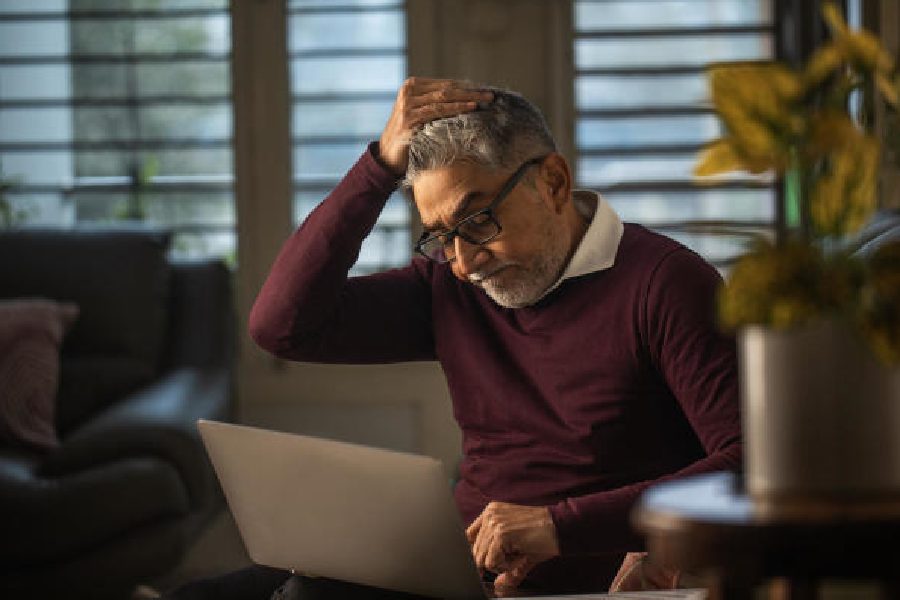
But at another level, computerisation has spawned new dangers and deterrents that have hurt many people and bewildered countless others. The biggest single group might be elderly people who received an exemplary education in their youth but have been left behind by the computer revolution. They are wary even of a UPI payment
app or an eminently user-friendly site like the Indian Railways' booking portal.
Needless to say, not all the elderly fall in this category. We should not infantilise their tribe (to which I myself belong). A colleague of mine, an expert in scholarly computation, is furious because the State Bank refuses to allow her a netbanking account. It would be good to know how many seniors share either her stand or her expertise. Many others clearly would not venture on such a course.
The resistance is at two levels. One is the lack of technical confidence even for simple tasks. The other is a gut distrust of the Establishment. After a lifetime of queueing and bribing for railway berths, they cannot view the online portal as either truthful or reliable. They are convinced it is a front for backdoor bookings. Being ourselves conditioned to think that way of all public amenities, how many of us can demur with full conviction, even if we don't really agree?
In a word, distrust of digital systems as the behemoth of arbitrary rule has spread beyond the educationally deprived. Being also economically deprived as a rule, the latter see fintech as a ploy of the exploiting classes. Today, the distrust has spread to a sizeable section of educated people. We do not always recognise how the digital divide cuts through class divisions. It does not merely exclude the poor. It also disempowers a section of society enjoying some degree of power and security through education, affluence or social affinity.
These are people supremely at ease with the world of pen, paper and print. Now they find the goal posts have shifted to a distance they cannot cover. Technology lies like a dragon between them and their money or travel or medical treatment. Nothing will convince them that the dragon is actually for their protection. Why should they think so, amid daily reports of online scams?
The young may be as distrustful of the world, but they were born to the technology and attuned to it. Where the malign human imagination comes into play, they are as vulnerable as their elders. Not long ago, a young Bangalore techie was cheated out of crores under threat of 'digital arrest'. But unlike their seniors, they are not overfaced
by the technology itself. They are naturally conditioned to the rhythm and ethos of an electronically mediated society. If they fall prey, it is through over-familiarity and over-confidence with the medium.
Hence the most piquant of the new disruptions in the electronic age: traditional worldly wisdom counts for less than ever before. The young have as much, if not more, to teach the old as the other way around — and I am not talking only about technology. Yet the old order exists, and for good and ill, largely controls the world. Will things change when those now young grow old? Or will they fall into the timeworn pattern? The elderly will not be there to see. For now, they can only think of reversing the familiar maxim to 'If age knew, if youth could.'
Sukanta Chaudhuri is Professor Emeritus, Jadavpur University
Related Opinion
A note on cookies
Newshunt uses essential cookies to keep you signed in and to remember your language and country, so the site works the way you expect. With your permission, we'd also like to use analytics cookies to understand how people use Newshunt and improve it over time.
Accepting only affects analytics. To learn more, view our Privacy Policy or Terms & Conditions.
(0)Comments