


unknown
Dredging keeps harbour flowing

MHRS Tractor and scoop moving dredged sand into a low-lying area on the sandspit.
Up to 60,000 cubic metres of sand was dredged from Mangawhai Harbour this season, helping keep the upper harbour channel navigable while strengthening vulnerable areas of the sandspit.
The five-month operation saw sand removed from approximately two hectares of the upper harbour channel and returned to two low-lying areas of the sandspit vulnerable to breach.
The work also helps maintain tidal flow through the harbour, allowing water, sand and sediment to continue moving through the system.
Keeping the harbour flowing
Mangawhai Harbour needs to keep flowing.
Water naturally moves in and out of the harbour with every tide. This tidal movement, known as the harbour's tidal prism, helps carry sand and sediment through the system.
As mangroves expand into parts of the harbour, less water moves in and out, and the flow becomes slower. This allows more sand and sediment to settle rather than be flushed out, creating shoals that can further restrict tidal flow.
Sediment can also enter the harbour from the surrounding catchment, including from earthworks and development. If this continues unabated, the harbour gradually fills in, reducing the open water and tidal flow that make it a harbour.
That's why MHRS's dredging and resource-consented mangrove management programmes are connected. Within consented areas, juvenile mangroves are removed to help maintain tidal flow, while dredging removes accumulated sediment and keeps the navigation channel open.
The approach is preventative – maintaining the harbour system before problems become critical.
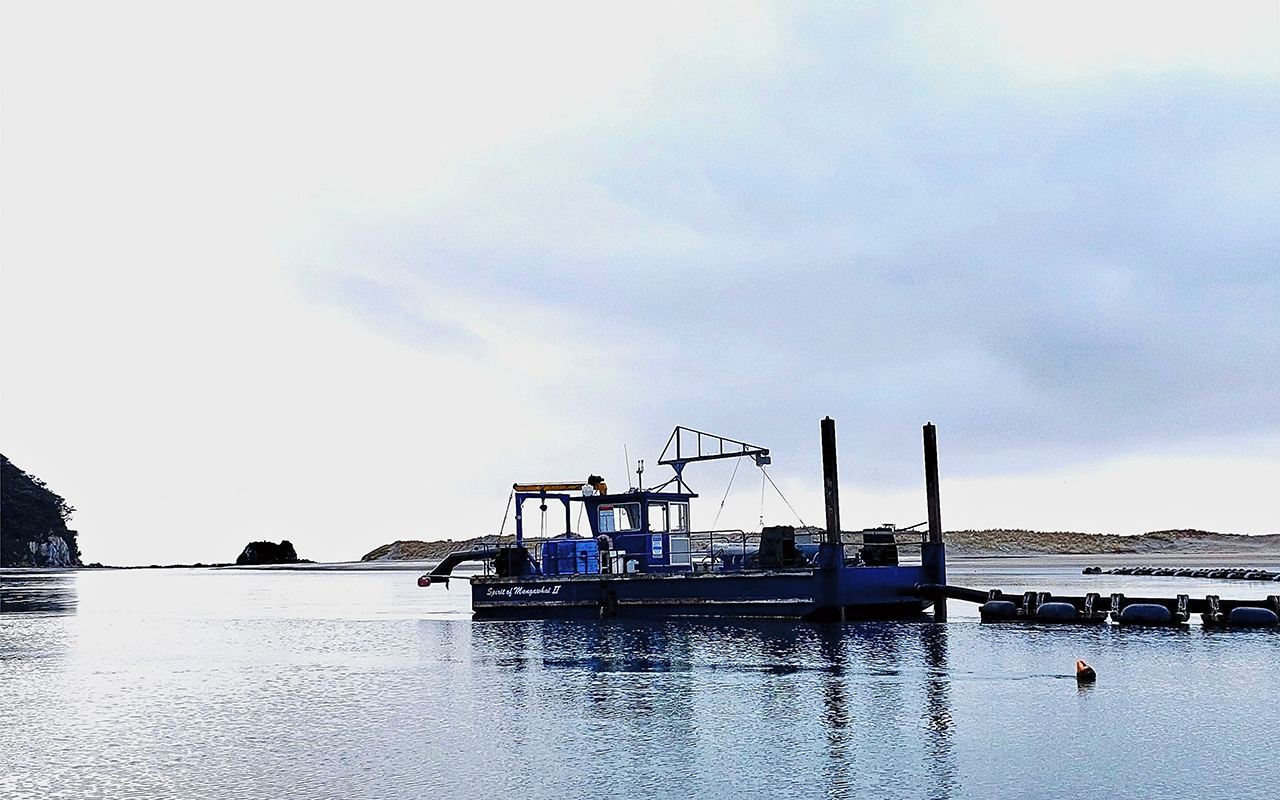
Spirit of Mangawhai II dredger at work deepening the channel.
Putting sand where it's needed
Sand naturally moves from the sandspit into the harbour channel. Dredging removes this accumulated material from the channel and returns it to the sandspit, keeping the sand within the harbour system.
This season, dredging focused on an area off the north-western end of the Mangawhai sandspit where the channel had shifted and was causing difficulties for boaties. The dredged material was placed in two low-lying areas identified as vulnerable to breach through a University of Auckland LiDAR survey. Researchers found an estimated 420,000 tonnes of sand had been lost from the Mangawhai sandspit in recent years.
The two newly replenished areas were planted with native spinifex to help trap and stabilise the sand. A similar area filled with dredged sand and planted last year is now well established, with the spinifex helping hold the replenished sand in place.
A connected system
The dredged sand is pumped from the upper harbour channel through a 300-metre pipeline onto the sandspit, where it is moved by a tractor with a scoop into locations agreed with DOC.
The dredged material also contains shell fragments, which provide nesting material favoured by tara iti/fairy tern.
With this year's season now complete, the dredger has headed to Marsden Cove for service and maintenance before returning for the next consented dredging window.
For MHRS, it is all part of managing one connected system: keeping the channel open, maintaining tidal flow and putting the sand back where it's needed most.
Related Opinion
A note on cookies
Newshunt uses essential cookies to keep you signed in and to remember your language and country, so the site works the way you expect. With your permission, we'd also like to use analytics cookies to understand how people use Newshunt and improve it over time.
Accepting only affects analytics. To learn more, view our Privacy Policy or Terms & Conditions.
(0)Comments