


Kamal Madishetty
Owaisi's Historical Myopia: Why Reducing Uzbekistan To ‘Babur's Land' Fails Both Past And Present

News opinion
Opinion | Owaisi's Historical Myopia: Why Reducing Uzbekistan To 'Babur's Land' Fails Both Past And Present
Opinion | Owaisi's Historical Myopia: Why Reducing Uzbekistan To 'Babur's Land' Fails Both Past And Present
Written By :
,
Last Updated: September 07, 2026, 09:34 IST
By reducing a pivotal Central Asian republic to a mere historical footnote of Mughal genealogy, Owaisi's rhetoric was both intellectually shallow and historically misleading.
Rapid Read
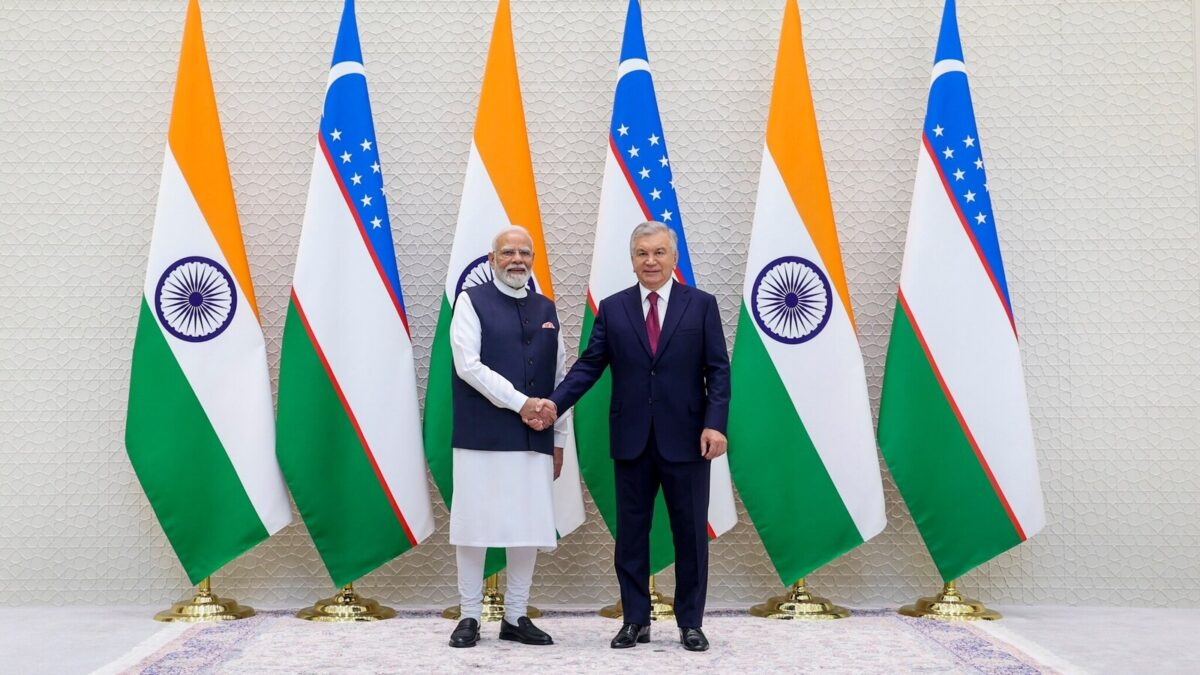
PM Narendra Modi in Uzbekistan. (Image: ANI)
When AIMIM president Asaduddin Owaisi sarcastically congratulated the Bharatiya Janata Party on Prime Minister Narendra Modi receiving Uzbekistan's highest civilian honour for foreign dignitaries, quipping that the award came from 'the very country from which Babur came to India", he was not offering serious geopolitical commentary.
Instead, his remarks were an exercise in partisan opportunism, intended to weaponise a foreign policy milestone for domestic polemics.
By reducing a pivotal Central Asian republic to a mere historical footnote of Mughal genealogy, Owaisi's rhetoric was both intellectually shallow and historically misleading.
The fundamental error in this rhetoric is the assumption that modern Uzbekistan represents a dynastic continuation of Babur. In the historical record, modern Uzbek identity traces back not to Babur, but to the very forces that defeated and banished him.
Babur was a Timurid prince of Chaghatai descent, hailing from the Fergana Valley. Far from being a revered founder of an Uzbek state, Babur was systematically routed, dispossessed and expelled from Central Asia by Muhammad Shaybani Khan, the leader of the Uzbek tribal confederation. The Uzbeks drove Babur out of Samarkand and Andijan, forcing his retreat into Afghanistan and ultimately northern India.
If geographic and historical lineage creates modern political inheritance, the Republic of Uzbekistan stands as the successor of Babur's fiercest adversaries, not his heirs. To frame contemporary Tashkent as 'Babur's land" in order to claim an ideological contradiction in New Delhi is an elementary category mistake.
Furthermore, viewing Central Asia solely through the prism of the sixteenth-century Mughal conquest ignores millennia of shared civilisational history. Central Asia's association with Islam spans only the most recent third of its recorded history. Long before the Arab conquests, the territories of modern Uzbekistan, Tajikistan and Turkmenistan were vibrant cultural corridors intimately intertwined with the Indian subcontinent. This relationship was not one of conquest, but of profound philosophical, artistic and commercial exchange.
The Hindu and Indic dimensions of this ancient relationship were foundational. Under the Kushan Empire, which spanned from Bactria to the Gangetic plains, an extraordinary syncretism took root. Kushan royal coinage explicitly fused Greek, Iranian and Indic sacred registers, portraying the Buddha alongside Hindu deities such as Shiva (rendered as Oesho, complete with his trident and Nandi) and Uma.
Archaeological excavations in southern Uzbekistan, notably at Dilberjin, reveal temples maintained for centuries by Shaivite devotees. At Termez, along the Amu Darya, monumental Buddhist complexes such as Fayaz Tepa and Kara Tepa flourished as vital bridges linking Gandharan and Kashmiri monastic networks to the wider Silk Road.
This cultural osmosis extended deeply into everyday life and high scholarship. The elite eighth-century Sogdian merchants of Panjikent adorned the walls of their reception halls with narrative frescoes illustrating stories from the Indian Panchatantra and Buddhist Jatakas. At Afrasiab in ancient Samarkand, seventh-century murals depicted Indian delegates alongside the major civilisations of the era. Centuries later, the Khwarezmian polymath Abu Rayhan al-Biruni mastered Sanskrit, documented Indian philosophical traditions and translated Patanjali's Yoga Sutras into Arabic. India's civilisational imprint on Central Asia long predated the arrival of Babur, Islam or the Delhi Sultanate.
Also misplaced is the notion that Uzbekistan's modern diplomacy is animated by medieval religious dynasticism. The Republic of Uzbekistan is a constitutionally secular, post-Soviet state that rigorously manages public religious life and focuses its national historical memory on Amir Timur, not Babur.
When Tashkent honours Babur today, it does so through a secularised literary lens—celebrating a native-born poet, memoirist and patron of the arts who spent his life yearning for Fergana, rather than an imperial conqueror of India.
Crucially, the Order of Oliy Darajali Do'stlik (Order of Highest Friendship) is a contemporary diplomatic instrument established in 2020 to recognise exceptional contributions to bilateral strategic partnerships. Its previous recipients include Chinese President Xi Jinping and Russian President Vladimir Putin. It is conferred on heads of state for contemporary geostrategic cooperation, not historical endorsements.
For India, Uzbekistan is an indispensable partner in Eurasia. Doubly landlocked yet bordering every other Central Asian republic and Afghanistan, Uzbekistan is the demographic anchor of the region, home to over 38 million people.
Prime Minister Modi's visit elevated ties to a Comprehensive Strategic Partnership, setting a bilateral trade target of $5 billion by 2030. Beyond trade, Tashkent is critical to India's strategic diversification. Uzbekistan provides vital supplies of raw uranium for India's civilian nuclear energy programme and offers joint exploration in critical and rare-earth minerals, including copper, molybdenum and lithium, essential for high-tech manufacturing and the clean energy transition.
Bilateral initiatives now span digital public infrastructure, such as the integration of India's UPI with Uzbekistan's UZQR payment system, as well as defence co-production and joint drills like Exercise DUSTLIK. On continental security, both nations share an acute interest in countering cross-border terrorism, radicalisation and instability. Connecting India to Central Asia via the International North-South Transport Corridor and Chabahar Port remains a logistical necessity to bypass regional bottlenecks.
To collapse this vital geopolitical engagement into a petty debate over Babur is to embrace historical illiteracy. India's engagement with Tashkent is rooted in an ancient civilisational continuum and driven by hard-nosed modern national interests. Reducing a major diplomatic achievement to a crude communal trope says far more about the limitations of partisan domestic polemics than it does about Indian foreign policy.
Kamal Madishetty is an Assistant Professor at Rishihood University and a Visiting Fellow at the India Foundation, New Delhi. Views expressed are personal and solely those of the author and do not necessarily reflect News18's views.
News18 Newsletter
Handpicked stories, in your inbox
A newsletter with the best of our journalism
submit
Quick Answers
Powered by
Ask News18 Why did Asaduddin Owaisi refer to Uzbekistan as "Babur's land"?
Asaduddin Owaisi sarcastically referred to Uzbekistan as "Babur's land" after Prime Minister Narendra Modi received Uzbekistan's highest civilian honor. He used this remark to weaponize a foreign policy milestone for domestic political debate, implying a contradiction given the BJP's stance on Babur. What is the historical relationship between modern Uzbekistan and Babur?
Modern Uzbek identity traces back to the forces that defeated and banished Babur, not to Babur himself. Babur, a Timurid prince, was systematically routed and expelled from Central Asia by Muhammad Shaybani Khan, leader of the Uzbek tribal confederation, forcing his retreat into Afghanistan and India. What is the significance of the Order of Oliy Darajali Do'stlik awarded to PM Modi?
The Order of Oliy Darajali Do'stlik is Uzbekistan's highest civilian honor for foreign dignitaries, established in 2020. It recognizes exceptional contributions to bilateral strategic partnerships and is conferred for contemporary geostrategic cooperation, not historical endorsements.
Powered by
Ask News18
First Published:
September 07, 2026, 09:34 IST
Disclaimer: Comments reflect users' views, not News18's. Please keep discussions respectful and constructive. Abusive, defamatory, or illegal comments will be removed. News18 may disable any comment at its discretion. By posting, you agree to our Terms of Use and Privacy Policy
Loading comments...
Related Opinion
A note on cookies
Newshunt uses essential cookies to keep you signed in and to remember your language and country, so the site works the way you expect. With your permission, we'd also like to use analytics cookies to understand how people use Newshunt and improve it over time.
Accepting only affects analytics. To learn more, view our Privacy Policy or Terms & Conditions.
(0)Comments